 Coverlet
Games as Laboratories for the Mind
A game is more than a score. It is a small world with rules, feedback, choices, and consequences—an unusually inviting place to notice how people think.
By Mourad Hamdi · Last reviewed
Why games are useful laboratories
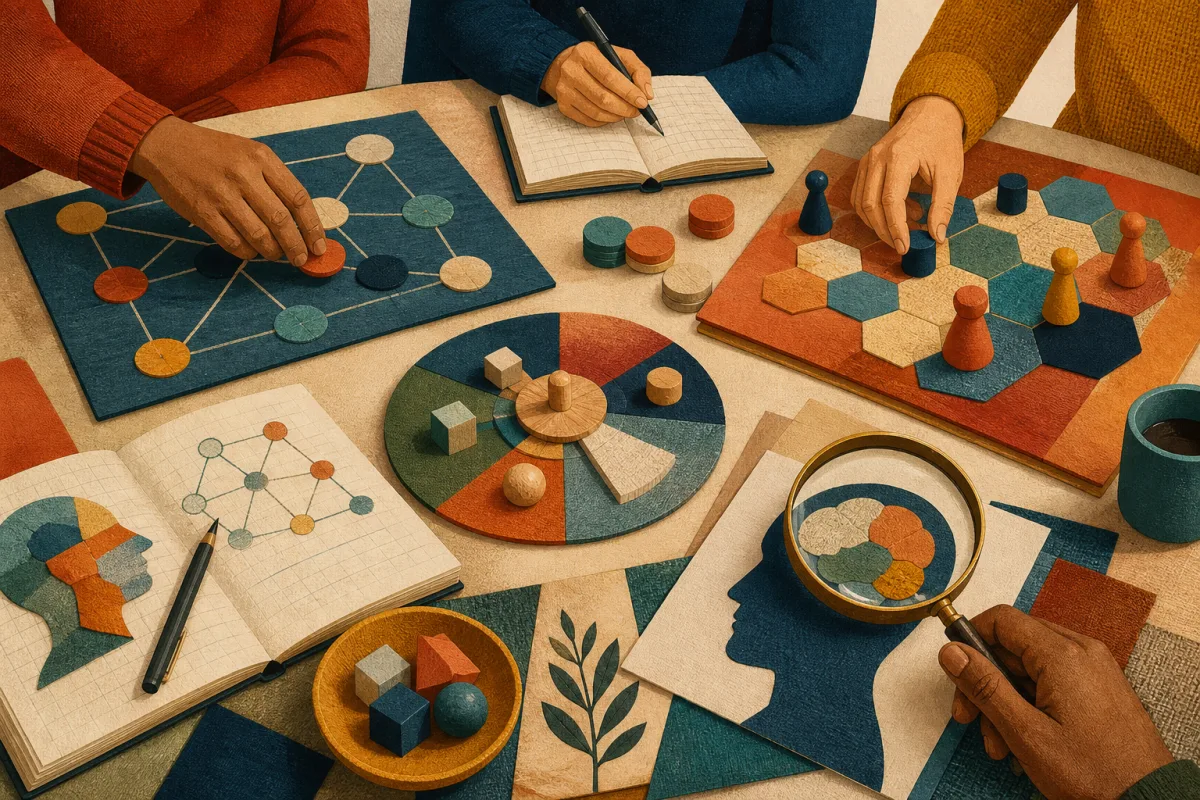
Researchers have long used simplified tasks to study attention, memory, learning, and decision-making. The strength of a classic laboratory task is control: fewer moving parts make it easier to compare one condition with another. But a highly controlled task can feel remote from the choices people make in ordinary life. The 2024 Perspective “Using games to understand the mind” makes the case for games as a complementary setting. Games can preserve enough structure for careful measurement while giving people an intuitive environment in which goals, uncertainty, feedback, and strategy matter.
That combination is what makes the laboratory metaphor useful. A game is not a brain scanner and it is not a complete model of a person. It is a designed environment where a researcher can ask a focused question: How does someone explore when the rules are only partly known? How deeply do they plan before acting? What changes when a choice has a visible consequence? How does a player learn a new pattern, coordinate with another person, or stay curious after a failed attempt?
Games also make participation easier to understand. Instead of asking someone to press a button whenever an abstract symbol appears, a study can give the participant a goal, a set of constraints, and a reason to care about the next move. The activity still needs careful design, but the motivation is part of the phenomenon rather than an inconvenient distraction. The Nature authors argue that games can support more ecological, scalable, and diverse ways of studying cognition while also warning that researchers must choose the format deliberately.
What games can reveal
At their simplest, games expose a chain of thinking. A player sees a state, forms a belief about what might happen, chooses an action, receives feedback, and updates a plan. In a rectangle puzzle, that might mean noticing that a clue has only a few legal shapes, testing how one candidate affects neighbouring cells, and revising the board when a contradiction appears. In a word game, it might mean balancing a familiar pattern against a surprising possibility. In a cooperative game, it might mean deciding what information to share and how to build a common plan.
These observations do not automatically reveal a single hidden ability called intelligence. They reveal strategies in context. A player may be cautious because the game rewards caution, exploratory because the cost of failure is low, or fast because the interface makes rapid choices valuable. The same person can behave differently when the rules, incentives, time pressure, or social setting changes. That is not a weakness. It is a reminder that cognition is adaptive: people use different approaches for different environments.
The Harvard University Games collection offers a broad public view of this range. It describes games as places where work, play, and art meet, and highlights their possible relationship to practical skills, difficult decisions, connection, education, history, and creative learning. The examples span Wordle, chess, classroom activities, historical collections, misinformation education, and game development. The variety matters. “Games” are not one intervention with one predictable effect; they are a family of formats that can support very different kinds of attention and participation.
The benefits of playing
For players, the first benefit can be intrinsic: a game makes a difficult activity inviting. Clear rules reduce the friction of getting started. Feedback tells you whether an idea worked. A visible endpoint makes progress legible. These design features can create a satisfying pause in a busy day without requiring the player to describe the experience as self-improvement.
Games can also provide practice in specific forms of thinking. A logic board may invite comparison, constraint tracking, spatial reasoning, or explanation. A strategy game may invite planning and risk assessment. A cooperative game may invite communication and perspective-taking. The honest claim is local: repeated play can make the player more familiar with the rules, patterns, and decisions that the game repeatedly presents. Whether that practice helps in another setting is a separate question.
Play can support curiosity because it turns uncertainty into an invitation. You do not need to know the answer before you begin; you need a next move worth trying. That structure can make experimentation feel safe, especially when failure is reversible and feedback is immediate. Harvard’s examples of playful learning and gamified education point toward the same design principle: a meaningful goal, a manageable challenge, and room to try again can help people engage with material that might otherwise feel flat.
Games can also connect people. A shared puzzle gives two people something concrete to discuss. A board, word, or narrative can become a small common language across age or experience. Even solitary play can create a ritual: a few quiet minutes, one clear problem, and a finished state to leave behind. For Coverlet, that is the idea behind turning completed daily boards into quilt blocks. You can learn the rectangle logic, explore the eight puzzle techniques, or download Coverlet for iPhone and iPad because the activity is enjoyable—not because a game should carry a promise it cannot support.
Where the metaphor breaks
A laboratory is useful only when its limits are visible. First, a game’s rules shape the behaviour observed. If a study uses one interface, one reward system, or one genre, its findings may describe that environment better than they describe games in general. Familiarity can matter too: an experienced player may be demonstrating learned conventions rather than a broad difference in reasoning.
Second, engaging data is not automatically valid data. Games can attract many participants and record many decisions, but scale does not remove confounds. Who chooses to participate? Who has the time, device, language, or interest required? Are people playing for the same reason? Do the recorded actions measure planning, pattern recognition, motor fluency, persistence, or a mixture? Researchers need clear hypotheses, suitable comparisons, and transparent analysis.
Third, improvement inside a game should not be quietly translated into improvement everywhere else. Learning to spot a useful rectangle shape can make a player better at that puzzle. It does not establish better performance at work, school, memory for appointments, or any health outcome. Even when a study finds a promising result, the result belongs to the tested game, population, schedule, and measure. Transfer is an empirical question, not a default property of play.
There are practical limits as well. Screen time competes with sleep, movement, conversation, reading, and unstructured rest. A game can be absorbing in ways that are helpful for one player and tiring for another. Privacy and data use deserve attention when games collect detailed behavioural traces. Good design therefore includes stopping points, understandable choices, accessible controls, and honest language about what the product is—and is not.
A better way to play
The laboratory metaphor is most useful when it makes us more observant, not more boastful. When you play, notice the specific experience: Are you comparing possibilities, learning a rule, practising patience, telling a story, or sharing a problem with someone else? Choose a game whose demands match the kind of challenge you actually want. Stop when the activity stops feeling restorative or interesting. If you are evaluating a claim, ask what was measured, in whom, for how long, and whether the same game was tested.
Games deserve serious study because they are serious human activities—and because they are fun enough to invite sustained attention. The Nature Perspective presents them as a complement to controlled experiments, not a replacement for them. Harvard’s collection shows how widely games can travel across learning, art, work, history, and connection. Together, those ideas offer a grounded view: games can be designed environments for curiosity, practice, and participation, while their benefits remain specific to the experience and evidence available.
That is a good standard for a quiet puzzle. Coverlet can give you a clear set of rules, a daily decision, and a small record of what you solved. If the board helps you enjoy a few focused minutes, that is already a complete reason to play. Explore the Coverlet game shelf or get the app from the App Store when you want a puzzle that treats attention as something to invite, not something to promise away.
References
APA 7 references for the sources discussed in this article. Last checked 15 Aug 2026.
- Allen, K., Brändle, F., Botvinick, M., Fan, J. E., Gershman, S. J., Gopnik, A., Griffiths, T. L., Hartshorne, J. K., Hauser, T. U., Ho, M. K., de Leeuw, J. R., Ma, W. J., Murayama, K., Nelson, J. D., van Opheusden, B., Pouncy, T., Rafner, J., Rahwan, I., Rutledge, R. B., ... Schulz, E. (2024). Using games to understand the mind. Nature Human Behaviour, 8, 1035–1043. https://doi.org/10.1038/s41562-024-01878-9
- Harvard University. (2023, August). Games. https://www.harvard.edu/in-focus/games/