 Coverlet
Eight daily puzzle techniques, one quilt
Coverlet gives every day eight different ways to reason, from rectangle area and connected regions to loops, patterns, runs, and balance.
By Mourad Hamdi · Last reviewed
One app, eight ways to think
Coverlet’s techniques share a quiet design language: a compact board, readable constraints, a finish you can understand, and a completed solve that can join your private quilt. What changes is the kind of attention each board asks you to use. Patchwork is about rectangle area and partitioning. Appliqué is about connected colour regions. Piecing is about pairing tiles and tracking consequences. Stitchline asks you to form one valid closed loop. Rosette turns pieces and rotations into a pattern. Buttons asks you to place one button in every row, column, and outlined patch. Coverlet 2.1 adds Cross-Stitch, with ordered runs that reveal a motif, and Gingham, with balance and adjacency rules. All eight techniques are available in the current iPhone and iPad App Store release. They are not difficulty labels for the same game. They are different entry points into deduction. If you enjoy drawing boundaries, start with Patchwork. If you want a visual pattern to emerge, read the Cross-Stitch guide. The useful choice is the technique that matches the shape of attention you have today, not the one with the most impressive-sounding challenge.
Patchwork: area, boundary, and certainty
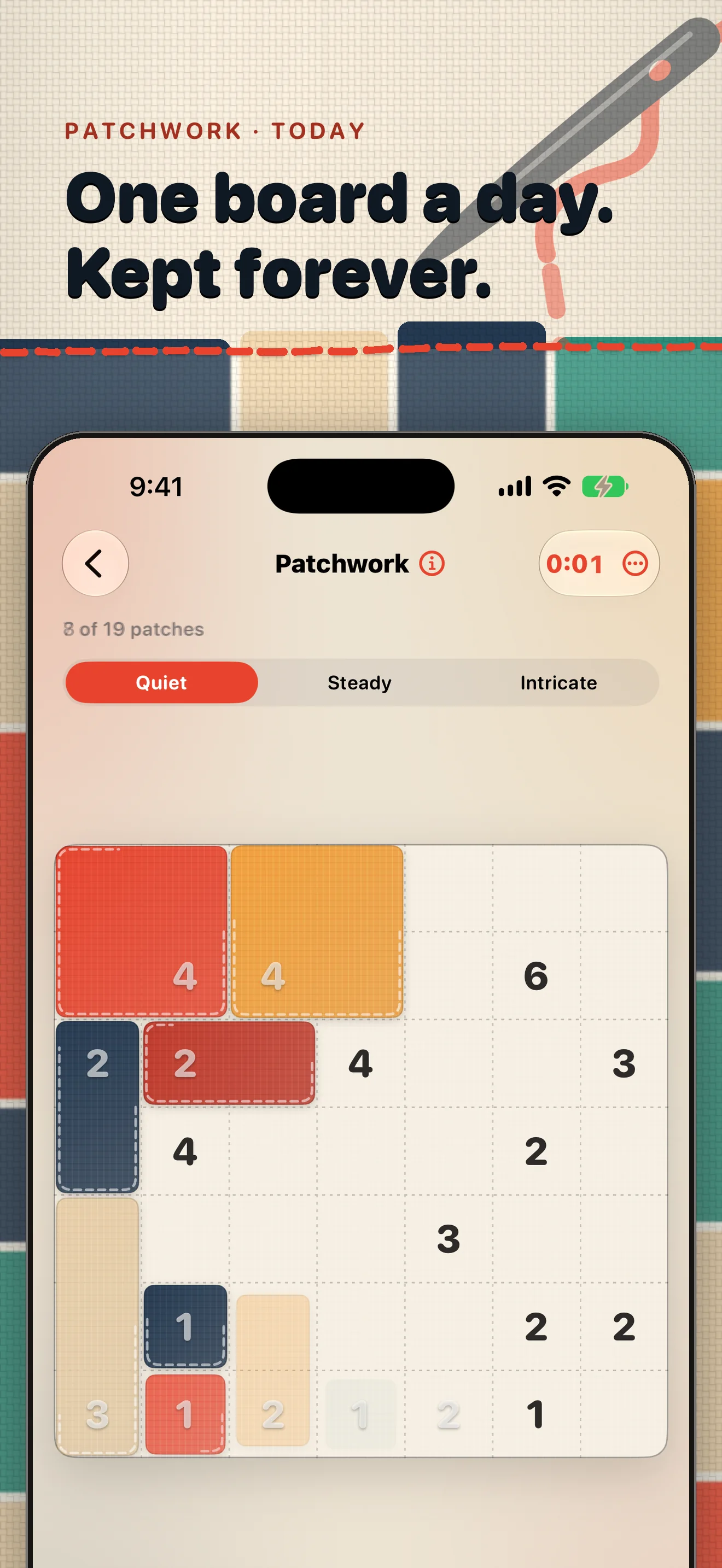
Patchwork is the welcoming rectangle puzzle because its rule can be stated clearly: each number belongs to one rectangle whose area matches the number, and all rectangles must cover the board. The solving work comes from translating area into possible dimensions, then using corners, edges, neighbouring clues, and empty space to remove candidates. A 3 tends to make a strip; a 6 offers more options until the board removes them. The pleasure is spatial and cumulative. When one rectangle is confirmed, its boundary changes the legal shapes around it, so a small certainty can unlock several cells. Use the rectangle logic guide if you want to practise the vocabulary, then use a daily Patchwork board when you want a fresh, finite problem. Patchwork is a good first technique for players who like explanations that remain visible on the board: the number, the shape, and the consequence of a move can all sit in front of you at once.
Appliqué and Piecing: connected regions and pairs
Appliqué changes the question from “What rectangle owns this area?” to “How can these colour islands become one connected cloth without creating an impossible split?” The board rewards a slower visual scan. Edges and small regions give you anchors, then each connection changes which empty cells can safely join the growing shape. It is a useful choice when you want logic with more visual grouping and less arithmetic. Piecing works differently again. Its paired tiles make every match a commitment: choosing one partner removes that possibility from the rest of the board and can expose a forced pair nearby. Look for rare shapes, unique neighbours, and matches that would otherwise leave a tile stranded. In both techniques, the best move is usually the one that preserves future options rather than the one that fills the most cells. Visit the Coverlet game shelf to compare the boards directly, and notice how the same calm interface supports different kinds of deduction without turning every technique into a timed contest.
Stitchline, Rosette, and Buttons: line, pattern, and placement
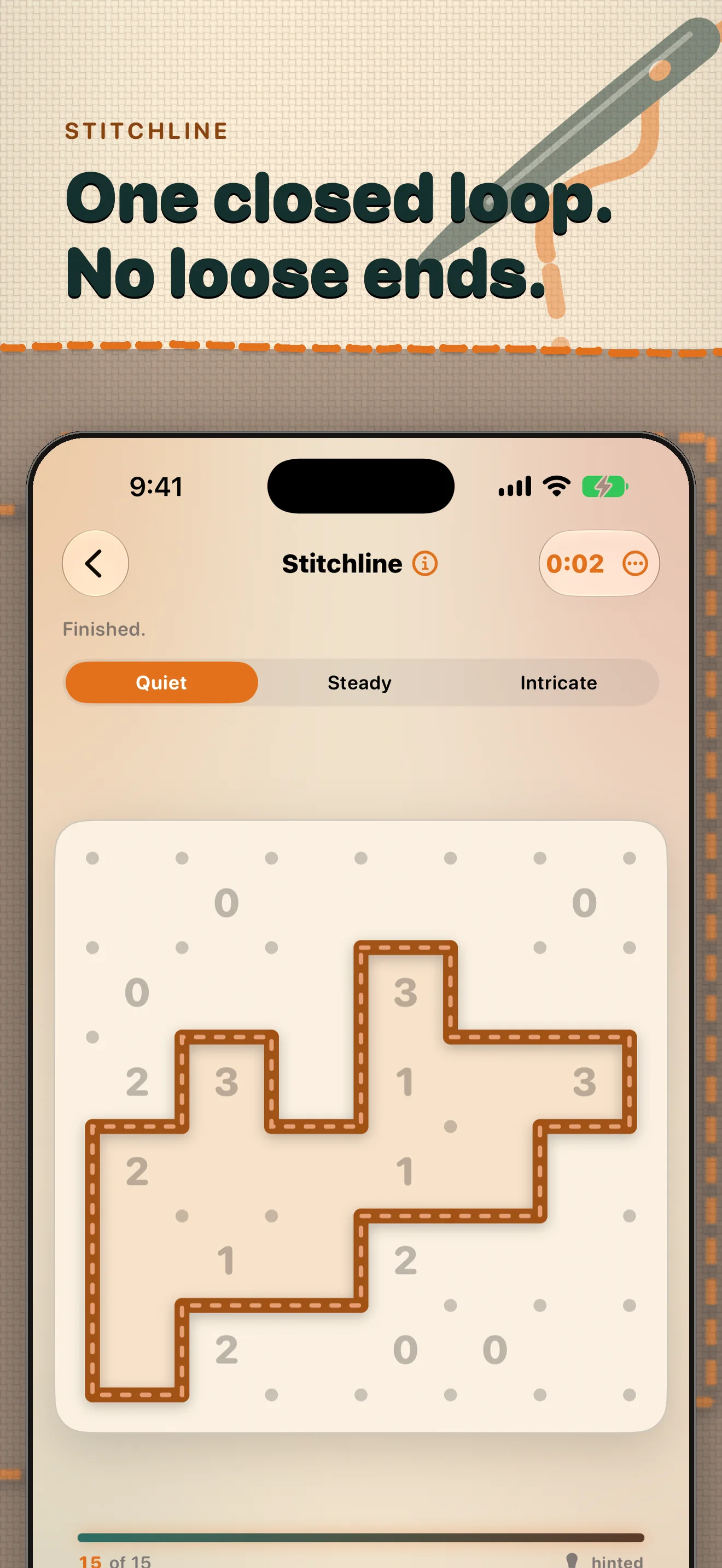
Stitchline is for the player who likes a route that must come home. The board asks you to draw one closed loop while respecting the local clues and avoiding branches, dead ends, or premature enclosures. Start with the edges and the cells where a line has very few legal exits. Every confirmed segment changes the options around it, so the solve feels like tracing a careful seam rather than filling a grid. Rosette offers a more rotational mood: its pieces must fit together into a coherent pattern, making orientation and repeated visual relationships important. Buttons shifts to exact placement. Put one button in every row, column, and outlined patch, ruling out cells as each placement constrains the rest. None of these modes is just visual decoration: the line, pattern, or placement system supplies the logic. That variety lets a player return to Coverlet for a different mental texture without needing a completely different app or reward system.
Cross-Stitch and Gingham: the next cut of the cloth
Coverlet 2.1 widens the shelf in two deliberate directions. Cross-Stitch is a Nonogram-style puzzle: compare possible ordered runs across rows and columns, fill what every legal placement shares, and let a stitched motif appear one certainty at a time. Gingham is a Takuzu-style balance puzzle: keep light and dark checks in proportion, prevent three identical checks in a row, and make completed rows and columns distinct. Both techniques change the scan without changing the product’s calm contract. They are included in the current iPhone and iPad release. Read the 2.1 guide for the rules in full.
Choose the right mood, then keep the solve
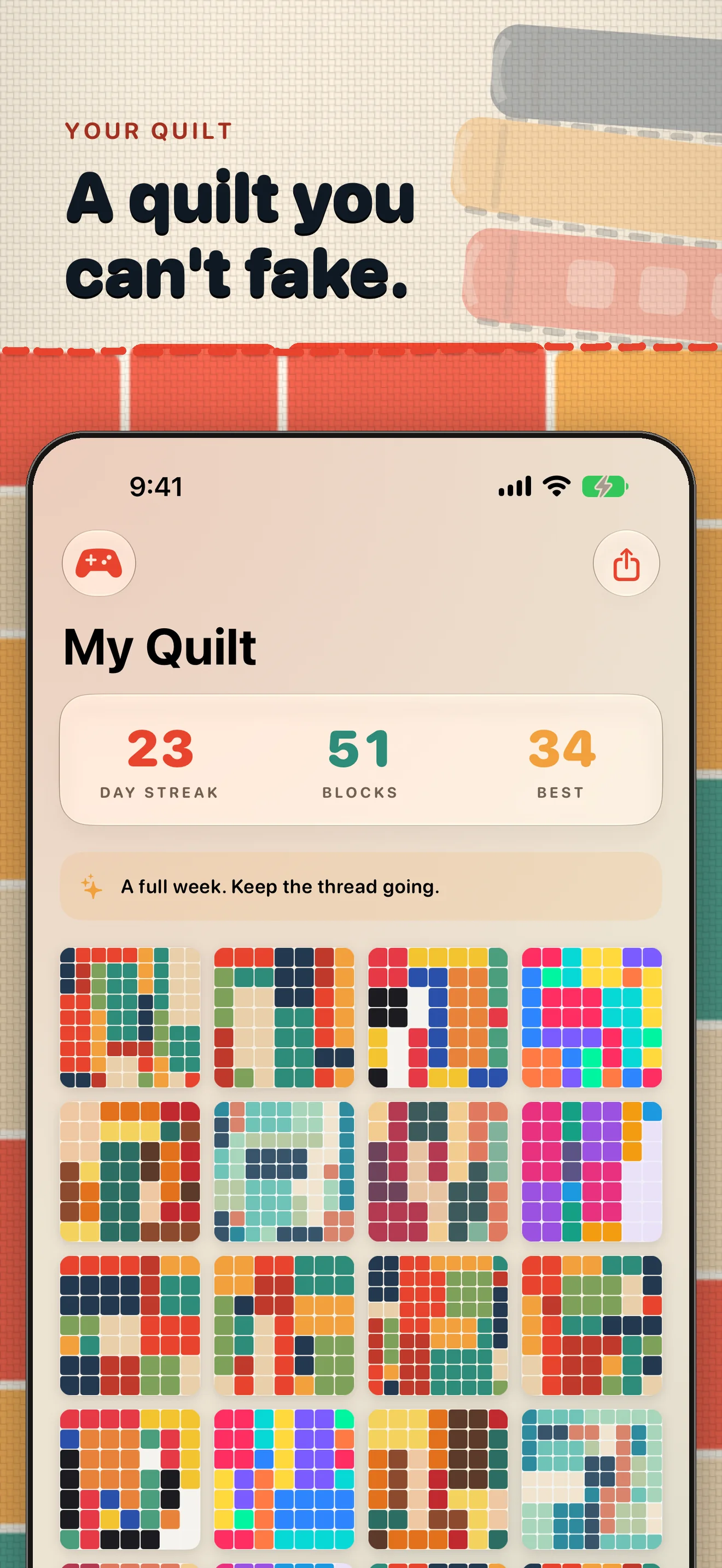
A practical way to choose is to name the attention you want before opening the board. Choose Patchwork when you want a clean area problem, Appliqué when colour and connection sound inviting, Piecing when you want pair-by-pair elimination, Stitchline when you want a single route, Rosette when you want rotation and pattern, and Buttons when you want exact placement. Cross-Stitch is the fit for ordered runs and an image emerging from constraints; Gingham is for balance, adjacency, and line-by-line comparison. All eight techniques are available in the current iPhone and iPad App Store release. Sprint is a separate short mode for a quick burst when three minutes is the honest amount of time you have. You do not need to master every technique in one sitting. Try one board, notice which kind of deduction makes you curious, and return to that technique until its first moves become familiar. Then switch deliberately rather than chasing novelty. The completed result still has somewhere to go: Coverlet’s quilt idea makes the archive part of the design, while the daily structure keeps the task finite. Read the certainty-first solving tips for a method that transfers across the whole project.
Build a small rotation instead of chasing mastery
A useful weekly rhythm is to choose one familiar technique and one contrast. For example, solve Patchwork on a quiet morning, then try Stitchline when you want a line-based change of language. The familiar board gives you a dependable entry point; the contrast keeps the app from feeling like a single repeated exercise. Notice the kind of mistake each technique teaches you to catch: an overlarge rectangle, a disconnected island, an abandoned tile, a dead-end line, or an orientation that breaks the pattern. Those observations are more useful than a universal difficulty ranking because they tell you how your own attention is working. Keep the rotation optional and short. The point is to discover which constraint makes you want to continue, then let the finished block join the same private record whichever technique produced it. Coverlet’s game shelf and app page give you the complete map when you are ready to choose.
Choose one of the eight live techniques when you want to play today, read the 2.1 guide for the newest two, and let the completed board join the Coverlet quilt.
References
APA 7 references for the research discussed in this article. Last checked 29 Aug 2026.
Keep reading