 Coverlet
How to play the rectangle logic behind Coverlet
Count the cells, draw the patch, and let each certain move make the next one easier.
By Mourad Hamdi · Last reviewed
Try the logic
Paint four patches. Leave no gaps.
Choose a number, tap the cells that belong to it, then check the board. The areas are 6, 4, 3, and 12—together they cover every square exactly once.
Choose 6, then paint its six cells.
Read the board as areas, not as isolated numbers
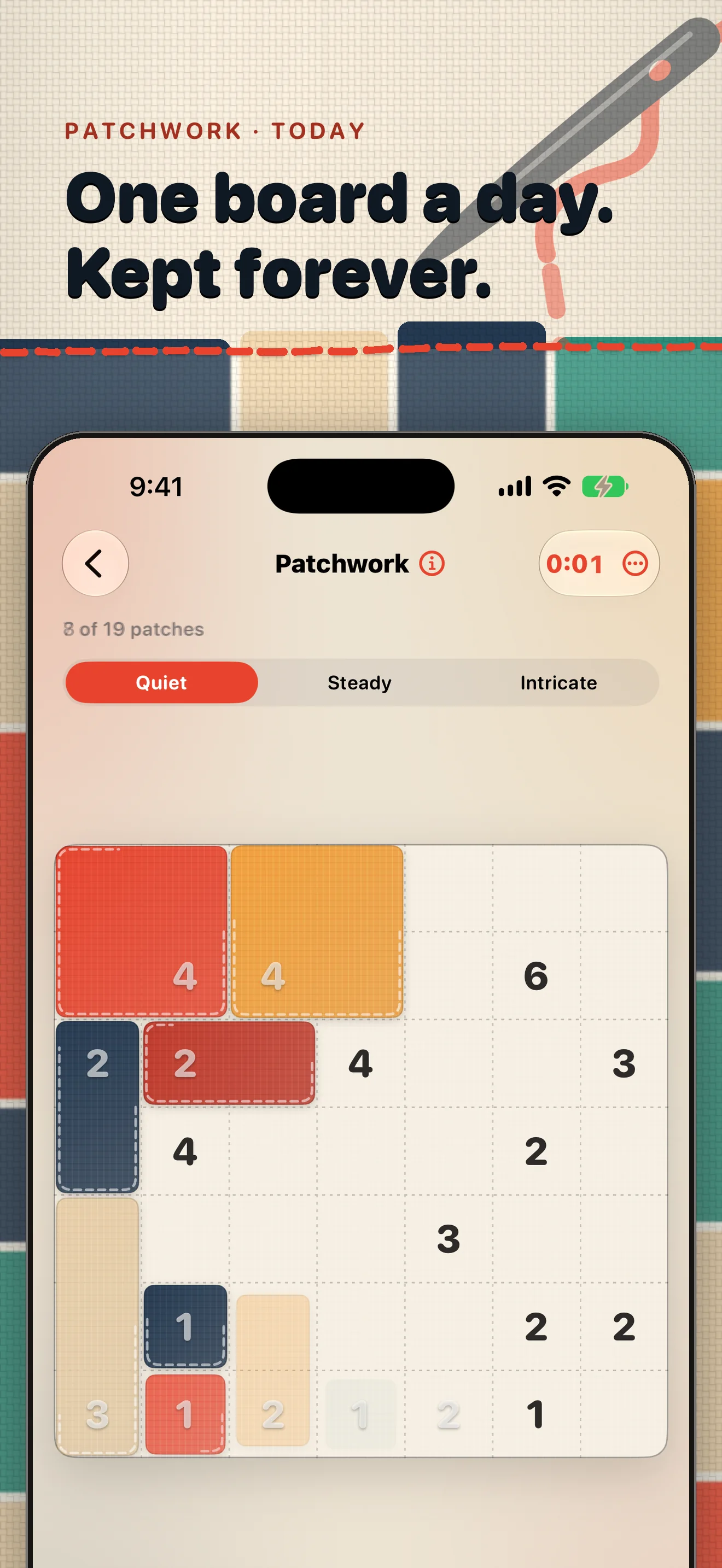
Shikaku becomes much easier once each number is read as an area request. A 3 does not ask you to place the digit 3; it asks you to give one rectangle exactly three cells. A 6 asks for six cells, perhaps in a 1×6 strip, a 2×3 rectangle, or a rotated version that fits the board. The finished board must obey four constraints at once: every rectangle contains exactly one clue, its area matches that clue, rectangles never overlap, and the rectangles cover every cell. That last rule matters because a locally plausible patch can still leave an impossible gap elsewhere. Coverlet’s Patchwork uses this same area-and-partition language in a daily board. Start by looking at the whole grid, not by tapping the first number that catches your eye. On a 5×5 teaching board, areas 6, 4, 3, and 12 add to 25, so they can form a complete cover. The sum is a useful orientation check, but it is not a solution by itself: you still need to prove where each boundary belongs.
Start with the smallest legal choice
The strongest first move is usually the clue with the fewest shapes that can actually fit. A 1 is already a one-cell rectangle. A 2 can only be a two-cell strip. A 3 is limited to a 1×3 or 3×1 strip, while a 6 has more factor pairs but may be restricted by the board edge. Write the factor pairs mentally or on paper, then remove any orientation that would run beyond the grid. Corners are especially valuable. A clue in a corner must own that corner cell, and its rectangle can extend only along the two available directions. An edge clue also loses one direction of growth. Do not treat a candidate as confirmed merely because it fits around its own clue; test whether it would include a second clue or strand an uncovered cell. The practical question is, “Which rectangle is the only one that can claim this cell without breaking another rule?” That shift from choosing a shape to proving a shape is the habit that makes Shikaku feel calm rather than speculative.
Use the interactive board as a proof exercise
The interactive demo on this article is deliberately small. Choose a clue such as 6, tap the cells you think belong to its rectangle, and continue until the board is painted. The clue palette tells you which area you are working on, while the board keeps the numbered cells visible as reminders of ownership. Use Check board after a meaningful attempt rather than after every tap. A partial board is expected to be incomplete; the useful feedback comes when you ask whether the current partition matches every target cell and leaves no empty square. A wrong check marks the cells that need another look, which lets you revise one boundary instead of erasing your whole solve. Reveal one patch is best used as a nudge when you have understood the rule but are stuck on the next deduction. Then press Clear and try the same board again from the first certain clue. This is not a score challenge. It is a compact way to practise the cycle of propose, inspect, check, and revise before you take the method into the daily Coverlet app.
Let neighbouring clues narrow the shape
A rectangle is defined as much by what it cannot include as by the cells it wants. If a candidate shape touches another numbered clue, reject it because every rectangle must contain one clue. If it claims a narrow passage that another clue must use, compare the alternatives before committing. After a rectangle is confirmed, mark all of its cells unavailable to the remaining clues and rescan the nearest numbers. The new empty-space outline often creates a forced move: a clue may now have only one factor-pair orientation, or a previously flexible cell may have only one possible owner. This propagation is the engine of a no-guess solve. It also explains why drawing a large rectangle too early is risky. A shape can match its area and avoid visible clues while quietly taking the only route available to a smaller number. When two candidates remain, keep both in mind and look for the cell they do not share. If one candidate is the only way to cover that cell, it is stronger than a guess. The board is constantly giving you negative information; use it.
Finish with a complete-partition check
A Shikaku solve is complete only when four checks pass together. Count the rectangles: there should be one for every clue. Count each rectangle’s cells: its area must equal the clue it contains. Scan for overlaps: no cell can belong to two patches. Finally scan for gaps: no cell can be left outside the partition. On a 5×5 board, the clue areas should total 25, but inspect the actual boundaries because matching totals can hide an incorrectly shaped rectangle. If the last empty cell will not fit, do not force it into the nearest patch. Return to the closest unresolved clue, list its remaining factor pairs, and ask which earlier boundary may have claimed too much space. For a worked small-board method, continue to How to solve a 5×5 Shikaku puzzle; for a broader comparison, read how Shikaku differs from Sudoku and Nonograms. The aim is not to finish quickly. It is to make every rectangle explainable when you look back at the board.
Want to practise the method on a new board? Try the Coverlet app, then compare the result with the beginner strategy guide.
References
APA 7 references for the research discussed in this article. Last checked 29 Aug 2026.
Frequently asked
Questions about this puzzle
What is the goal of a Shikaku-style puzzle?
Divide the whole grid into non-overlapping rectangles. Each rectangle must contain one numbered clue, and its area must equal that clue.
What should I do first?
Start with a corner or edge clue, a 1, or a number with very few factor pairs. Those clues usually have the smallest set of legal rectangles.
Can I guess a rectangle?
You can test candidates, but a reliable solve comes from eliminating shapes with edges, neighbouring clues, and already claimed cells until one candidate remains.
Keep reading