 Coverlet
What is Shikaku? A clear guide to the rectangle puzzle
Shikaku is a grid puzzle with one clean promise: turn each number into one rectangle, then cover the board exactly once.
By Mourad Hamdi · Last reviewed
The basic definition
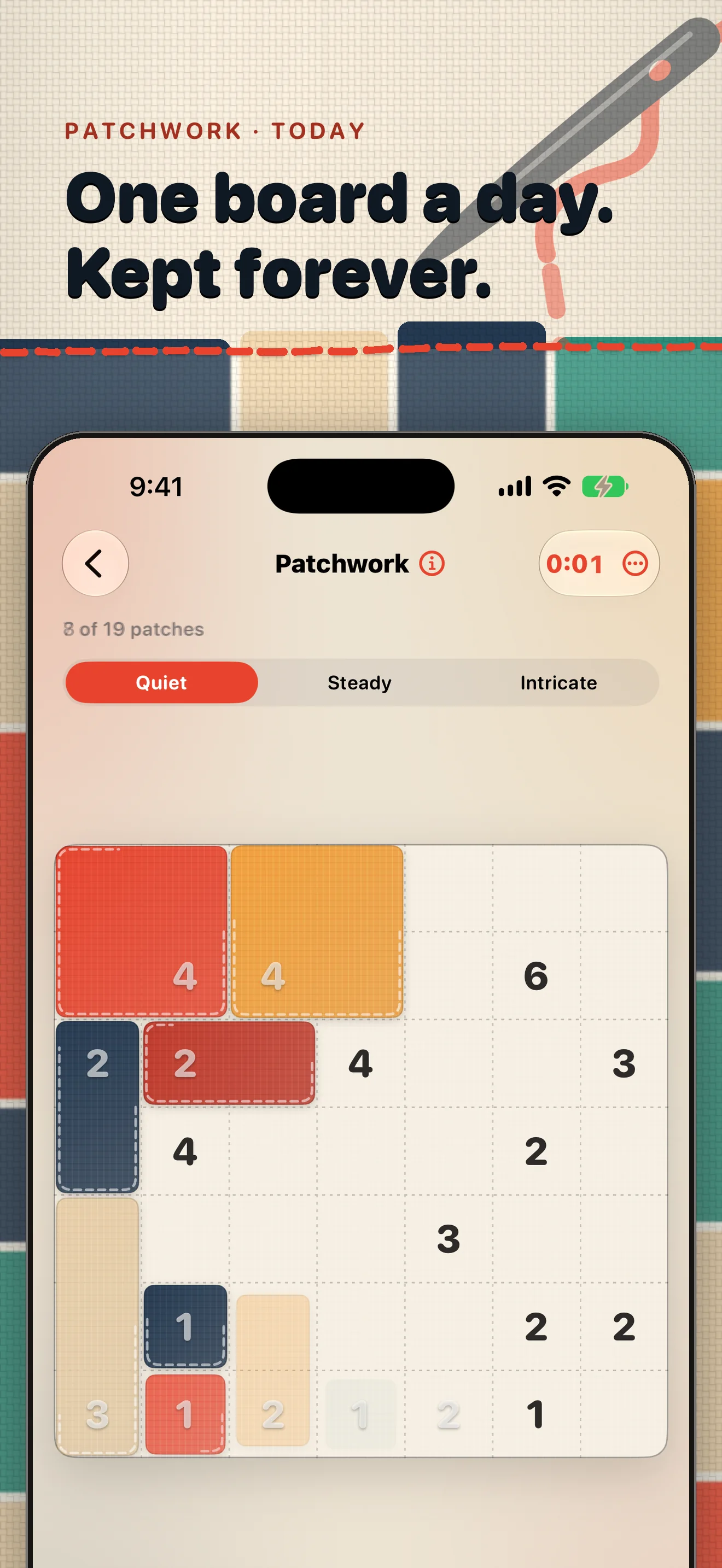
Shikaku is a grid-based logic puzzle about partitioning space. The board contains numbered cells, and each number belongs inside one rectangle whose area matches that number. The rectangles must not overlap, and together they must cover the board with no gaps. That is the whole rule set, but it creates a rich deduction problem because one number can often fit several shapes at the beginning. A clue marked 3 can be a horizontal or vertical three-cell strip. A clue marked 6 can be a 1x6 strip, a 2x3 rectangle, or a rotation that survives the board edges. The solve is therefore spatial rather than a conventional number-placement exercise. You are not filling a 6 into an empty square; you are deciding which six cells belong to the rectangle owned by the clue. Once the vocabulary is clear, the beginner strategy guide turns the definition into a sequence of practical moves.
Four rules to keep visible
It helps to keep four checks beside the board. First, every rectangle contains exactly one numbered clue. Second, the rectangle's area equals that clue. Third, rectangles cannot overlap. Fourth, the complete partition leaves no empty cells. These rules work together. A shape can have the correct area and still be invalid because it contains two clues. A set of individually plausible rectangles can still fail because two of them claim the same cell. A nearly finished board can still be wrong if one unclaimed square remains. Thinking in this checklist makes feedback more useful because you can ask which rule a candidate violates. It also prevents a common beginner mistake: choosing a rectangle because it looks symmetrical or tidy. Shikaku does not reward decoration. It rewards the shape that the clues, edges, and remaining empty space require.
Factor pairs narrow the shape
Area gives you a shortlist of rectangle dimensions. For 12, the basic factor pairs are 1x12, 2x6, and 3x4, along with their rotations. A 5x5 board immediately removes 1x12 because it cannot fit, and an edge or neighbouring clue may remove more. For 4, the candidates are 1x4, 2x2, and 4x1. For 1, there is only one cell. This arithmetic is not a separate maths test; it is a fast way to describe the legal geometry. After listing the factor pairs, place the clue at the centre of each possible rectangle and check the boundary. Then check whether the rectangle would swallow another clue or leave a nearby clue with no possible area. The 5x5 walkthrough shows why a small board is a useful teaching example: you can compare the candidate shapes without losing sight of the whole partition.
Where the first move comes from
Look for a corner, an edge, or a clue with very few factors. A corner clue has only two directions in which its rectangle can grow, and a narrow board can force a strip. An edge clue may have a candidate that reaches the boundary in only one orientation. A clue with area 1 is already complete. Once you place a certain rectangle, mark its cells as unavailable and revisit its neighbours. The placement may turn a 6 into a forced strip, or it may reveal that a particular empty cell can belong to only one remaining clue. This process is called propagation in many logic-puzzle explanations: a local certainty changes the possibilities elsewhere. If you want to practise without committing to a full article walkthrough, open Coverlet Patchwork. It uses the same readable rectangle-and-area idea inside a daily game, while the short guide gives a gentler first introduction.
Shikaku and Coverlet
Coverlet Patchwork uses the rectangle logic found in Shikaku-style puzzles, but Coverlet is a broader iPhone and iPad app rather than a name change for the classic format. The app places the technique inside a daily ritual with Quiet, Steady, and Intricate boards, and every completed solve becomes part of a personal quilt. It also includes Appliqué, Piecing, Stitchline, and Rosette, so you can move to a different kind of deduction when you want a visual change. The core game is generated on-device, and the current app page says no account is required for core play. Those product details surround the puzzle rule; they do not alter the rule itself. If you are searching for a definition, remember the four essentials: one clue per rectangle, matching area, no overlap, and complete coverage. If you are looking for a place to practise that rule daily, read the app details and try Patchwork.
Common beginner mistakes
The first mistake is treating the clues as digits to place rather than areas to shape. The second is choosing a rectangle because it looks balanced before checking whether it leaves room for the neighbours. The third is postponing the no-gap check until the final cell, when an earlier overlap could have explained the difficulty. A fourth mistake is assuming that a large number is always the best place to begin. Sometimes a 12 has many candidate rectangles, while a corner 2 has only one legal orientation and provides stronger evidence. The correction for all four mistakes is the same: translate the rule, list candidates, use the boundary, and propagate every certainty. If you want to compare this process with a familiar number-placement puzzle, read the format comparison. If you want to see the rule in Coverlet's product context, use the Shikaku landing guide and then open Patchwork.
Once the vocabulary is clear, continue with a complete beginner strategy or compare Shikaku with Sudoku and Nonograms.
References
APA 7 references for the research discussed in this article. Last checked 29 Aug 2026.
Frequently asked
Questions about this puzzle
Is Shikaku a number-placement puzzle?
Not exactly. The numbers describe rectangle areas rather than the digits you place. The solve is spatial: choose rectangle boundaries that partition the grid.
What does every rectangle need to contain?
Exactly one numbered clue. Its area must match that clue, and the rectangles together must cover the board without gaps or overlaps.
Is Coverlet the same as Shikaku?
Coverlet's Patchwork technique uses the same satisfying area-and-rectangle logic, then adds a daily board, multiple techniques, offline play, and a private quilt for completed solves.
Keep reading