 Coverlet
How to share a puzzle result without spoiling the answer
A good puzzle share lets someone see that you played without forcing them to see how the puzzle is solved.
By Mourad Hamdi · Last reviewed
A result is not the same thing as a solution
The social value of a daily puzzle often comes from comparing experiences: “I solved today’s board,” “that one was harder,” or “try this mode.” None of those messages requires revealing the exact moves. A spoiler-safe share separates the outcome from the reasoning. It shows that the player took part while leaving the central pleasure—the deductions, false starts, and final click—to the recipient.
Build a safe result card
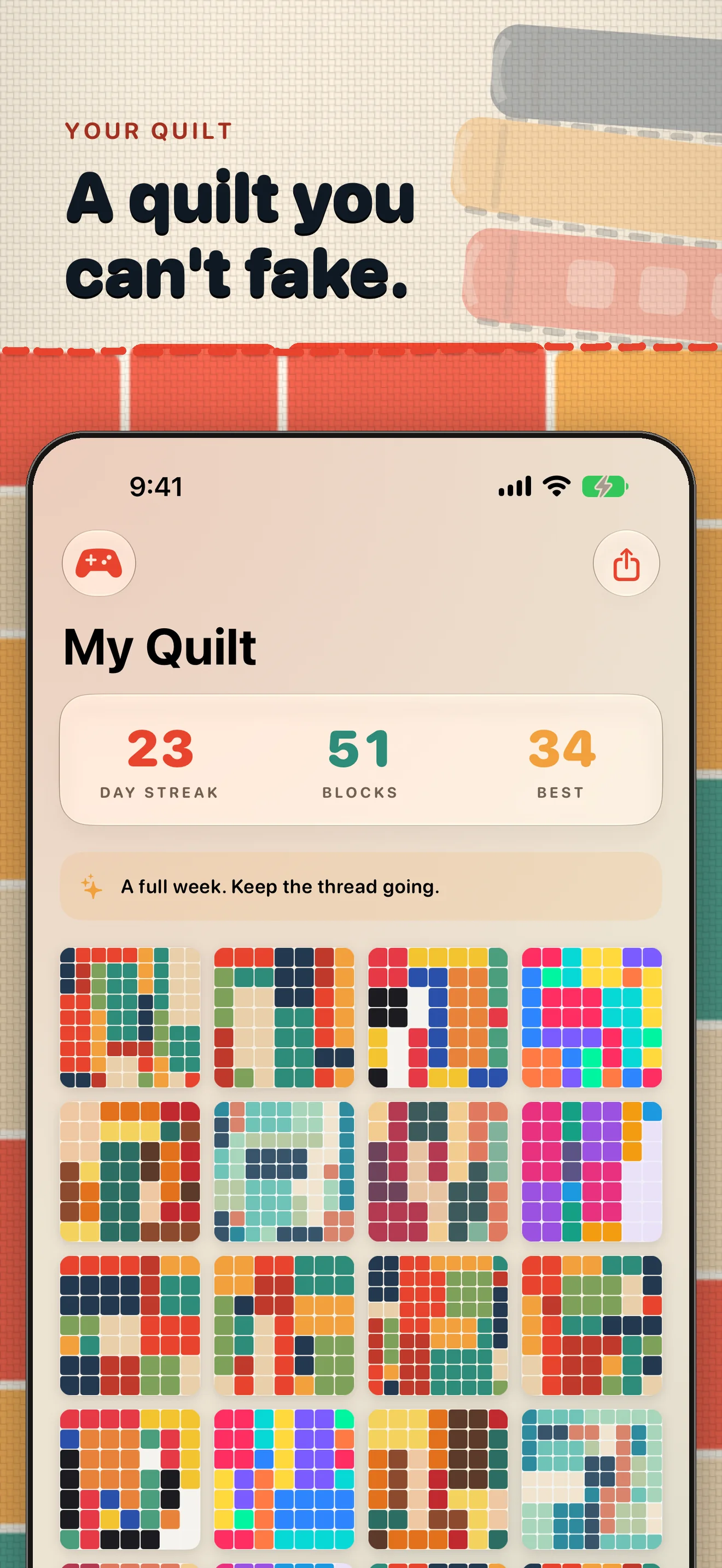
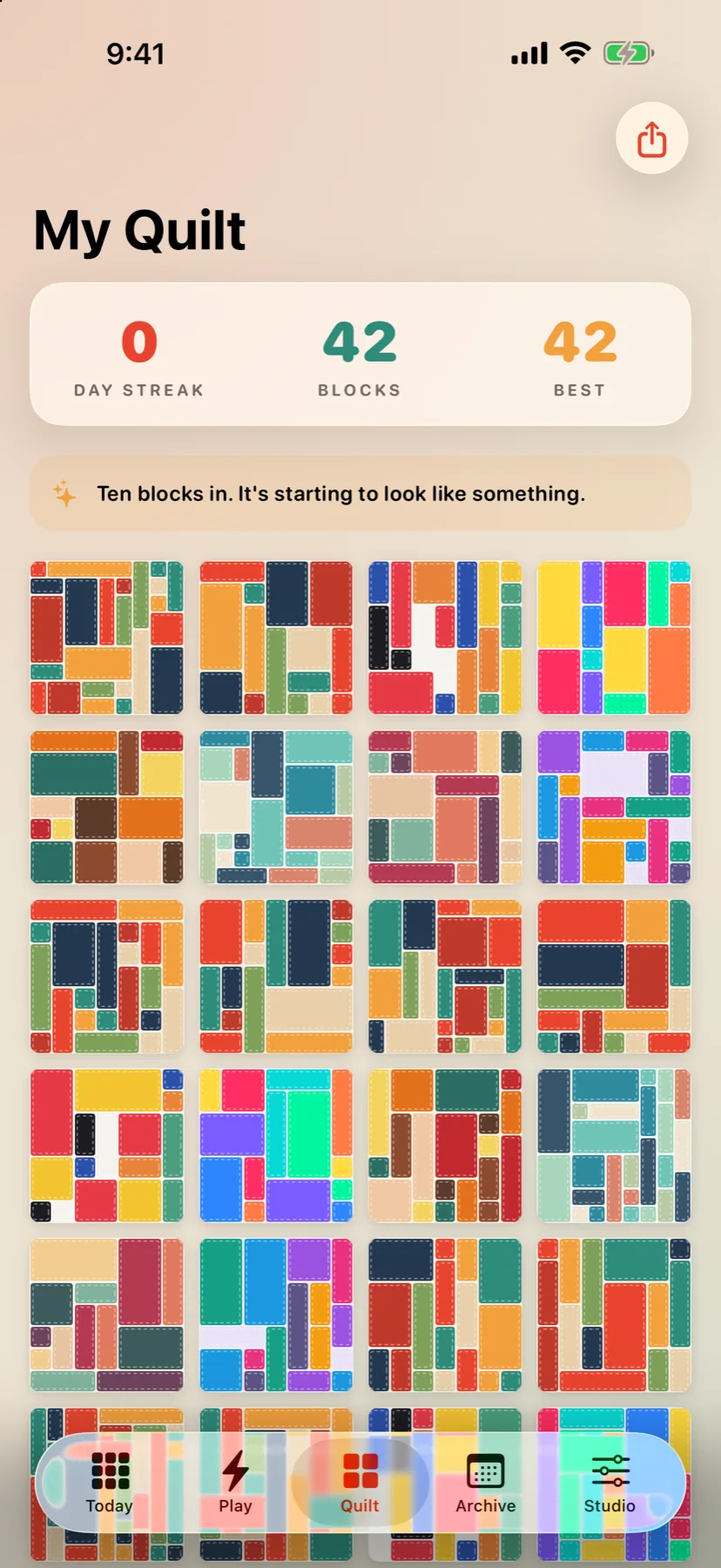
A useful result card can contain the puzzle date, mode name, difficulty, completion state, elapsed time if the player chooses to show it, and a visual signature of the finished board. It should not contain the entire board, hint history, clue order, or a replayable move sequence unless the player explicitly asks for that. For a quilt-style game, a completed block is a natural artifact: it is distinctive enough to recognize and abstract enough to protect the solve.
Make consent visible before the share sheet
The player should know what the share action will create before the system sheet opens. Use a label such as “Share result” for a safe card and “Challenge a friend” for an action that opens a puzzle link. If the app is about to include a time, username, or leaderboard rank, show that content in the preview and offer a way to remove it. Self-determination research emphasizes the importance of agency and competence for satisfying motivation; in a social surface, that means the player controls both the message and the moment of sending (Ryan & Deci, 2000).
Protect the recipient from accidental spoilers
A message should announce the kind of content before it reveals anything: “I finished today’s puzzle—want to try it?” is safer than placing the solved grid at the top of a notification. Preview links should use a neutral image or finished pattern, not the board with all answers visible. If a link includes a challenge state, the landing page should explain that it opens the same puzzle and should not auto-complete it for the recipient.
Remember that social proof is not neutral
People use other people’s reactions as information, but visible reactions can also bias later judgments. Muchnik, Aral, and Taylor (2013) found in a randomized experiment that positive social influence increased positive ratings and produced an accumulating upward bias. The design implication is not to remove every comparison. It is to distinguish a real score from a popularity cue, show sample size and context when they matter, and avoid manufacturing a crowd around a quiet personal activity. A result card can invite curiosity without saying that everyone else already agrees.
Use the Apple share surface with platform differences in mind
Apple’s game design guidance describes different default interactions across iPhone, iPad, Mac, Apple TV, visionOS, and Apple Watch. The share action should therefore be reachable through the device’s normal controls and remain understandable when the board is resized or viewed at a distance (Apple, n.d.). On iPhone and iPad, the system share sheet can support a compact result card. On a larger screen, the action may need a visible button and keyboard or pointer path. On a watch, the right answer may be a handoff or a glanceable complication rather than a dense share composer.
A Coverlet pattern for spoiler-safe sharing
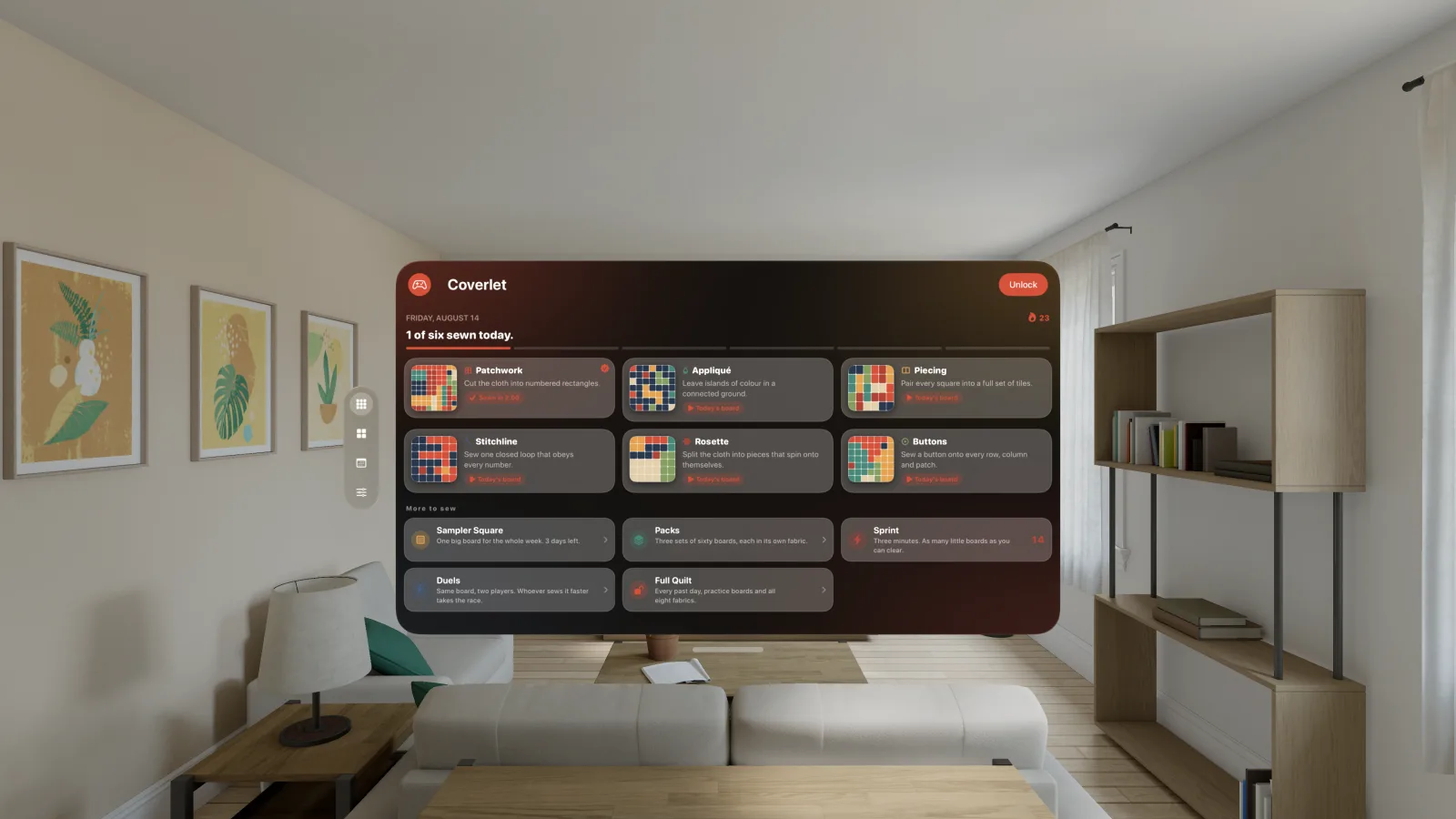
The first tap can be “Share quilt block,” with a preview containing the block art, technique name, date, and a short line such as “I solved today’s Coverlet puzzle.” A second, clearly separate action can be “Challenge a friend,” which creates a link to the daily board without attaching the sender’s solution. If a time or streak is included, let the player remove it. Keep the finished quilt optional and private by default; the social object should be something the player deliberately chooses to pass along, not a forced broadcast.
Measure welcome, not noise
A share feature should be evaluated through the recipient journey: was the card understandable, was the link opened, did the recipient start a puzzle, and could they leave without an account or a spoiler? Also measure cancellations, muted notifications, and support questions. A high share count can coexist with a poor experience if the prompt is noisy or the content is misleading. The better metric is informed participation: someone understood the invitation and chose to continue.
Read the broader viral-design guide, then compare the platform guide before deciding how one result should travel across Apple devices.
References
APA 7 references for the research discussed in this article. Last checked 29 Aug 2026.
- Muchnik, L., Aral, S., & Taylor, S. J. (2013). Social influence bias: A randomized experiment. Science, 341(6146), 647–651. Source
- Apple. (n.d.). Designing for games. Apple Developer. Retrieved August 25, 2026, from https://developer.apple.com/design/human-interface-guidelines/designing-for-games/ Source
- Apple. (n.d.). Game Center. Apple Developer. Retrieved August 25, 2026, from https://developer.apple.com/design/human-interface-guidelines/game-center Source
- Ryan, R. M., & Deci, E. L. (2000). Self-determination theory and the facilitation of intrinsic motivation, social development, and well-being. American Psychologist, 55(1), 68–78. Source
Frequently asked
Questions about this puzzle
What should a spoiler-free puzzle result include?
Include the puzzle date or number, mode, difficulty, completion state, and a visual or emoji pattern that does not reveal the board solution. Keep the answer, move sequence, and clue state private by default.
Can a puzzle result show a score?
Yes, if the score is meaningful and the player understands what it measures. Avoid presenting an unverified percentile or social ranking as if it were universal.
Should a friend challenge open the exact same puzzle?
It can, but the link should say what it does and preserve the recipient’s choice. A challenge should never silently expose the sender’s solution.
How can Coverlet share its result?
A Coverlet share can focus on the finished quilt block, selected mode, and daily identity, with a separate opt-in path for challenging a friend to solve the board.
Keep reading