 Coverlet
What makes a puzzle game go viral? A research-based design guide
A puzzle does not spread because a button says share. It spreads when the rule is easy to explain, the result is worth showing, and the social path respects the person who did the solving.
By Mourad Hamdi · Last reviewed

Viral is a network effect, not a quality certificate
“Viral puzzle game” is a useful discovery phrase, but it can hide three different outcomes: a lot of people see a game, a lot of people try it, or players keep bringing other players into it. Those are not the same metric. A short-lived spike can come from a creator, a platform feature, or a novelty cycle. A healthier product question is whether a person can understand the game quickly, enjoy a fair solve, and give a friend a reason to try the same experience. The goal is not to manufacture urgency; it is to reduce the friction between genuine enjoyment and a considerate invitation.
Teach the rule in one sentence
The strongest viral puzzle formats tend to make the first action comprehensible. A person should be able to say what they are trying to do without a long tutorial: arrange the rows, connect the path, fit the area, find the category, or reveal the pattern. That clarity is not just onboarding polish. It gives the player language for telling someone else about the game. A share that needs a paragraph of explanation has more friction than one that lets a friend understand the challenge from a glance. The best first board therefore demonstrates the constraint while preserving the pleasure of discovery.
Bound the loop so the result can travel
A daily puzzle creates a shared time reference: today’s board, one challenge, one result. A bounded loop also makes the social artifact easier to interpret. Someone can show that they solved a board, compare a pattern, or invite another person to try it without needing to broadcast an entire history. This is different from an endless feed that keeps asking for attention. A small finished state can be more memorable than a large progress dashboard because it gives the recipient a complete object to understand.
Use energy carefully: what virality research actually found
Berger and Milkman (2012) found that online content associated with high-arousal emotions—such as awe, anger, or anxiety—was more likely to be shared than low-arousal content, even after accounting for factors such as usefulness and prominence. That finding is about online content, not a recipe for making a puzzle stressful. The design inference should be narrower: a result that creates curiosity, delight, surprise, or a satisfying sense of achievement may be more shareable than a result that feels flat. Do not manufacture anger or anxiety to grow a calm puzzle. Give the player a genuine moment worth showing.
Social proof needs honesty and restraint
Visible counts, ratings, and “your friends are playing” messages can change behaviour even when the underlying content has not changed. In a randomized experiment, positive social influence increased the likelihood of positive ratings and produced accumulating upward bias (Muchnik et al., 2013). For a puzzle app, that is a warning against fake popularity, inflated percentile claims, or presenting a small sample as a crowd. If Coverlet shows a leaderboard, it should identify what is actually being compared, keep the board and device context clear, and make participation optional. A finished quilt block is often safer social proof than a number that implies a universal ranking.
Design the sharing path as a consented invitation
A share button should answer three questions before it opens the sheet: what exactly will leave the app, who might see it, and does the result reveal the answer? A safe default is a compact result card with the date, mode, difficulty, and a visual pattern—not the full board state. An explicit “challenge a friend” action can create a separate link that tells the recipient they are opening a puzzle, not a spoiler. Keep the share action close to the completed result, make it reversible before sending, and do not interrupt the solve with repeated prompts.
Network features are product decisions, not decorations
Aral and Walker (2011) used a randomized trial to study different viral product features across a large social network. Their work shows why placement and delivery matter: passive broadcast can generate more total peer adoption because it is used more often, while active personalized messages can be more effective per message. That is a useful measurement distinction for an iPhone game. Count invitations that are actually opened and played, not only taps on a share icon. Ask whether the recipient understands why the message arrived and whether the sender intended to send it.
Keep playfulness separate from data extraction
Research on viral promotional advergames found that perceived playfulness was associated with forwarding and personal-data sharing, while prize value was related to forwarding but not in the same way to data sharing (Zhao & Renard, 2018). Coverlet is not a promotional advergame, but the design lesson travels: a playful experience can earn an invitation without making personal data the price of participation. Do not require a contact upload, a public identity, or an account just to show a completed puzzle. Let the result carry the invitation.
The Coverlet opportunity: share the cloth, not the pressure
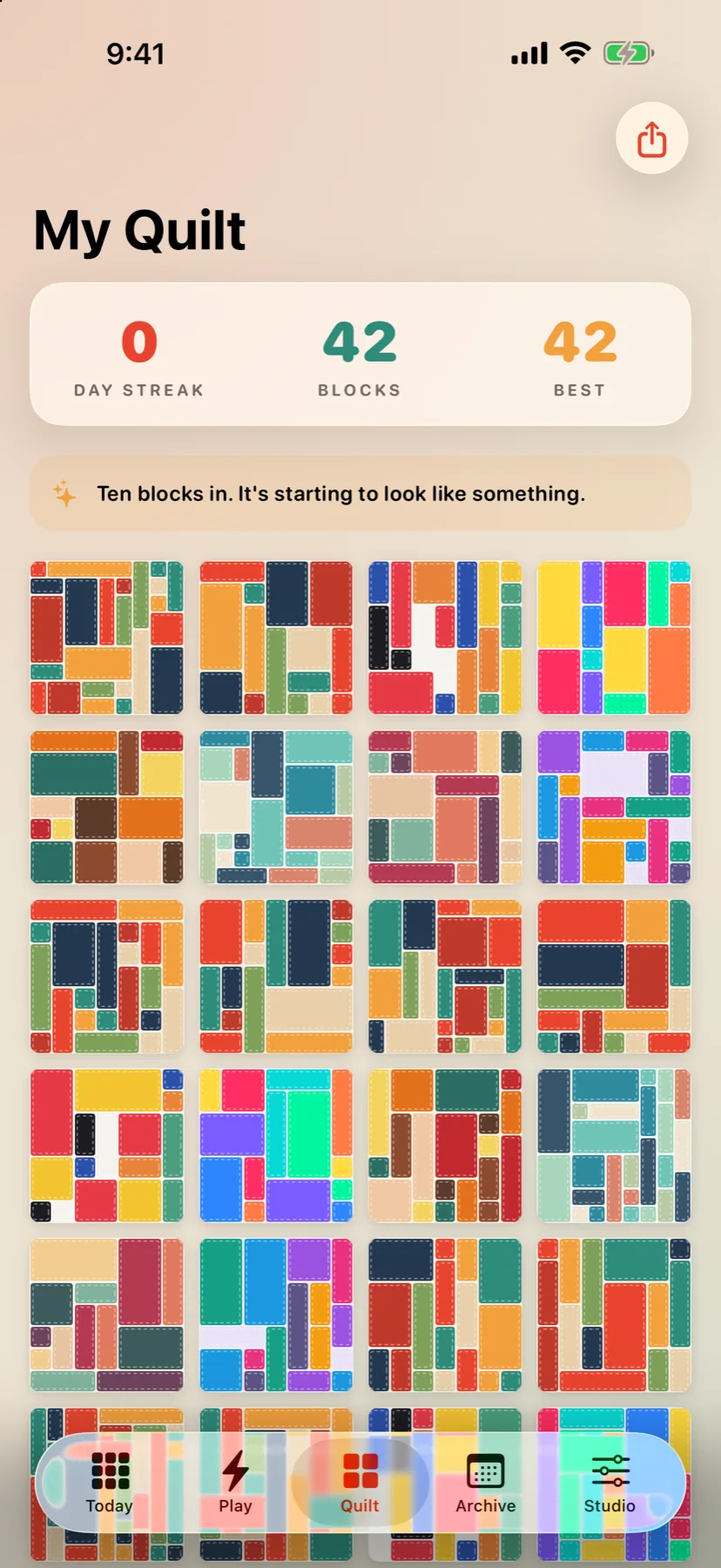
Coverlet already has a natural social object: a completed quilt block or a small finished quilt. The current App Store listing describes sharing a quilt and challenging a friend, which gives the product a stronger starting point than a generic “invite friends” prompt. The next improvement is clarity: show exactly what will be shared, default to spoiler-safe art, make a friend challenge explicit, and keep public rankings secondary. The product can be discoverable without becoming noisy. A quiet puzzle is allowed to have a social surface that feels like passing a piece of cloth across a table.
Measure the right outcome
For a research-aligned growth loop, track the sequence rather than one vanity number: result viewed, share sheet opened, message sent, recipient link opened, recipient started a board, and recipient returned later. Segment by platform and permission state. Watch for negative signals too: share cancellations, blocked links, support requests, or players who stop after a surprise prompt. A viral feature is successful when it creates informed, welcome discovery—not when it extracts the maximum number of sends from a single solve.
For the product side of the question, compare spoiler-safe sharing with platform-specific puzzle design, then explore the iPhone experience.
References
APA 7 references for the research discussed in this article. Last checked 29 Aug 2026.
- Berger, J., & Milkman, K. L. (2012). What makes online content viral? Journal of Marketing Research, 49(2), 192–205. Source
- Muchnik, L., Aral, S., & Taylor, S. J. (2013). Social influence bias: A randomized experiment. Science, 341(6146), 647–651. Source
- Aral, S., & Walker, D. (2011). Creating social contagion through viral product design: A randomized trial of peer influence in networks. Management Science, 57(9), 1623–1639. Source
- Zhao, Z., & Renard, D. (2018). Viral promotional advergames: How intrinsic playfulness and the extrinsic value of prizes elicit behavioral responses. Journal of Interactive Marketing, 41(1), 94–103. Source
- Ryan, R. M., & Deci, E. L. (2000). Self-determination theory and the facilitation of intrinsic motivation, social development, and well-being. American Psychologist, 55(1), 68–78. Source
Frequently asked
Questions about this puzzle
What makes a puzzle game go viral?
A viral puzzle usually combines a rule that is easy to explain, a result that is distinctive, a short enough loop to try, and a sharing path that creates curiosity without revealing the solution.
Does viral mean addictive?
No. Virality describes social spread; addiction is a clinical and ethical concept that should not be used casually as a growth goal. A puzzle can be widely shared while still having clear boundaries and an easy stopping point.
Should a puzzle app show a leaderboard to grow faster?
Not automatically. Social proof can influence judgment, and randomized research shows that visible ratings can bias later ratings. Use rankings only when they represent a real, meaningful comparison and let players opt out.
How could Coverlet improve puzzle sharing?
Make the finished quilt block, difficulty, and date easy to share; keep the board state private by default; offer an explicit challenge link; and measure useful invitations rather than maximizing raw share taps.
Keep reading