 Coverlet
Why every Coverlet solve becomes a quilt block
Most daily games ask you to come back tomorrow. Coverlet also gives yesterday somewhere to go.
By Mourad Hamdi · Last reviewed
A completion needs somewhere to go
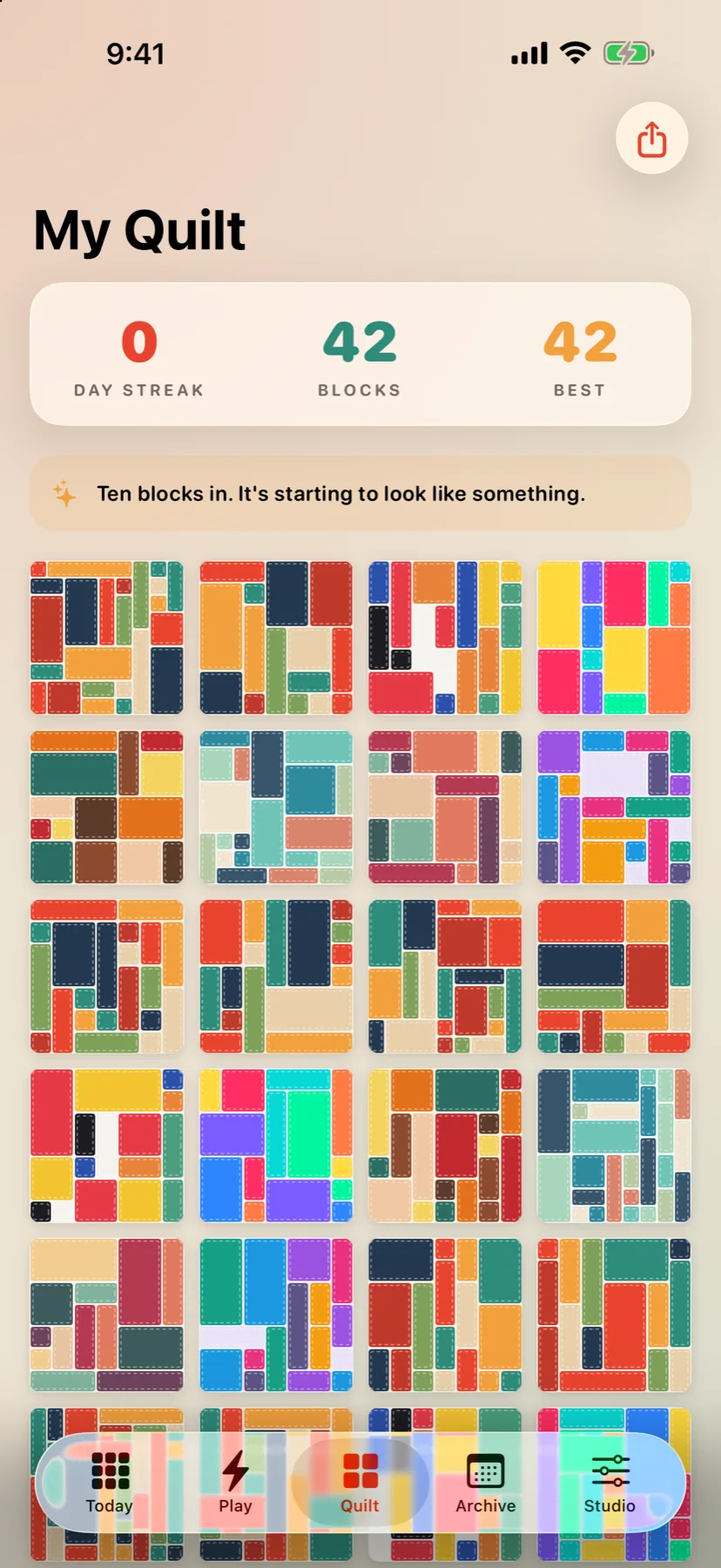
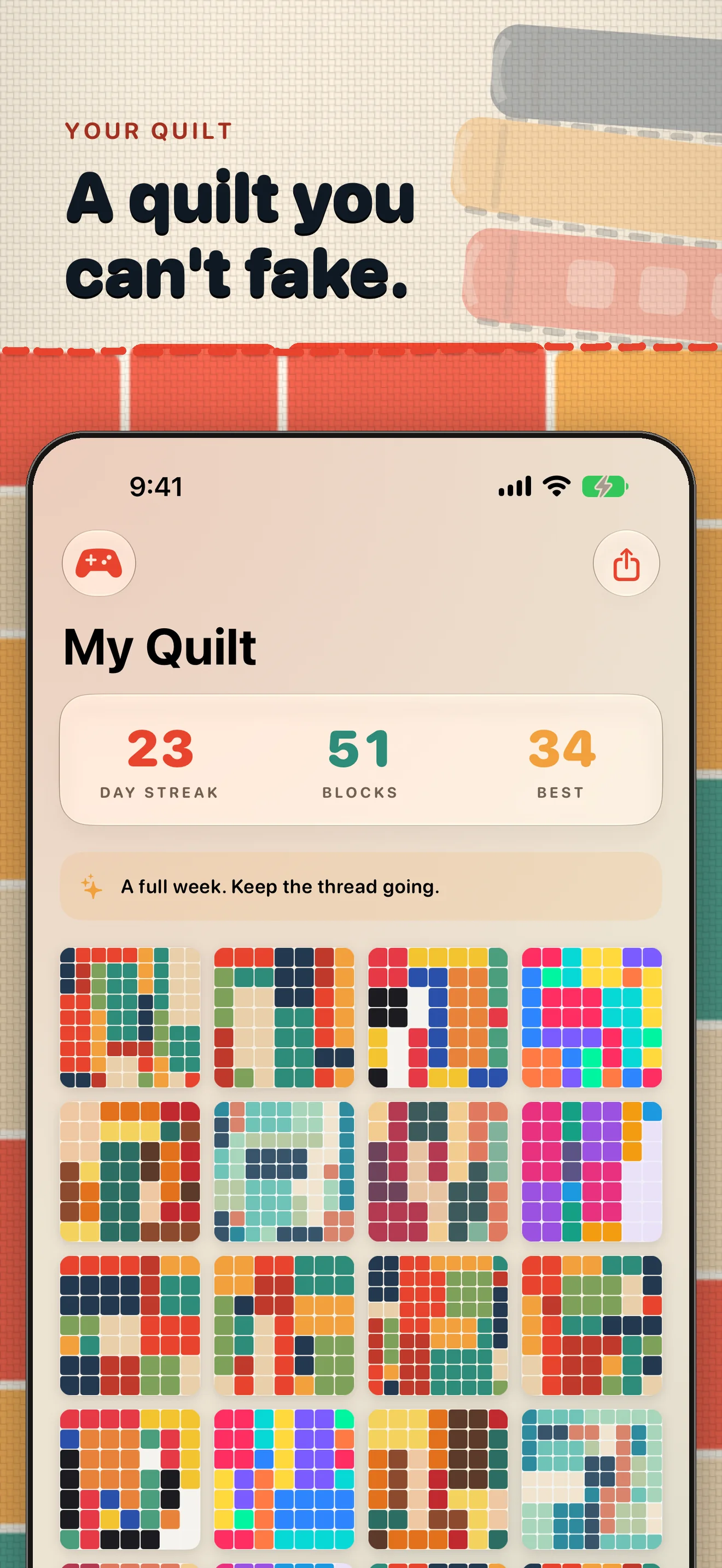
Many daily games make tomorrow visible but leave yesterday behind. You finish a board, see a number or a brief animation, and then the next challenge replaces it. Coverlet began with a different question: what if the completed solve became part of a record you could see growing? The quilt is that record. It gives the small act of finishing a puzzle a place in the product without turning the place into a public leaderboard. A block is not proof that a player is productive, clever, or consistent enough. It is simply a visible trace of a board they chose to complete. That modest scale matters. A few minutes can remain a few minutes while still having a shape afterwards. Open Coverlet for iPhone and iPad and the idea is easy to understand: today’s puzzle is an experience, and the quilt is where finished experiences gather.
The quilt is a private archive, not a performance feed
The visual metaphor could have become a social scorecard, but the better fit is private accumulation. A quilt lets a player notice colour, rhythm, and change over time without asking them to publish a streak or compare their pace with someone else’s. That choice supports a more generous relationship with a daily habit. Missed days do not create holes that need to be defended; they simply leave the fabric as it is until the next solve. The archive also respects different kinds of completion. A Quiet board and an Intricate board can both become part of the same record, even though they demand different amounts of time. The result is not a ranking of effort. It is a personal surface that can remind someone that they made room for a small, bounded activity. The daily routine guide explains how to return without turning a gentle ritual into another obligation.
Motivation without overclaiming
There is useful research behind designing for autonomy, competence, and intrinsic motivation. Self-determination theory describes conditions that can support more self-directed engagement, and game-motivation research has explored how satisfying feedback and a sense of choice can affect the experience of play. Those sources—such as Ryan and Deci’s foundational work and Ryan, Rigby, and Przybylski’s game-motivation model—help explain why a clear goal and meaningful progress can feel better than pressure. They do not prove that Coverlet’s quilt causes happiness, improves mental health, or creates a lasting habit for every player. A product decision is not a clinical result. The more honest claim is narrower: keeping a completed board visible can make progress easier to notice, while privacy and optional pacing can leave more control with the player. For broader context, the research discussion in what puzzle-game evidence can and cannot say keeps that boundary explicit.
Why visual memory fits a logic game
The quilt is not an unrelated reward pasted onto the puzzle. A rectangle board already asks the player to see areas, boundaries, adjacency, and negative space. A finished patch can therefore become a visual memory of the reasoning that produced it. Over time, a row of blocks suggests sequence without requiring a calendar full of statistics. Colour can distinguish days or techniques, but it does not need to grade them. The archive is also forgiving of irregularity: a real quilt can contain different fabrics, sizes, and patterns, and Coverlet can let a player’s record feel similarly personal. This is a design advantage over a single progress bar, which reduces a rich set of experiences to one number. The board remains the centre of attention; the quilt simply gives the finished board a longer afterlife. That relationship is why the visual system should stay calm, legible, and spacious rather than becoming a noisy collection screen.
Keep the reward gentle
A good long-term reward should invite attention without demanding it. Coverlet’s quilt can acknowledge a solve, but it should not punish a pause, manufacture urgency, or imply that more play is automatically better. That means keeping the daily board finite, making the next action clear, and allowing a player to choose among techniques and difficulty moods. It also means being candid about privacy: a personal archive is only comforting if the player can understand where it lives and what the app does with their information. The quilt is most successful when it says, “You finished something,” not, “You owe the system another day.” If you want to explore the underlying game choices, compare the eight daily puzzle techniques; if you want the design rationale in one sentence, Coverlet turns a solved puzzle into a small piece of personal history without claiming that a game can solve the larger problems of life.
Design the texture of the record
A quilt becomes meaningful through variation, not through a single perfect block. The same is true of a puzzle archive. One day may leave a bold Patchwork shape; another may leave a quieter loop or a more patterned result. That visual difference can help a player remember the texture of a week without requiring a diary entry or a performance graph. It also gives the product room to respect different forms of attention. A player who solves slowly is still building a record; a player who chooses Sprint is not making a lesser contribution. The archive should therefore favour clarity over gamification: let the block be recognisable, let the collection breathe, and make the act of opening it feel optional. In that sense, the quilt is a design surface for memory rather than a dashboard for optimisation. The broader notes on relaxing puzzle design describe why that distinction matters.
For a quieter product loop, compare relaxing puzzle design with the practical daily routine guide.
References
APA 7 references for the research discussed in this article. Last checked 29 Aug 2026.
- Ryan, R. M., & Deci, E. L. (2000). Self-determination theory and the facilitation of intrinsic motivation, social development, and well-being. American Psychologist, 55(1), 68–78. Source
- Ryan, R. M., Rigby, C. S., & Przybylski, A. (2006). The motivational pull of video games: A self-determination theory approach. Motivation and Emotion, 30(4), 344–360. Source
- Johannes, N., Vuorre, M., & Przybylski, A. K. (2021). Video game play is positively correlated with well-being. Royal Society Open Science, 8(2), 202049. Source
Keep reading