 Coverlet
Can puzzle games make you happier? What the research actually says
A small puzzle can brighten a few minutes. The science is more interesting—and more careful—than a promise that any app can make everyone happy.
By Mourad Hamdi · Last reviewed
First, define the happiness claim
Happiness is not one switch that a puzzle turns on. Researchers distinguish momentary positive affect, recovery from stress, enjoyment, life satisfaction, and clinical mental-health outcomes. A person can enjoy a ten-minute puzzle without becoming happier in a broad, lasting sense. That distinction matters for Coverlet: the honest promise is a thoughtful daily moment, not treatment, therapy, or a guaranteed mood change.
What the larger studies show
Johannes, Vuorre, and Przybylski (2021) found a small positive relation between self-reported video-game play and affective well-being in a large study, while also emphasizing that the result does not prove that games cause better well-being. Reviews likewise describe possible cognitive, emotional, motivational, and social benefits, but the effects vary with the game, the player, the outcome measure, and the way play is studied (Granic et al., 2014; Pallavicini et al., 2018).
Why a puzzle can feel good in the moment
A puzzle gives attention a bounded object: a rule to understand, a constraint to inspect, and a next move that is available but not compulsory. That structure can support enjoyment, a sense of progress, and a brief change of mental context. Emotion-regulation research suggests that games may be used for mood management, but it also warns that the same activity can serve different purposes for different people (Villani et al., 2018). A calm board is an invitation, not a prescription.
What Coverlet can responsibly offer
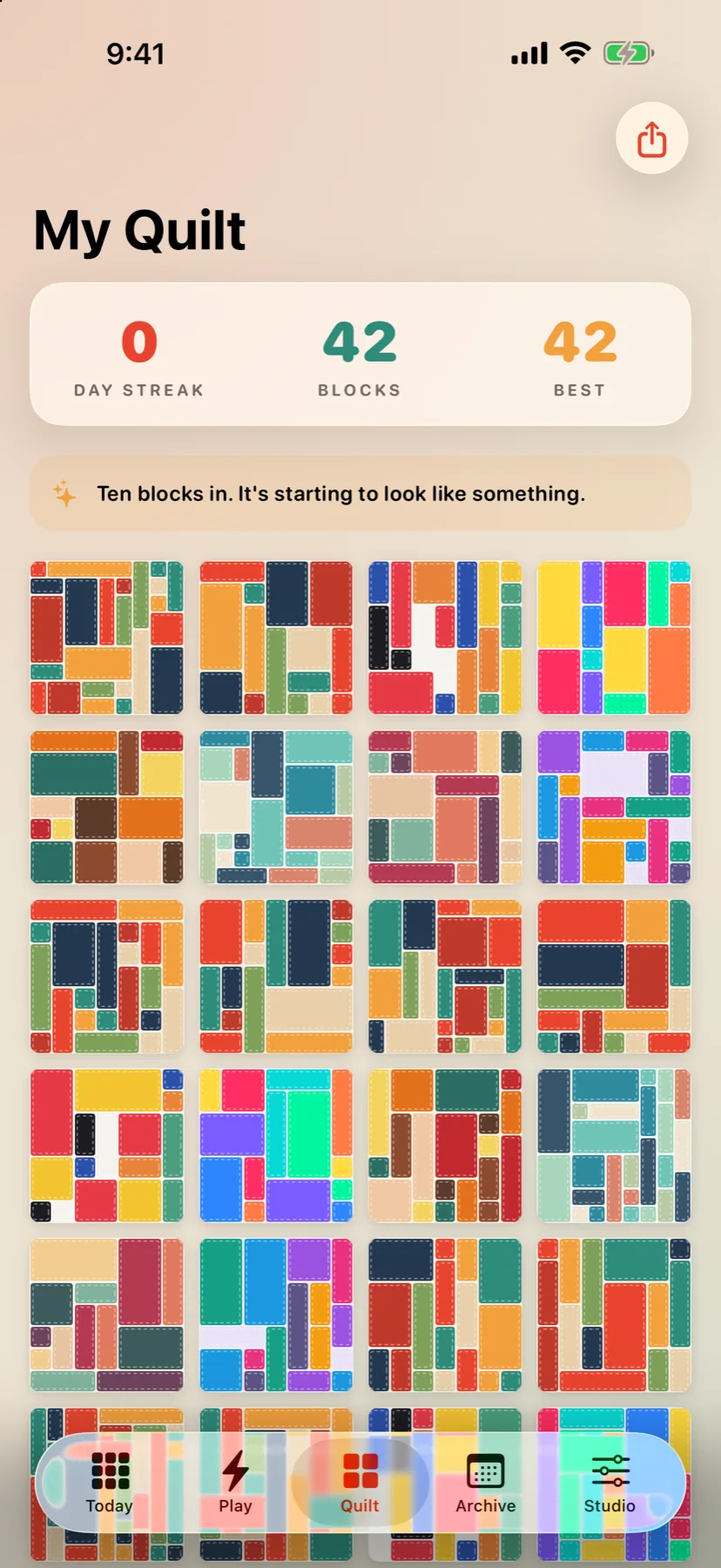
Coverlet is designed around private, daily logic play on iPhone and iPad: readable boards, several puzzle techniques, on-device puzzle generation, and a quilt that records finished work. Those choices are compatible with the research themes of agency, engagement, and recovery, but no cited study tested Coverlet. The right wording is that Coverlet may give a person a pleasant, satisfying place to focus for a few minutes—not that it improves mental health by itself.
Try a small personal experiment
For one week, notice three things before and after a board: your mood, your sense of mental busyness, and whether you chose to stop when the puzzle was complete. Do not score yourself or force a streak. If a short Coverlet session leaves you feeling more settled or satisfied, that is useful personal information; if it feels like pressure, close the app and choose a different kind of rest. The best evidence for your routine begins with your own boundaries.
First, define what happier means
A puzzle can make a few minutes feel enjoyable without changing a person's overall happiness, and those are different claims. Researchers may study momentary positive affect, recovery from stress, enjoyment, life satisfaction, emotion regulation, or clinical symptoms; the outcomes should not be collapsed into one promise. A person may finish a board feeling pleased because a difficult pattern became clear, while another person may find the same board tiring on a crowded day. That variation is not a failure of the research. It is a reminder that experience depends on the player, the activity, the setting, and the outcome being measured. For Coverlet, the responsible starting point is modest: a small, readable puzzle may offer a pleasant place to focus for a few minutes. It is not a treatment, a guarantee, or a substitute for care. Once the question is stated precisely, the evidence becomes more useful because we can ask whether play is associated with a feeling, whether a mechanism is plausible, and whether a result has actually been tested in the product being discussed.
Read association as association
In a large study, Johannes, Vuorre, and Przybylski (2021) reported a small positive relation between self-reported video-game play and affective well-being. That is interesting evidence against the idea that all play is automatically harmful, but it does not establish that playing a game caused participants to feel better. People who feel better may choose to play, people with more free time may both play and report better well-being, and the type of game or context may matter. Reviews also describe possible cognitive, emotional, motivational, and social benefits while emphasising that effects vary across games, players, and measures (Granic et al., 2014; Pallavicini et al., 2018). The careful conclusion is therefore conditional: some kinds of play may support some aspects of well-being for some people in some circumstances. That is a stronger and more honest conclusion than either extreme. It gives designers room to make a good experience while refusing to turn a correlation into a medical or universal claim.
Why a small board can feel good in the moment
A puzzle gives attention a bounded object. There is a rule to learn, a set of constraints to inspect, and a next move that is available without being compulsory. That structure can create a temporary change of context: instead of carrying every open task in your head, you can attend to one defined problem. Completing a deduction may also create a small sense of progress, especially when the feedback explains why the move works. Research on games and emotion regulation suggests that people may use play to manage or shift mood, but the same activity can have different functions for different people (Villani et al., 2018). A puzzle may help one person transition out of a stressful task and feel like one more demand to another. The practical design question is whether the game supports choice and a clear ending. A calm session should be easy to pause, should not punish a missed day, and should let the player decide whether the board is the right kind of rest today.
What Coverlet can responsibly say
Coverlet is designed around private daily logic play on iPhone and iPad: readable boards, several puzzle techniques, on-device core generation, and a quilt that records finished work. Those choices are compatible with research themes such as agency, engagement, and recovery, but none of the cited studies tested Coverlet. It would therefore be inaccurate to say that Coverlet makes people happier, improves mental health, or produces a measured recovery benefit. The more defensible language is experiential: Coverlet offers a small puzzle, a clear completion, and a private visual record that some players may find pleasant or satisfying. The difference between may and will matters. It protects readers from overpromising and gives them permission to notice their own response. If the app feels calming, that is a personal observation. If it feels like pressure, the right response is to stop or choose another kind of rest, not to force the evidence to fit the product story.
Try a low-pressure personal observation
For one week, treat a short puzzle as an observation rather than an intervention. Before playing, notice whether you feel restless, tired, bored, or ready for concentration. Afterward, ask whether the board left you more settled, more alert, unchanged, or more frustrated. Also note whether you chose to stop when the puzzle ended. Do not turn the result into a score, streak, or self-improvement test. The point is to learn what function a puzzle has in your own routine. A board may work well after a long commute but poorly when you need physical movement or conversation. It may be enjoyable when the rules are clear and irritating when the difficulty is wrong. Research can describe patterns across groups, while your small observation can help you set a boundary for your own use. The best outcome is not proving that a game is good for everyone. It is finding a form of play that fits the moment without asking the game to carry more psychological weight than it can support. Include ordinary context in your notes: sleep, workload, interruptions, and whether you played by choice. A change in mood after a puzzle may reflect the break itself, the relief of finishing a task, or the surrounding circumstances rather than a special property of the game. That uncertainty is useful. It keeps a pleasant experience personal and keeps research claims proportionate. If the activity repeatedly adds pressure, shorten it, change the difficulty, or leave it out of that part of the day.
For the design ideas behind this approach, read why every Coverlet solve becomes a quilt block and how a relaxing puzzle can make room for thought.
References
APA 7 references for the research discussed in this article. Last checked 29 Aug 2026.
- Johannes, N., Vuorre, M., & Przybylski, A. K. (2021). Video game play is positively correlated with well-being. Royal Society Open Science, 8(2), 202049. Source
- Granic, I., Lobel, A., & Engels, R. C. M. E. (2014). The benefits of playing video games. American Psychologist, 69(1), 66–78. Source
- Pallavicini, F., Ferrari, A., & Mantovani, F. (2018). Video games for well-being: A systematic review on the application of computer games for cognitive and emotional training in the adult population. Frontiers in Psychology, 9, 2127. Source
- Villani, D., Carissoli, C., Triberti, S., Marchetti, A., Gilli, G., & Riva, G. (2018). Videogames for emotion regulation: A systematic review. Games for Health Journal, 7(2), 85–99. Source
Keep reading