 Coverlet
Logic puzzle solving tips: start with certainty
Good solving is less about seeing everything and more about finding the one thing that cannot be otherwise.
By Mourad Hamdi · Last reviewed
Find certainty before progress
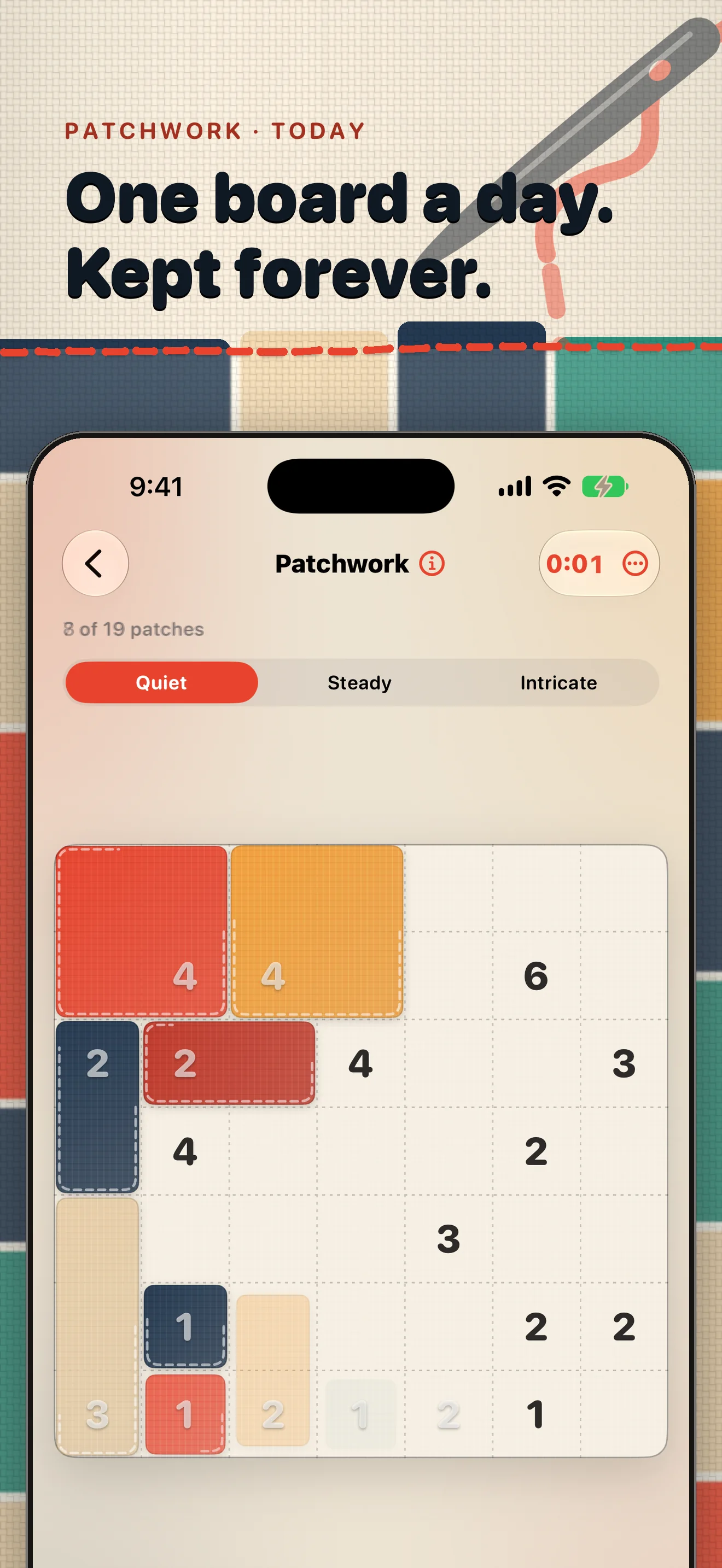
The most reusable logic-puzzle habit is to look for what cannot be otherwise before looking for what would be convenient. A forced cell, a unique partner, a required line exit, or a corner rectangle is more valuable than a move that merely makes the board look fuller. Scan the whole puzzle once before committing. Ask which clue has the fewest legal candidates, which empty cell has the fewest possible owners, and which boundary would become impossible if you ignored it. This approach works across Coverlet’s techniques because each board is a constraint system, even when the visible language changes. In Patchwork, certainty may come from area and edges. In Stitchline, it may come from a line that cannot branch. In Piecing, it may come from a tile with only one compatible partner. A slow first scan is not wasted time; it is how you avoid spending the next ten minutes repairing an assumption.
Translate every clue into candidates
A clue is useful only after you translate what it permits. For a rectangle puzzle, turn area into factor pairs and remove dimensions that run off the board, touch a second clue, or collide with a confirmed patch. For a loop puzzle, list the legal exits at a cell and eliminate any choice that would create a branch or a sealed-off region. For a pairing puzzle, compare each tile with its possible partners and mark a match when every alternative has been ruled out. You do not need a large notation system. A short list in your head, a light pencil mark, or a deliberate pause before tapping is enough. The important move is to keep candidates separate from commitments. “This shape fits” is not the same as “this shape is forced.” Use the rectangle guide to practise that distinction on a small board, where the consequences of each candidate stay visible.
Use edges, corners, and neighbours
Boundaries carry information for free. A corner removes two directions. An edge removes one. A closed loop cannot leave a cell with three connections, and a connected region cannot grow through a boundary that would split the remaining board. After every confirmed move, rescan the nearest clues instead of jumping to the most interesting part of the puzzle. Neighbours reveal consequences that a clue cannot show alone. A rectangle with the correct area may still be wrong if it blocks the only route to another number. A tile pair may be locally plausible but leave a rare tile with no partner. Think in terms of space left behind: what cells remain, which clues still need room, and whether the remaining shape can be completed without overlap? The best deductions often appear one step away from the move you just made. If you want a guided example, the 5×5 Shikaku walkthrough shows how edge information and propagation reinforce each other.
Propagate one move at a time
Once a move is certain, let it change the rest of the board. Mark claimed cells, remove incompatible candidates, and look again for a new singleton. This is propagation: one fact narrows a neighbour, the neighbour narrows another clue, and the board gradually becomes less ambiguous. Avoid making several speculative moves before checking the consequences. If something breaks later, you will not know which assumption caused it. When you are genuinely stuck, compare candidates rather than guessing. Suppose a clue has two possible rectangles. What cell does one candidate claim that the other leaves open? What neighbouring clue would be starved by one shape? Sometimes the contradiction is immediate; sometimes you need to hold the two scenarios briefly and follow each to the next forced result. Keep the smallest useful branch and return to certainty as soon as the board gives it. The goal is not to avoid all thought experiments. It is to make them controlled, reversible, and explainable.
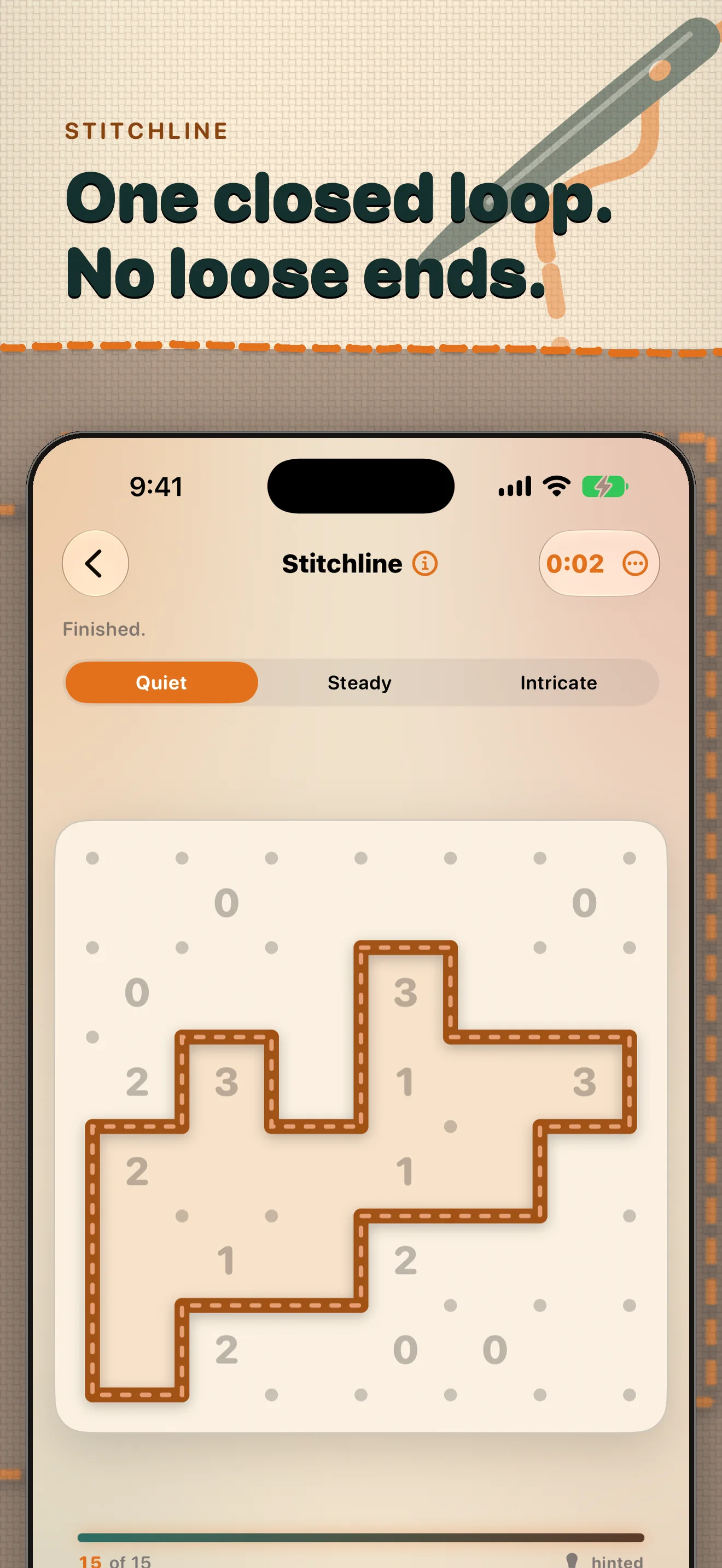
Audit the finish and learn from it
A correct-looking final board still deserves an audit. Check every clue, every area, every boundary, and every empty cell. In Patchwork, the clue areas should total the board area, but also verify that each rectangle contains one clue and that no cells overlap. In Stitchline, trace the full path and confirm it is one closed loop with no branch or isolated segment. In Piecing and Rosette, confirm that every tile or piece is used exactly once and that the pattern rule holds globally. If the puzzle is wrong, do not simply reset and forget it. Find the earliest decision that was treated as certain without enough evidence. That is the reusable lesson. For a calm repeatable routine, choose a board in the technique guide, make one justified move, and let the finished solve remain visible in the Coverlet quilt. Good solving is not the absence of mistakes; it is the ability to turn a mistake into a clearer next scan.
Keep a small candidate log
When a board feels difficult, write down only the candidates that matter. For a rectangle clue, note its remaining dimensions; for a loop, note the cells where a segment can still turn; for a pair, note the two or three partners that remain. This turns a vague sense of being stuck into a concrete question. After a confirmed move, cross out the candidates it eliminates and rescan the list with the fewest entries. You can do this on paper, in a notes app, or with the board’s own visible states; the method is more important than the tool. A candidate log also makes a later mistake easier to diagnose because you can see which possibility was removed too early. Use the interactive Shikaku board to practise the habit without a difficult full-size puzzle, then apply it to a daily board when you want more depth.
Put the method into practice with the interactive rectangle guide, then choose another technique when you want a different constraint language.
References
APA 7 references for the research discussed in this article. Last checked 29 Aug 2026.
Keep reading