 Coverlet
Relaxing puzzle games without ads or tracking
A relaxing puzzle does not need to be empty. It needs to give your attention somewhere kind to land.
By Mourad Hamdi · Last reviewed
Relaxation is a design condition, not a promise
A relaxing puzzle game is not simply a game with soft colours or slow music. It is a game that gives attention a clear place to land, explains the next decision, and lets the player stop without being punished for stopping. Research on games and recovery has examined how play can help some people shift away from strain, while broader reviews of games and emotion regulation describe possible pathways rather than universal outcomes. Those findings are useful design context, not a guarantee that any puzzle will reduce stress or improve mental health. A responsible article should keep that boundary visible. Coverlet is a leisure puzzle app, not a treatment tool. Its more modest goal is to make a few minutes of deduction feel readable, private, and complete. The research-led evidence guide explains why correlation, training effects, and everyday well-being should not be collapsed into one promise.
Make the next move legible
Relaxation is difficult when the board asks the player to remember hidden rules or decode noisy feedback. A calm puzzle gives the player a stable visual system: clues remain readable, placed cells look different from empty cells, and a mistake can be inspected without shame. Patchwork does this through area, rectangle, and boundary relationships. Appliqué uses connected regions and colour, while Stitchline makes continuity the central question. Rosette uses repeated pattern and rotation, Buttons uses exact placement, Cross-Stitch uses ordered runs, and Gingham uses balance across rows and columns. Across all eight techniques, legibility lowers the effort spent fighting the interface, leaving more attention for the deduction itself. Start with the eight techniques and choose the visual language that feels inviting today. If a board is too dense, switch to a quieter mood or a smaller commitment rather than interpreting difficulty as a test of endurance.
Give the player control over pace and pressure
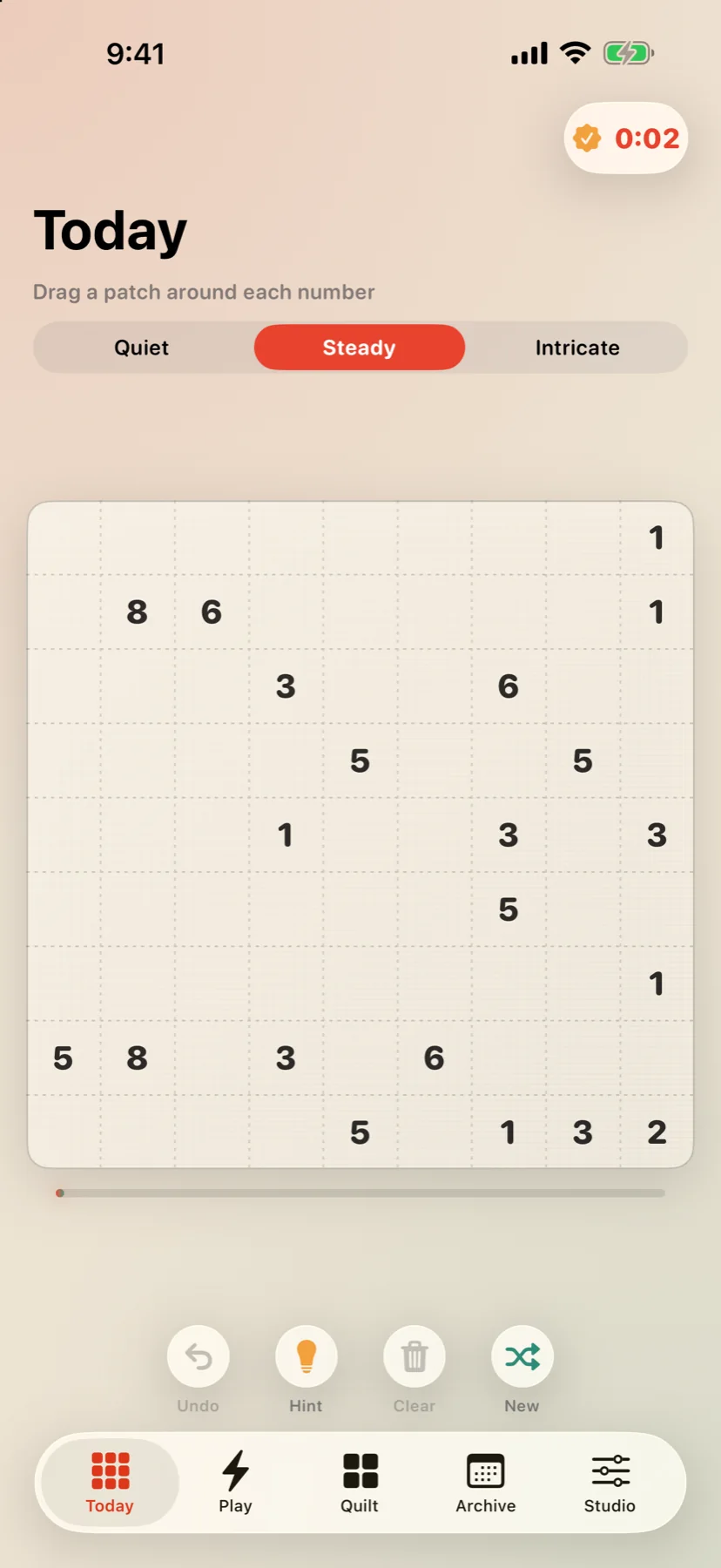
A relaxing game should let the player decide how much challenge belongs in the moment. Coverlet’s Quiet, Steady, and Intricate moods offer a choice before the board begins, while Sprint is available when a short timed burst is genuinely appealing. That choice matters because challenge is not a fixed property of a puzzle; it depends on time, energy, familiarity, and context. A player on a commute may want a small finished board. Someone at home may want a more intricate deduction. The product should not treat both states as the same user who merely needs more reminders. Control also means recoverable mistakes, no required social comparison, and a clear way to pause. A streak can be motivating for some people, but it can also turn a leisure activity into an obligation. The daily routine article offers a gentler model: return because the next board is appealing, not because missing one has become a moral failure.
Protect the quiet with privacy and restraint
Ads, tracking prompts, aggressive notifications, and unexplained account requirements can undo a carefully designed puzzle experience. Privacy is not decorative trust language; it is part of whether a player can relax into the board. A good product states what the core game needs, separates optional platform services from the puzzle itself, and avoids making personal progress feel like a resource to be traded. Coverlet’s promise of private progress is connected to the quilt: completed boards can remain a personal record rather than a public performance feed. This does not mean that a game is automatically safe or that privacy removes every source of stress. It means the interaction does not add pressure that has nothing to do with solving. Read the Privacy policy and offline puzzle checklist alongside the visual experience. Calm design is strongest when the product’s behaviour and its explanation agree.
Let completion be enough
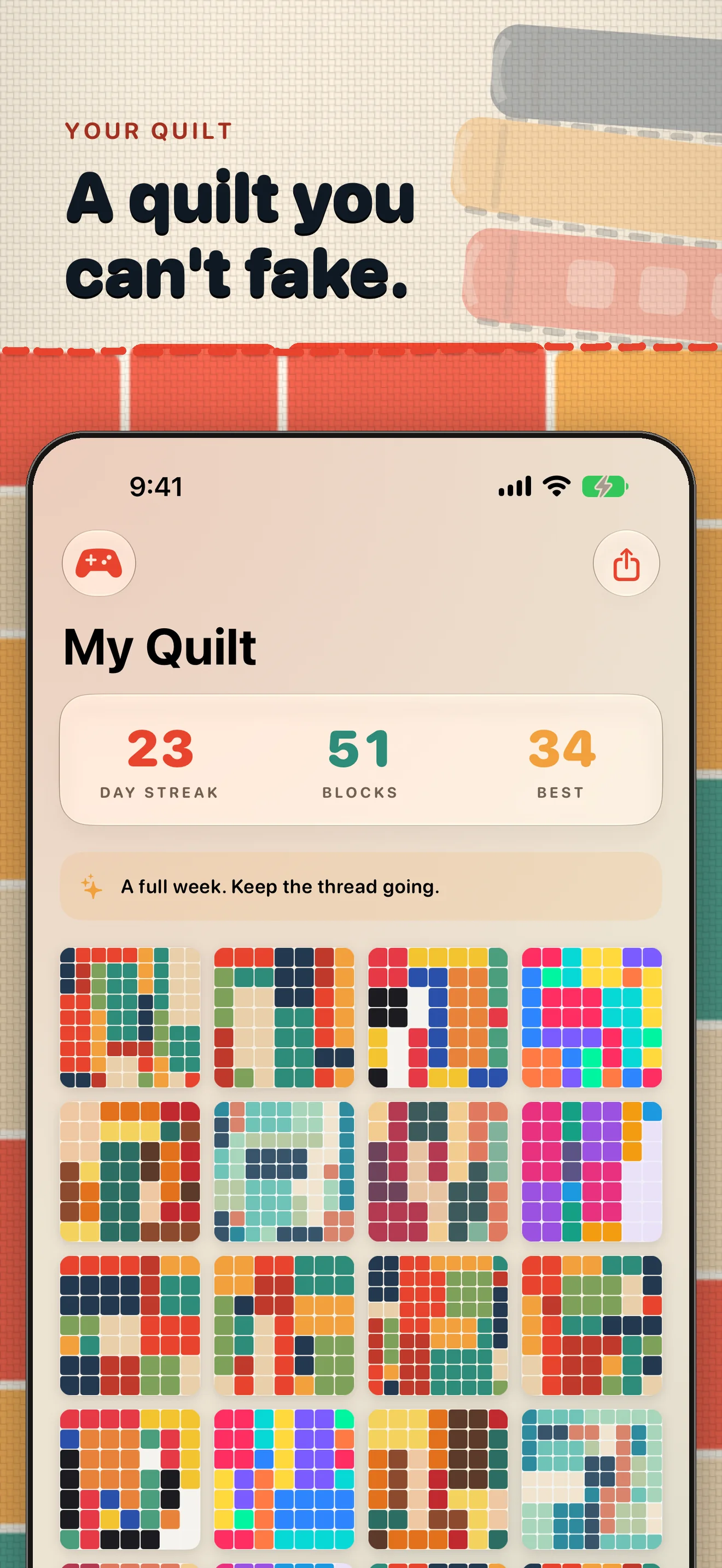
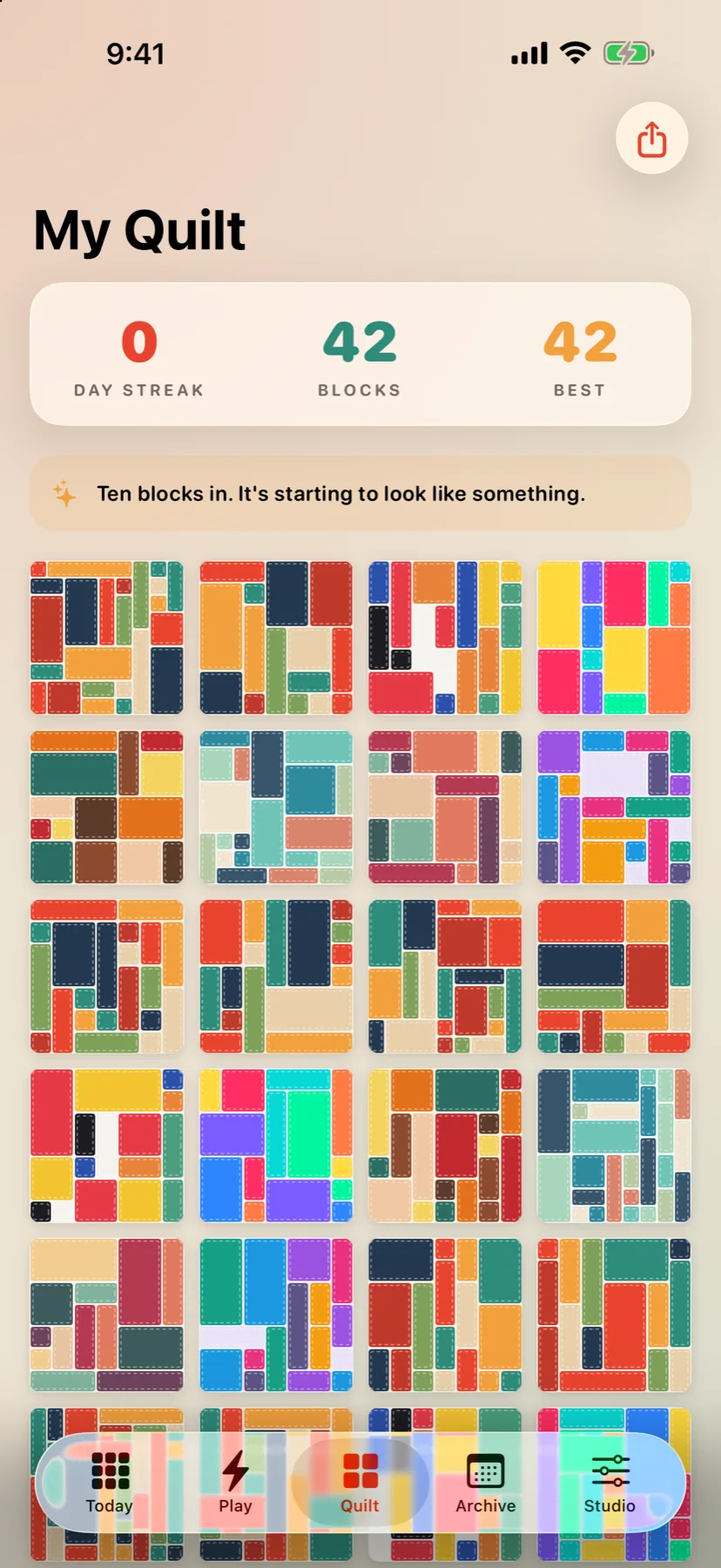
A relaxing puzzle does not need an endless reward ladder. Finishing one board can be a sufficient endpoint, especially when the result has somewhere gentle to go. Coverlet’s quilt turns completed boards into a visual archive, so the player can see a history of chosen attention without being asked to optimise it. That idea fits evidence about enjoyment and motivation better than a claim that every solve produces a measurable health benefit. Research on well-being and game play includes correlations, different kinds of games, and different populations; it cannot certify the outcome of one Coverlet session. The honest invitation is smaller: try a board, notice whether the rules and pace suit you, and stop when you are done. If you want a practical starting point, use certainty-first solving to reduce guesswork, then return to the app only if the next puzzle sounds worthwhile. A quiet game earns trust by leaving the player with choice, clarity, and a completed moment—not by insisting that the moment must become a habit.
Choose a gentle reset when the board stops feeling restful
Even a well-designed puzzle can become the wrong activity for a particular moment. If you are rereading clues without taking them in, rushing taps, or feeling irritation at a board that was meant to be finite, stop and reset the context rather than pushing harder. Switch from Intricate to Quiet, choose another technique, or leave the board unfinished and return later. A reset is not evidence that the game failed or that you failed the game; it is information about the fit between challenge and attention right now. The app can support that choice through clear pause states, reversible moves, and language that does not shame a player for leaving. Coverlet’s offline guide offers a similar test for travel conditions: the right board is the one that remains useful when time and attention are limited. Relaxation is easier to protect when stopping is treated as a valid completion of the session.
Start with one finite board, keep the evidence boundary in mind, and stop when the completed moment feels complete.
References
APA 7 references for the research discussed in this article. Last checked 29 Aug 2026.
- Reinecke, L. (2009). Games and recovery: The use of video and computer games to recuperate from stress and strain. Journal of Media Psychology, 21(3), 126–142. Source
- Villani, D., Carissoli, C., Triberti, S., Marchetti, A., Gilli, G., & Riva, G. (2018). Videogames for emotion regulation: A systematic review. Games for Health Journal, 7(2), 85–99. Source
- Johannes, N., Vuorre, M., & Przybylski, A. K. (2021). Video game play is positively correlated with well-being. Royal Society Open Science, 8(2), 202049. Source
- Granic, I., Lobel, A., & Engels, R. C. M. E. (2014). The benefits of playing video games. American Psychologist, 69(1), 66–78. Source
Keep reading