 Coverlet
How to solve Shikaku puzzles: a beginner's strategy guide
Start with the smallest choices, make each rectangle earn its place, and let the finished patches reveal the rest of the board.
By Mourad Hamdi · Last reviewed
Try the logic
Paint four patches. Leave no gaps.
Choose a number, tap the cells that belong to it, then check the board. The areas are 6, 4, 3, and 12—together they cover every square exactly once.
Choose 6, then paint its six cells.
Read the board as areas
Before drawing anything, translate every number into a space requirement. A 3 needs a three-cell rectangle, so its first candidates are a 1x3 strip and a 3x1 strip. A 6 has more possibilities: 1x6, 2x3, 3x2, and 6x1, subject to the board boundary. This first inventory is more useful than trying to guess the final picture. Write down the candidates mentally or on a scratch surface, then ask which shapes can actually contain the clue. A clue near a corner cannot use cells beyond either edge. A clue beside another number cannot claim that number's cell, because each rectangle must contain exactly one clue. The basic rule is covered in what Shikaku means; the solving habit is to treat area as a constraint that narrows shape, not as a number to place.
Start with the smallest choice
The best first move is usually the clue with the fewest legal shapes, not necessarily the smallest number. A 1 is forced to occupy one cell. A 2 in the middle may be horizontal or vertical, while a 2 in a corner has fewer options. A 3 against an edge may be forced into a strip if the other orientation would leave the board. A 12 in the centre can have several factor pairs, but a 12 near a narrow boundary may lose most of them immediately. Scan for corners, edges, and factor pairs together. When a clue has one candidate left, place it with confidence. When it has two candidates, keep both visible in your reasoning instead of choosing the prettier one. The 5x5 walkthrough is a useful companion because a small board lets you see how one forced rectangle changes the candidate list around it.
Use edges and neighbours
Edges are not just boundaries; they are evidence. A rectangle that reaches a corner must include the corner, and a rectangle along the top edge can only extend downward from that row. Then inspect the clues beside the candidate. Suppose a clue marked 6 could be a 2x3 block in two positions. If one position would cover a cell that a nearby 1 must own, remove it. If one position would surround another clue with too little room for its area, remove it. This is a local comparison, but it has a global effect: every rejected rectangle protects cells for the remaining clues. Work around the board rather than moving randomly. For each unresolved clue, ask which cells every candidate shares, which cells only one candidate uses, and whether a neighbour has become more constrained. You are looking for overlap between possibilities, not a visual pattern that merely looks balanced.
Propagate after every placement
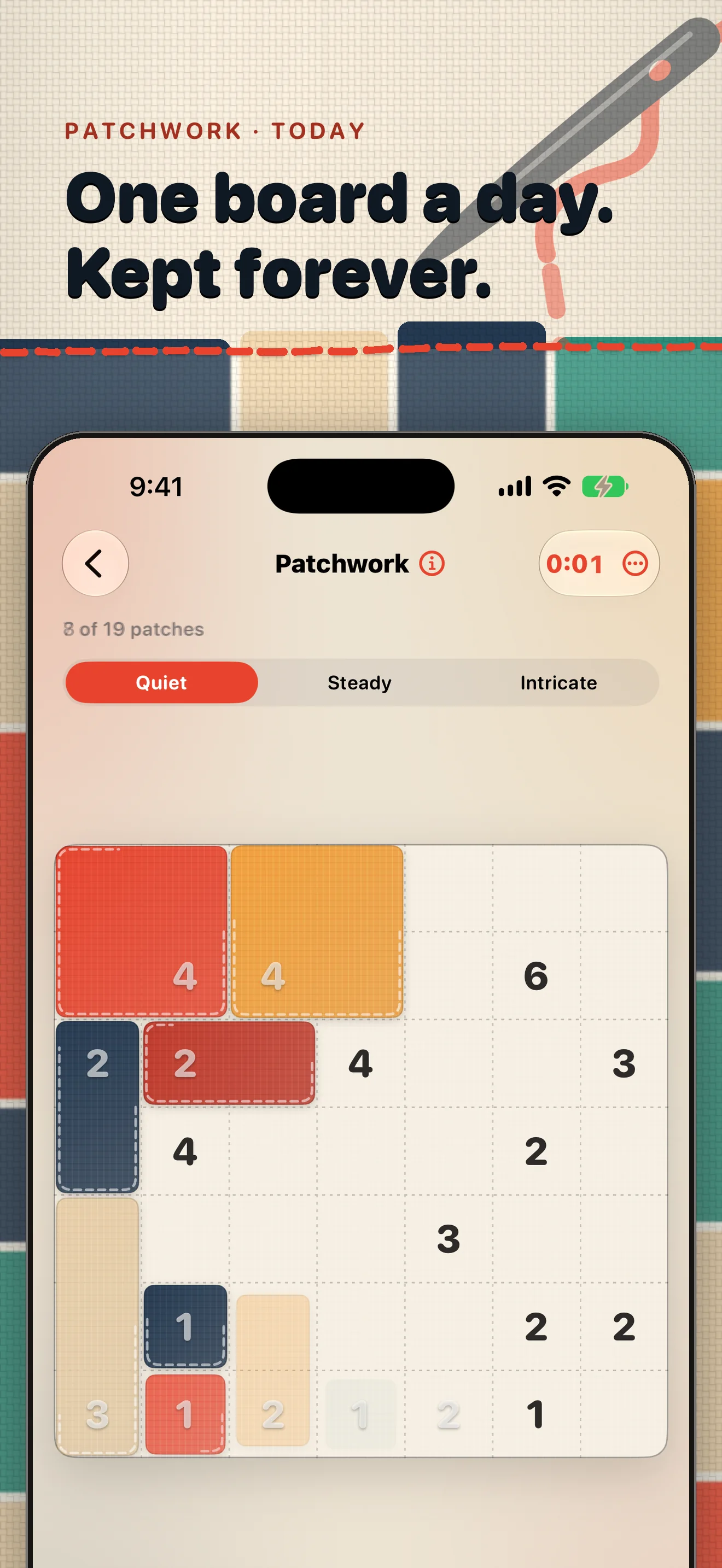
A confirmed rectangle is a new boundary for the puzzle. Mark its cells as unavailable and immediately return to the clues that touch it. Their factor pairs have not changed, but their legal positions have. A 6 that once allowed a 2x3 block may now be limited to a 1x6 strip because the placed rectangle blocks one row. A clue that had two orientations may become forced because only one still reaches an unclaimed cell. This is the central loop of a no-guess solve: place a certain rectangle, remove its cells, recalculate nearby candidates, and repeat. Do not postpone this bookkeeping until the end. The more often you propagate, the smaller the unresolved space becomes. If you are working through Coverlet Patchwork, the interactive board makes the same idea visible: a finished patch is valuable because it changes what the remaining empty cells can mean.
Test contradictions before committing
When no clue is immediately forced, use a careful contradiction test rather than a guess. Pick a clue with two candidates and examine one possibility temporarily. Does it leave an isolated cell that no remaining rectangle can reach? Does it force a neighbour to claim two clues? Does it make the total remaining area impossible? If so, reject that candidate and keep the other. The test is local, but the contradiction can appear several steps away. A useful discipline is to change one assumption at a time and keep the original candidate list intact. If both candidates appear viable, do not force a decision; solve elsewhere and let another placement provide evidence. Shikaku rewards patience because a choice that looks ambiguous at the start often becomes certain after one edge or corner is resolved. For a comparison with other forms of deduction, see how Shikaku differs from Sudoku and Nonograms.
Finish with a no-gap check
A board is solved only when all four conditions hold: every clue belongs to one rectangle, each rectangle has the correct area, no rectangles overlap, and no cells remain empty. Check the last few cells as carefully as the first few. A tempting final strip may have the right area but contain a second clue, or it may fit the empty space while leaving another rectangle short by one cell. Count each finished area, trace every boundary, and inspect any cell that has not been claimed explicitly. Then compare your method with the worked 5x5 method and try a fresh Patchwork board. The goal is not to solve by speed. It is to make each rectangle earn its place so the final partition feels like the only answer the evidence allowed. A clean final check also gives you an explanation when something fails: name the broken rule, find the conflicting shape, and revise the earliest unsupported assumption.
Once the logic feels familiar, try the daily Patchwork board in Coverlet or compare it with the other puzzle techniques in the app.
References
APA 7 references for the research discussed in this article. Last checked 29 Aug 2026.
Frequently asked
Questions about this puzzle
How do I use a clue's number?
Treat the number as the area of its rectangle. List factor pairs such as 1×6, 2×3, and their rotations, then remove shapes that run off the board or touch another clue.
Why are corners useful?
A corner rectangle must include the corner and can only extend along two board edges. That boundary often removes enough candidates to make the placement certain.
How do I know the puzzle is solved?
Every clue must belong to one rectangle, every rectangle must have the right area, and the board must have no overlaps or empty cells.
Keep reading