 Coverlet
How to build a daily logic puzzle habit
The best puzzle habit is one you can return to on ordinary days—not a second job disguised as a streak.
By Mourad Hamdi · Last reviewed
Choose a board that fits the day
A daily routine becomes easier when the first decision is honest. Coverlet presents a daily board in each of eight techniques, with Quiet, Steady, and Intricate sizes, so you can choose the amount of attention you actually have. Quiet may suit a short break; Steady may fit a settled commute or lunch; Intricate may belong to an evening when you want more room for deduction. Sprint is a separate three-minute timed mode when a quick burst is what you want. The point is not to select the hardest board as proof of discipline. It is to reduce the friction between opening the app and making a first move. A routine that respects the day can survive ordinary interruptions better than one built around a fixed performance target.
Begin with one small intention
Before touching the board, choose one thing to notice. You might look for a corner clue, count the area of a likely rectangle, follow one connected region, or simply complete one clear deduction. This gives the session a shape without turning it into a test. If the board is Patchwork, start with the rectangle rule: numbers describe areas, and rectangles must cover the board exactly once. If you are in another technique, use the mode's own clue language rather than importing a strategy that does not fit. One intention is enough because the daily ritual should leave room for curiosity. You do not need to predict whether the board will be easy, difficult, or finished before you begin. You only need a next observation that you can check.
Use certainty as momentum
The first minute is a good place for evidence, not urgency. Scan for a clue with very few possible shapes, a boundary that removes most candidates, or a completed patch that changes its neighbours. In a line or region mode, look for the equivalent constrained move. This is not a promise that every puzzle becomes easy once you find one clue. It is a way to keep the next action understandable. Research on self-determination describes autonomy and competence as important qualities of self-directed activity, but those ideas should not be turned into a health guarantee or a claim about what Coverlet does for every player (Ryan & Deci, 2000). Coverlet's practical design choice is more modest: readable boards, multiple choices, and feedback that lets the solve remain yours. The choice and autonomy note gives the broader context.
Let the session have an ending
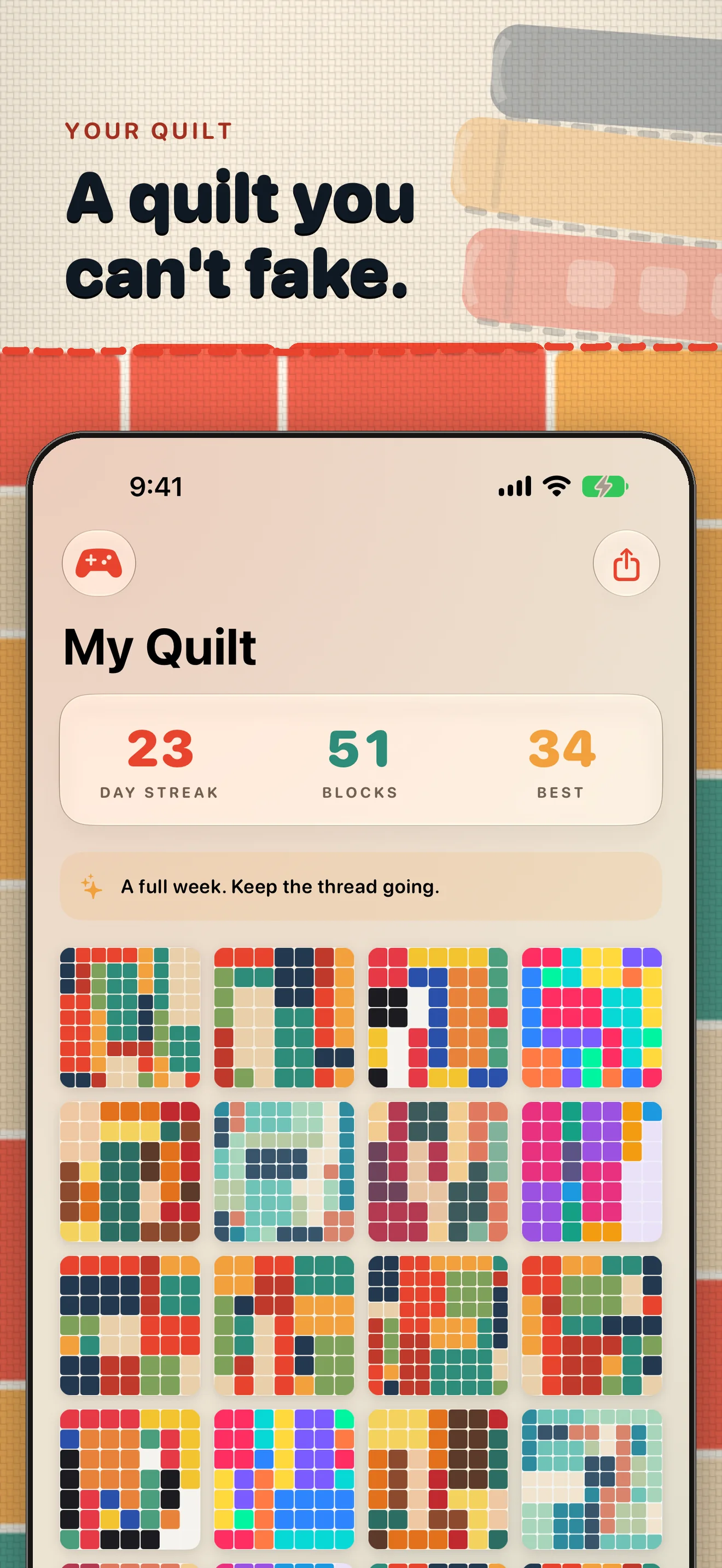
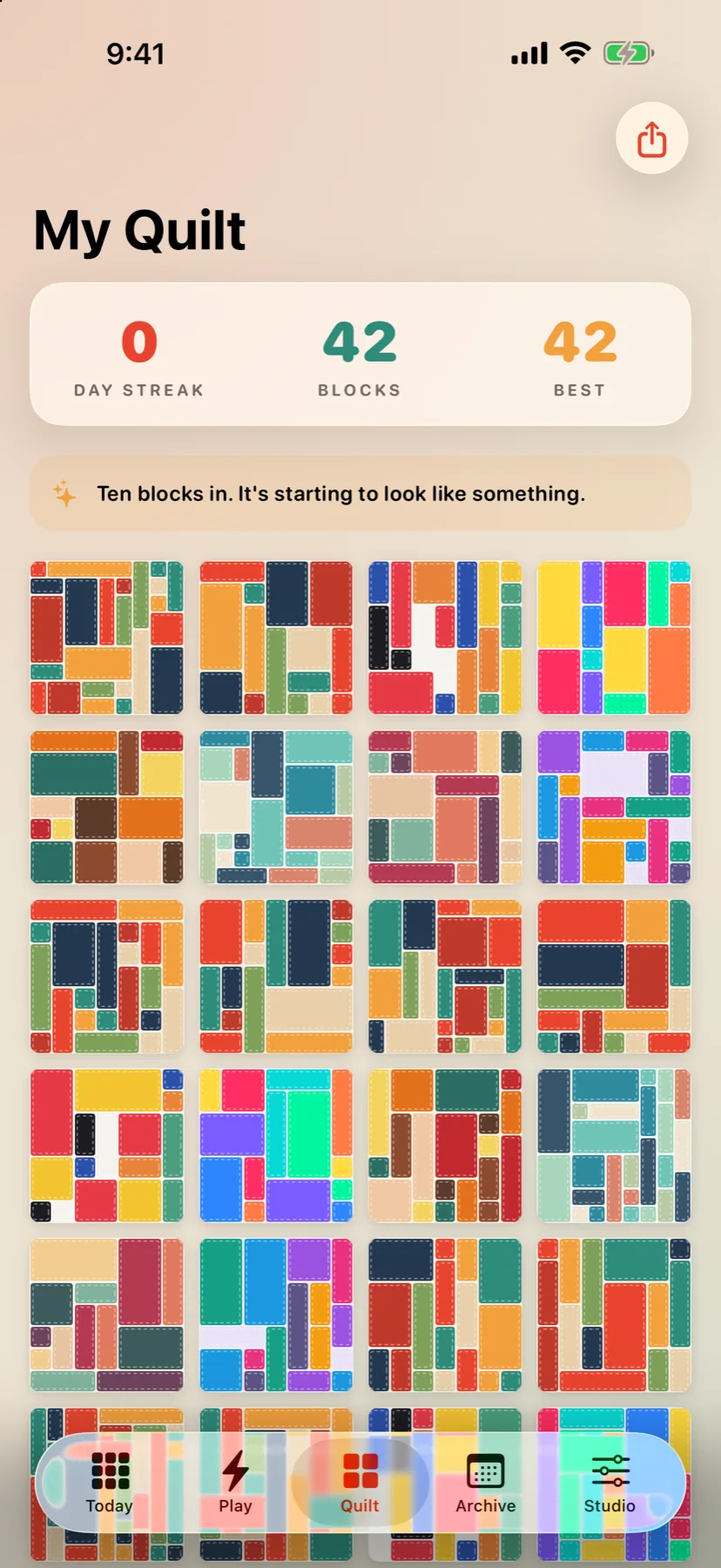
Decide in advance what a complete session means. It could be one finished board, one useful deduction, or the moment your available time runs out. Coverlet turns completed boards into quilt blocks, which gives a solve somewhere to go after the board closes. That visual archive can make the ending visible without requiring another board immediately. Research on games and recovery discusses play as a possible transition after strain, while also emphasizing that the context and the person matter (Reinecke, 2009). The safe takeaway is not that a daily puzzle treats stress. It is that a bounded activity can be easier to stop when its beginning, middle, and end are legible. Read why the quilt exists for the design reasoning behind keeping a finished solve rather than only showing the next challenge.
Return without streak pressure
A missed day is information about the day, not a verdict on the habit. If the routine starts to feel like an obligation, reduce the size of the session or choose a different technique. The daily game can remain a private invitation rather than a public record. Population research has found associations between video-game play and well-being, but association is not proof that a particular game causes a particular outcome, and more play is not automatically better (Johannes et al., 2021). That is why a useful routine includes permission to stop. Keep the next return simple: open the board, read one clue, and decide whether this is a good moment. The joyful habit guide explores the same boundary, while the app page documents the daily boards, offline core play, and privacy model. If you miss several days, restart with the smallest available board rather than trying to compensate. A routine is measured by how gently it can resume, not by how perfectly it avoids interruption. You can leave a board unfinished when the available moment ends; that is part of the boundary.
Make the next return easy
A routine is easier to resume when you leave yourself a clear doorway. Close after a natural endpoint, notice which board size suited the day, and let the finished quilt block be enough evidence that the session happened. You can also make the next start concrete: keep the app where it is easy to find, decide whether tomorrow is likely to be a Quiet or Steady day, or bookmark the rectangle guide if you are still learning the first technique. These are environmental choices, not promises about productivity. They simply reduce the number of decisions between intention and play. If a session becomes frustrating, name the friction accurately. Was the board too large for the available time? Did you need a clearer rule? Were you interrupted? Adjust that one factor instead of deciding that the entire routine has failed. The completion note is a useful reminder that closure can be small. A routine built around a small, repeatable return is more honest than one that depends on never missing a day.
For a practical first step, read the rectangle logic guide and try one Patchwork board today.
References
APA 7 references for the research discussed in this article. Last checked 29 Aug 2026.
- Ryan, R. M., & Deci, E. L. (2000). Self-determination theory and the facilitation of intrinsic motivation, social development, and well-being. American Psychologist, 55(1), 68–78. Source
- Reinecke, L. (2009). Games and recovery: The use of video and computer games to recuperate from stress and strain. Journal of Media Psychology, 21(3), 126–142. Source
- Johannes, N., Vuorre, M., & Przybylski, A. K. (2021). Video game play is positively correlated with well-being. Royal Society Open Science, 8(2), 202049. Source
Keep reading