 Coverlet
Best puzzle games for iPhone: how to choose one you’ll actually keep
The best puzzle game is not the one with the loudest promise. It is the one whose rules, pace, controls, and stopping point fit the way you want to play.
By Mourad Hamdi · Last reviewed
“Best” means best fit, not a universal ranking
Search results for best puzzle games often collapse very different experiences into one list: word games, number puzzles, physics challenges, hidden-object games, and slow logic boards. That makes a ranking less useful than a fit test. Do you want a daily board or an endless run? A quiet deduction or a fast reaction? A private activity or a social competition? The answer changes which game deserves your download. A good comparison names the trade-off instead of pretending that one format is objectively best for every iPhone player.
Start with the constraint you enjoy
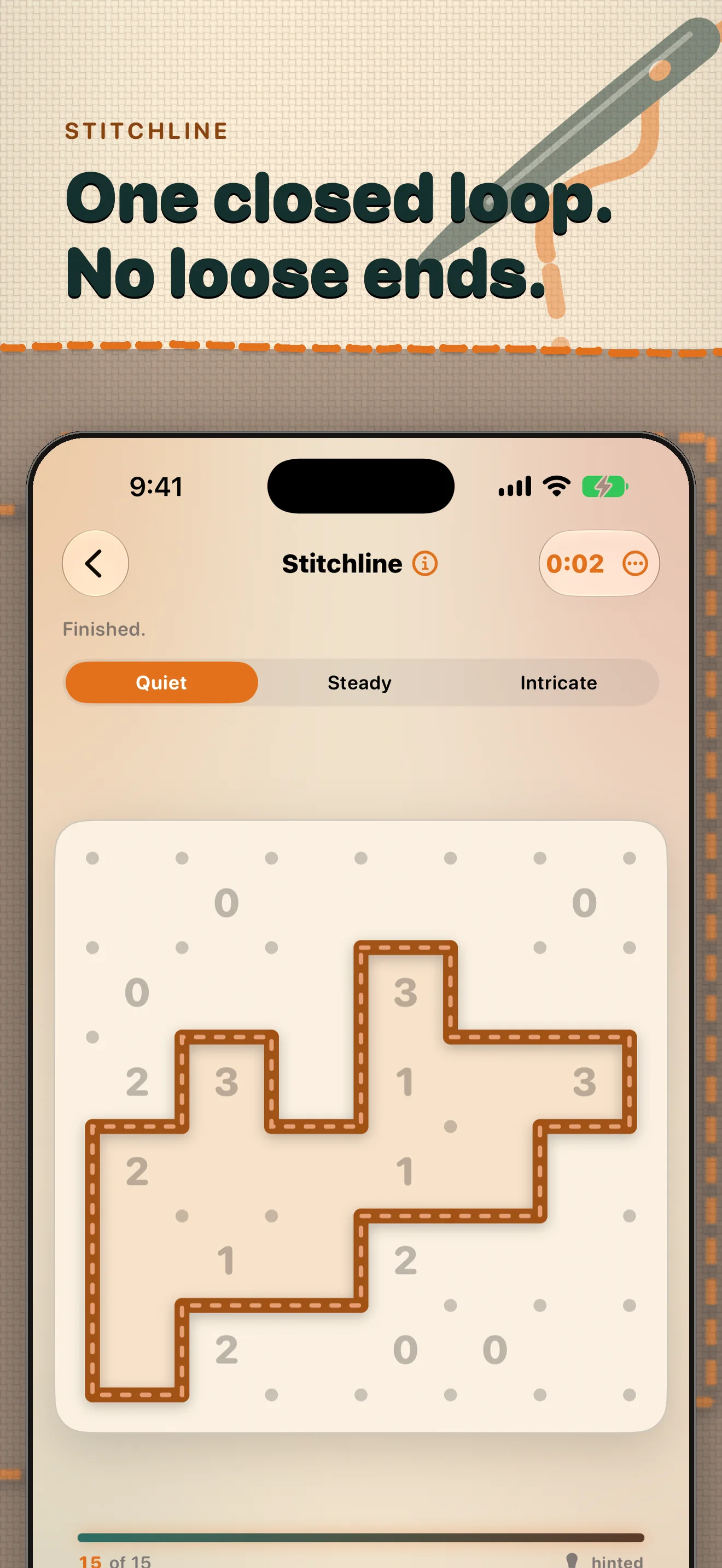
The most important choice is the question the board asks. Rectangle logic asks where an area can fit. A Nonogram asks which cells can belong to ordered runs. A loop puzzle asks how local connections can become one valid path. A word puzzle asks you to retrieve, test, and rearrange language. In problem-solving terms, the rule is the structure that turns a vague challenge into a sequence of decisions. Cognitive-load research and classic work on human problem solving both support the value of making the task structure visible: the player can spend attention on the deduction rather than reverse-engineering an interface (Sweller, 1988; Newell & Simon, 1972). Choose the puzzle language that makes you curious about the next move.
Look for a bounded daily loop
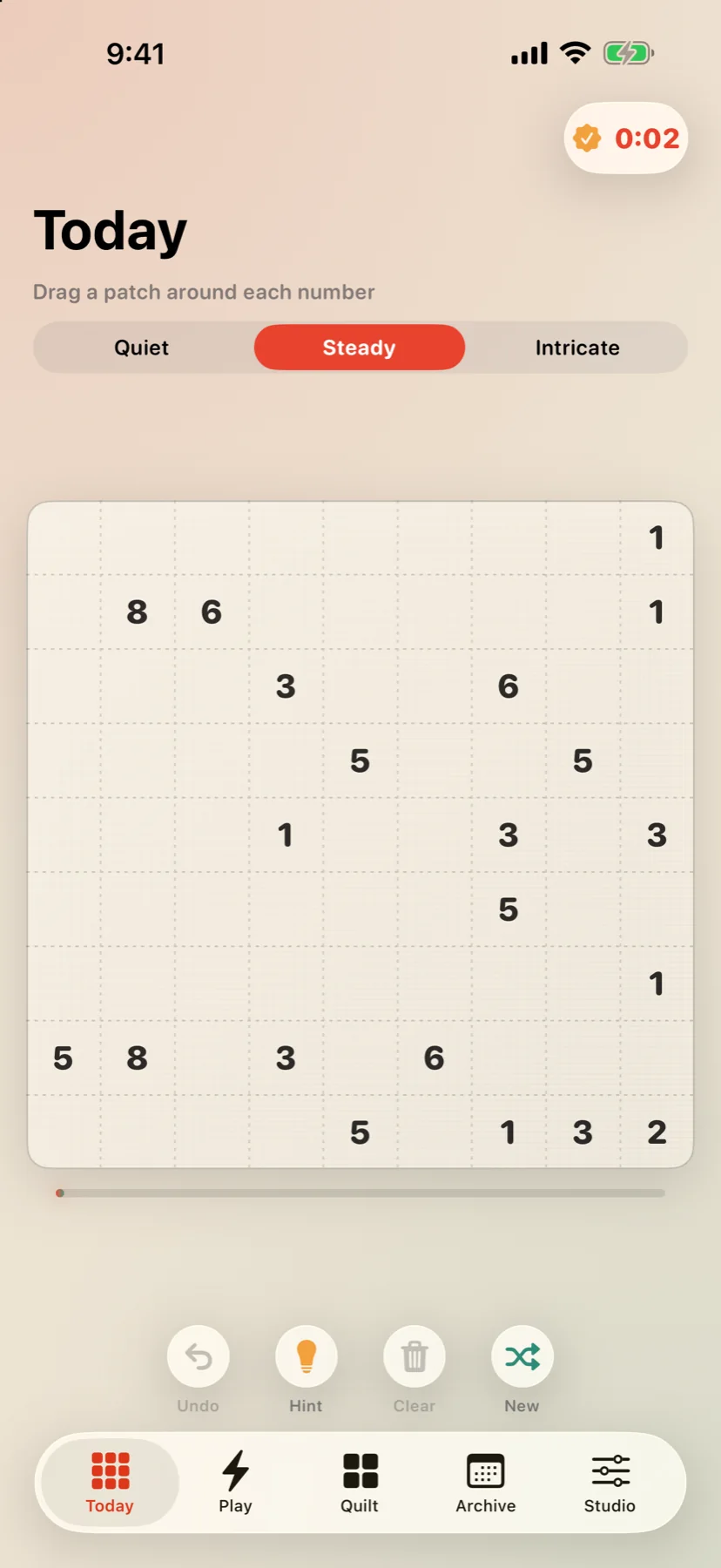
A daily puzzle can be a better fit than an endless feed when you want a clear beginning and end. Look for a board that tells you what today’s challenge is, gives you enough feedback to resume after interruption, and lets completion be an endpoint rather than a prompt to keep scrolling. A daily loop does not need a streak to be meaningful. It can simply give a small piece of finished work a place in your day. Coverlet uses Quiet, Steady, and Intricate board sizes on supported full-fidelity devices so the daily question can expand or contract around the time you actually have.
Check the product contract before you fall in love with the screenshots
An attractive board does not tell you whether the core game works offline, how much advertising appears, whether a subscription is required, or what happens when you make a mistake. Read the store description and privacy information for those boundaries. For Coverlet, the core daily boards are generated on-device, no Coverlet account is required for core play, and the current product model uses optional one-time additions rather than a subscription. Optional Apple services—such as purchases or Game Center—have their own requirements. Clear product language is part of quality because it lets you choose the experience with informed expectations.
Match the puzzle to the screen in your hand
On iPhone, the best board is not necessarily the one with the most cells. It is the one whose clues remain legible, whose targets are comfortable to tap, and whose important state does not disappear behind a toolbar. Apple’s game design guidance treats touch as the default iPhone interaction and describes different input assumptions for iPadOS, macOS, tvOS, visionOS, and watchOS (Apple, n.d.). That makes platform-specific polish meaningful. If a game feels cramped on your device, a larger board or a different game may be a better choice than simply increasing the difficulty.
Use this 60-second download checklist
Before installing, answer seven questions. What is the core rule? How long can one session reasonably be? Can you play the central puzzle without a connection? Are ads, subscriptions, or accounts part of the path? Can you undo or recover from a wrong move? Does the interface explain progress without relying on colour alone? And is there a natural place to stop? These questions are more durable than a temporary chart position. They also help you compare a large premium game with a small daily logic app on the same terms.
Where Coverlet fits
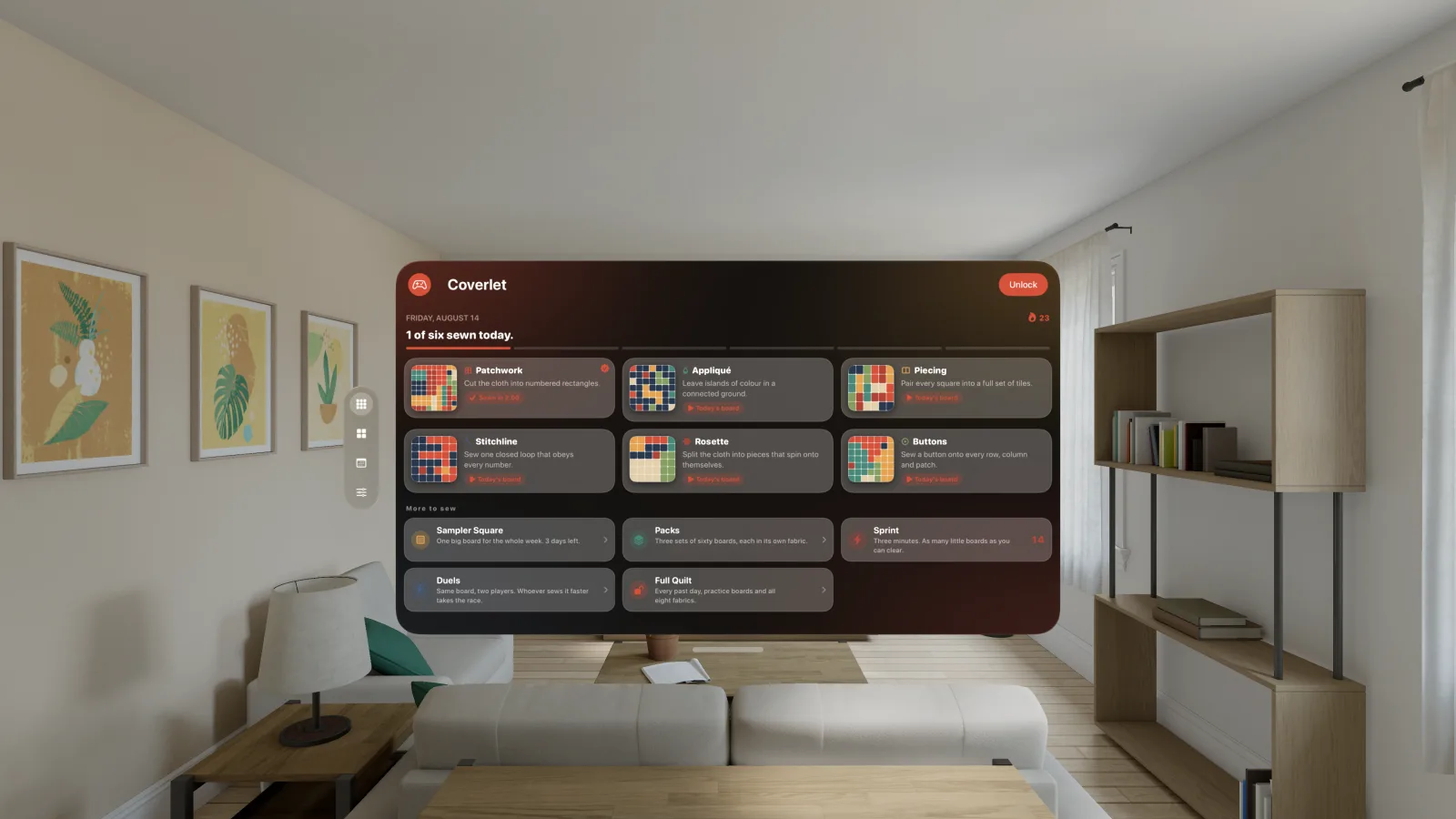
Coverlet is designed for the player who wants variety inside a quiet daily ritual. Patchwork, Appliqué, Piecing, Stitchline, Rosette, Buttons, Cross-Stitch, and Gingham use different visual constraints, but each board ends in a finished pattern that can join My Quilt. The point is not to claim that the app improves every mental ability; systematic reviews of games and cognitive training show why benefits, when observed, depend on the practiced mechanic and measured outcome (Pallavicini et al., 2018). The product promise is smaller and more concrete: open a readable board, make deductions, and keep a visible record of having finished it.
If that sounds like your kind of puzzle, browse the Coverlet game shelf, compare the iPhone guide, and read how the eight techniques differ.
References
APA 7 references for the research discussed in this article. Last checked 29 Aug 2026.
- Sweller, J. (1988). Cognitive load during problem solving: Effects on learning. Cognitive Science, 12(2), 257–285. Source
- Newell, A., & Simon, H. A. (1972). Human problem solving. Prentice-Hall. Source
- Ryan, R. M., & Deci, E. L. (2000). Self-determination theory and the facilitation of intrinsic motivation, social development, and well-being. American Psychologist, 55(1), 68–78. Source
- Apple. (n.d.). Designing for games. Apple Developer. Retrieved August 25, 2026, from https://developer.apple.com/design/human-interface-guidelines/designing-for-games/ Source
- Pallavicini, F., Ferrari, A., & Mantovani, F. (2018). Video games for well-being: A systematic review on the application of computer games for cognitive and emotional training in the adult population. Frontiers in Psychology, 9, 2127. Source
Frequently asked
Questions about this puzzle
What makes a puzzle game good on iPhone?
A good iPhone puzzle game explains its rule quickly, gives you a readable board, supports comfortable touch input, and lets you stop without losing your progress or dignity.
Are puzzle games good for your brain?
Research supports more specific claims than a blanket promise. Practice can improve performance on related tasks, but a commercial puzzle app should not claim to prevent disease or make everyone smarter.
What should I check before downloading an iPhone puzzle game?
Check the core mechanic, offline behaviour, ads and subscription model, privacy choices, accessibility information, session length, and whether the game gives you a natural stopping point.
Why might Coverlet fit this kind of player?
Coverlet combines eight daily logic techniques, on-device core play, three board sizes on supported full-fidelity devices, and a quilt that keeps completed solves.
Keep reading