 Coverlet
Why different puzzle techniques create different moods
The rule may be logical in every mode, but the way a board asks you to look changes the emotional texture of the solve.
By Mourad Hamdi · Last reviewed
Mood is contextual, not a fixed property of a mode
When a player says that a game feels calm, tense, playful, or absorbing, they are describing an interaction between the mechanic, the interface, the setting, and their current state. The same Stitchline board may feel elegant after breakfast and demanding after a long day. Reviews of games and well-being emphasize that outcomes vary with genre, design, player goals, and context rather than treating all games as one intervention (Granic et al., 2014; Pallavicini et al., 2018). This matters for Coverlet because a technique can be described accurately without assigning it a guaranteed emotional effect. Patchwork may feel orderly to one player; another may find its area constraints demanding. Sprint may feel energising to someone who enjoys a clock and stressful to someone who wants recovery. The useful promise is choice. A player can sample a mode, notice the fit, and change course. Mood language should describe possibilities and design texture, not imply that an app can regulate emotion for everyone or that a certain technique is a cure for a difficult feeling.
Eight ways to look
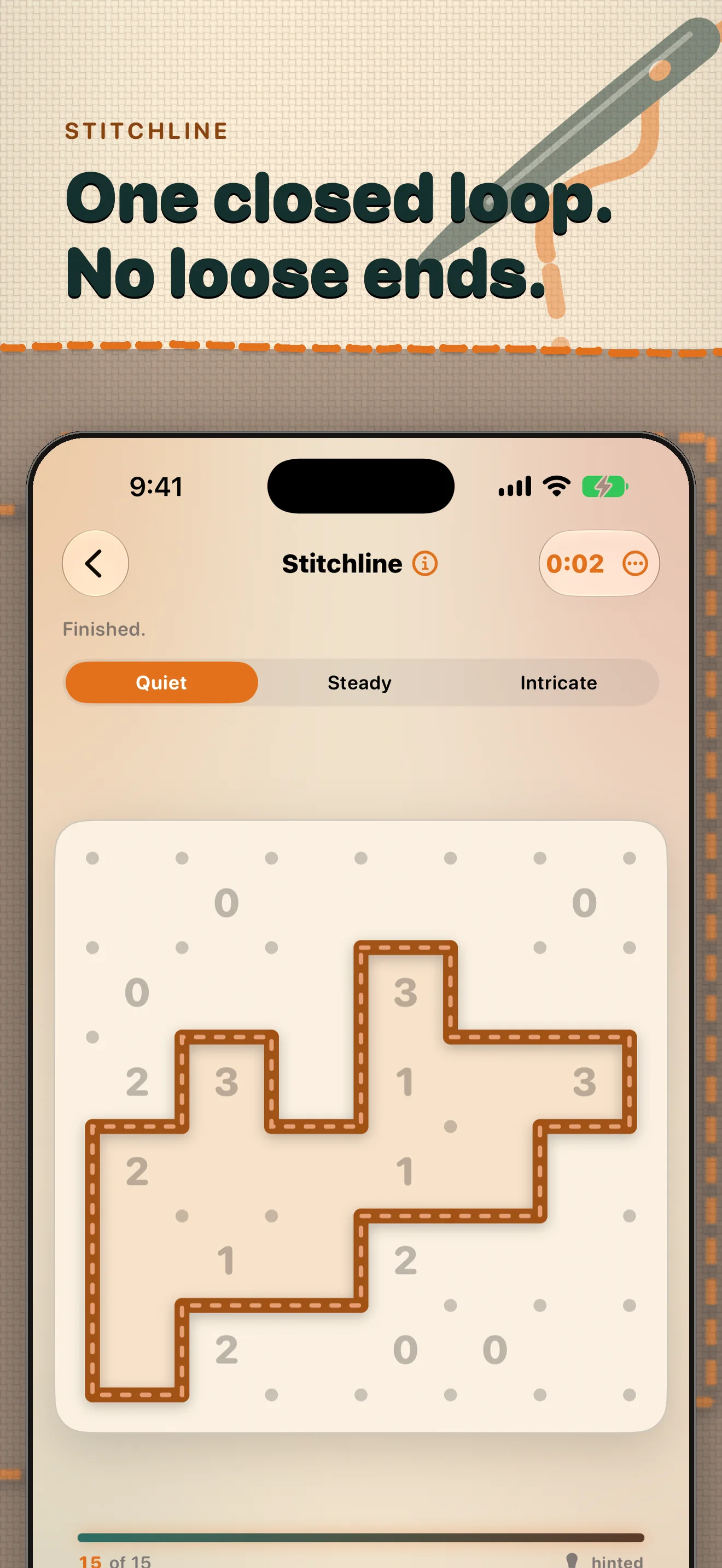
Patchwork asks you to reason about area and partition. Appliqué asks you to preserve connected colour regions. Piecing asks you to compare and combine tiles. Stitchline asks you to maintain a single loop. Rosette asks you to notice repetition and rotation. Buttons asks you to place exactly one button in every row, column, and outlined patch. Cross-Stitch asks you to compare ordered runs, while Gingham asks you to balance light and dark lines. Sprint is a separate timed activity for a quick burst. These descriptions explain the experience; they are not claims that one technique changes mood in every player. Coverlet’s techniques keep a family resemblance while changing what the eye and hand must track. Patchwork emphasises area and partition: a clue must belong to exactly one rectangle with the right number of cells. Appliqué asks the player to preserve connected colour regions. Piecing turns attention toward combinations and candidate arrangements. Stitchline asks the player to maintain a single loop while checking whether local choices remain globally possible. Rosette makes repetition and rotation more prominent. Buttons turns attention toward exact placement across rows, columns, and outlined patches. Sprint is a separate timed activity, changing the tempo when a quick burst sounds appealing. These descriptions can help a reader choose a board without pretending to predict a mood. Start with the mechanic you want to notice: boundaries, continuity, combinations, pattern, placement, or speed. If the visual surface feels too busy, choose a clearer or slower mode. If a timer increases pressure, leave Sprint for another moment. A technique is a lens for the puzzle, not a personality test.
Choice supports agency
Self-determination research suggests that autonomy and competence are central to satisfying motivation (Ryan & Deci, 2000). A multi-technique app can support that by letting a player choose a board that fits the moment. The choice might be a slower visual region, a familiar rectangle, or a short Sprint. The point is not to optimise a user; it is to let the user steer. Self-determination theory identifies autonomy, competence, and relatedness as important conditions for satisfying motivation (Ryan & Deci, 2000). The model does not prove that a particular puzzle technique will improve mood, but it offers a useful design vocabulary. Autonomy can mean deciding whether to play, selecting a technique, and stopping without penalty. Competence can mean understanding why a move works and recovering from a mistake. Relatedness can mean sharing a deduction or a finished quilt block, even when the main session is private. Ryan, Rigby, and Przybylski (2006) similarly examined how game features can support motivational experiences. A multi-technique app can make that agency visible by presenting alternatives rather than treating one mode as the correct route. The player is not being optimised. They are choosing a demand that fits their attention and energy. This distinction helps keep the article practical: use the game shelf to explore, not to diagnose your mood; treat a pleasant session as a personal experience, not as evidence of a universal effect.
Difficulty is a conversation
A challenge feels different when the player understands how to improve. A clear clue, a visible candidate, and a recoverable mistake keep difficulty inside a conversation: the board asks a question, the player tests an answer, and the next state explains what happened. Coverlet's demonstrations and guides are designed to make that conversation more legible. A challenge often feels more welcoming when the player can understand how to respond. A clear clue, a visible candidate, and recoverable feedback turn difficulty into a conversation: the board asks a question, the player tests an answer, and the next state explains what happened. When the interface hides the rule or makes an error feel final, the same numerical difficulty can feel more punishing. Coverlet’s guides and demonstrations can support a conversation by showing the shared rectangle logic before a player explores a different technique. Practical design details matter: keep targets large enough to use comfortably, label visual states, avoid relying on colour alone, and let the player pause or restart without embarrassment. A mode can be challenging without being hostile. If a board becomes frustrating, reduce the challenge, switch techniques, or take a break. There is no reliable reason to finish the hardest available puzzle simply because it is available. The best mode is the one that gives the player an intelligible next step.
Choose the mood you have
Do not choose the hardest board because it sounds virtuous. Choose the one that matches your attention. A quiet rectangle may be right after a long day; a loop may be right when you want a new visual rhythm; Sprint may be right when a timer sounds energising rather than stressful. The player is the authority on the fit. Before opening a board, ask what kind of attention you have rather than what kind of attention you should have. A quiet rectangle may fit a tired evening. A connected region may offer a fresh visual problem. A loop may suit someone who wants continuity and a clear global shape. A repeated pattern may feel playful, while Sprint may be welcome when a timer sounds energising rather than stressful. Try one board and observe the result: did the mechanic make you curious, settled, alert, or irritated? That observation is practical guidance, not a clinical measure. Research on games and emotion regulation describes potential benefits but also stresses variation in player goals and circumstances (Villani et al., 2018). If the fit is poor, change the activity without treating the choice as failure. A puzzle can be a small part of a good day, and a good day may contain no puzzle at all. Agency is the central mood-supporting feature: the player gets to decide what the moment needs.
Run a small personal experiment
Try each technique on a different day and write down three words afterward. Describe the mechanic first, then your response: for example, loop, clear, absorbed or timer, rushed, stop. This is not a mood scale or a research study. It is a way to notice whether the player's language matches the choice. If a mode repeatedly feels too activating, leave it aside; if another makes the rules easier to see, return to it. Change one condition at a time when possible, such as board size, time of day, or screen. The experiment should remain light enough that it does not turn play into homework. Research can explain why design and context may matter, but it cannot predict your personal fit in advance. Let your experience guide the next choice while keeping the conclusion local: this technique suited me in this situation, not this technique fixes everyone's mood.
Use the Coverlet game shelf to try each mode, then read the original technique guide for the shared design language.
References
APA 7 references for the research discussed in this article. Last checked 29 Aug 2026.
- Granic, I., Lobel, A., & Engels, R. C. M. E. (2014). The benefits of playing video games. American Psychologist, 69(1), 66–78. Source
- Ryan, R. M., Rigby, C. S., & Przybylski, A. (2006). The motivational pull of video games: A self-determination theory approach. Motivation and Emotion, 30(4), 344–360. Source
- Pallavicini, F., Ferrari, A., & Mantovani, F. (2018). Video games for well-being: A systematic review on the application of computer games for cognitive and emotional training in the adult population. Frontiers in Psychology, 9, 2127. Source
- Villani, D., Carissoli, C., Triberti, S., Marchetti, A., Gilli, G., & Riva, G. (2018). Videogames for emotion regulation: A systematic review. Games for Health Journal, 7(2), 85–99. Source
Keep reading