 Coverlet
Puzzles and healthy aging: what cognitive activity research suggests
Cognitive activity is associated with healthy aging in important studies. Association is not a promise, and an enjoyable puzzle is not a prescription.
By Mourad Hamdi · Last reviewed
Cognitive activity is one part of healthy aging
Healthy aging is not a single score and it is not a competition to remain mentally young. It includes physical health, sleep, mood, social connection, independence, purpose, access, and the ability to participate in activities that matter to a person. Puzzles can be one form of cognitive leisure, but they should sit alongside movement, relationships, learning, rest, and medical care rather than replace them. The evidence is also broader than any one app. Studies may examine reading, games, social activity, or a composite measure of cognitive engagement; their results cannot be transferred automatically to Coverlet. A respectful article should make the invitation inclusive: play because it is interesting, comforting, or socially meaningful, not because an older person owes anyone proof of mental fitness. Difficulty and pace should be adjustable, and taking longer should not be framed as failure. The goal is access to enjoyable activity, not a promise that a puzzle will prevent decline or diagnose a condition.
What observational studies say
Verghese and colleagues (2003) followed adults older than 75 and found that participation in cognitive leisure activities was associated with a lower risk of dementia. Wilson and colleagues (2013) likewise linked greater life-span cognitive activity with slower cognitive decline in a longitudinal clinical-pathologic cohort. These are important findings, but people are not randomly assigned to a lifetime of puzzles; health, education, mood, access, and many other factors can shape both activity and outcomes. Verghese and colleagues (2003) followed adults older than 75 and reported that participation in cognitive leisure activities was associated with a lower risk of dementia. Wilson and colleagues (2013) likewise linked greater life-span cognitive activity with slower cognitive decline in a longitudinal clinical-pathologic cohort. These studies are important because they suggest that mentally engaging activity may be related to later outcomes, but they are not randomized assignments to a lifetime of puzzles. People who have more access to activities may also differ in education, income, health, mood, social support, mobility, or early cognitive status. Reverse causation and confounding remain possible. The findings therefore support an encouraging association, not a guarantee or a prescription. They also do not identify a required dose, the best activity, or an outcome for a particular player. It is reasonable to say that keeping the mind engaged can be part of a rich life. It is not reasonable to say that completing Coverlet boards prevents dementia or that a person who does not play is failing to protect their brain.
What intervention studies add
Randomized training studies test a narrower question. Nouchi and colleagues (2012) reported short-term improvements after a brain-training intervention in older adults, while noting that long-term effects and everyday relevance were uncertain. Anguera and colleagues (2013) studied a custom multitasking game and found improvements that persisted for six months. Neither study tested Coverlet or proves that ordinary puzzle play prevents cognitive decline. Intervention research tests a narrower question and can help separate a program from a general association. Nouchi and colleagues (2012) reported short-term improvements in executive functions and processing speed after a randomized brain-training intervention in older adults, while noting uncertainty about long-term effects and everyday relevance. Anguera and colleagues (2013) studied a custom multitasking game and reported cognitive-control benefits that persisted for six months. Those results are useful precisely because they concern defined games, schedules, participants, and measurements. Neither study tested Coverlet, and neither proves that ordinary puzzle play prevents cognitive decline. A reader should ask whether the intervention resembles the activity being recommended, whether the outcome matters in daily life, how long the effect lasted, and whether the study included people with similar needs. This careful reading does not make the research less hopeful. It makes the hope more honest. A leisure puzzle may be worth doing for enjoyment and practice even when the research cannot justify a broad health claim.
Design for access, not deficit
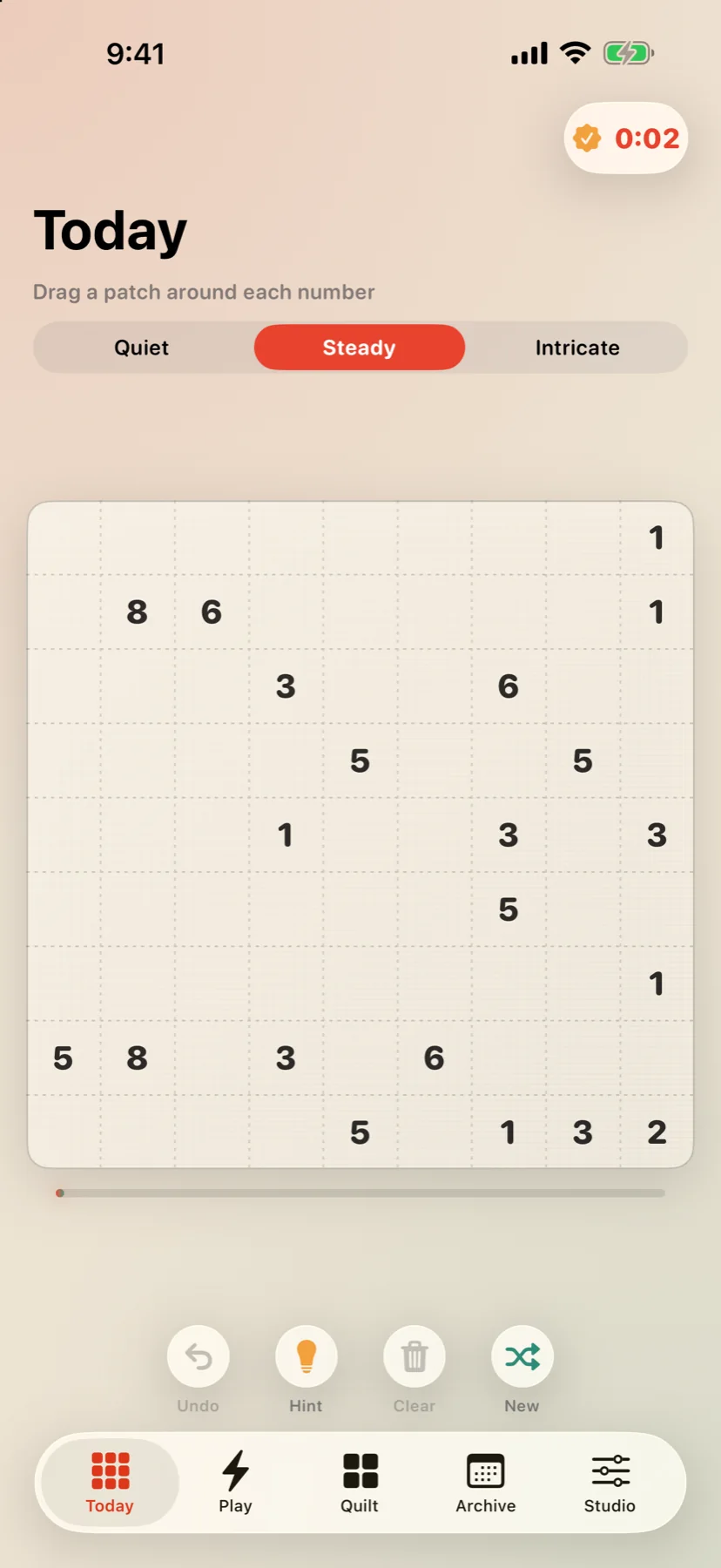
A welcoming puzzle should use legible type, strong contrast, predictable touch targets, clear error recovery, and an adjustable pace. It should not imply that a player is failing if a board takes longer. Coverlet's iPhone and iPad surfaces are designed around readable constraints and private progress so that the experience can remain personal rather than competitive. A welcoming puzzle begins with practical access. Use legible type, strong contrast, stable layouts, predictable touch targets, clear focus and selection states, and feedback that does not rely on colour alone. Give the player time to inspect a clue and make mistakes recoverable without shame. On a phone, a large target and a concise instruction may matter more than decorative complexity; on an iPad, generous spacing can make relationships easier to see. Accessibility is not a special mode for a presumed deficit. It is good design for tired eyes, changing lighting, unfamiliar interfaces, different motor control, and anyone who wants a calmer experience. Coverlet’s private progress and lack of competitive pressure can support that approach, but the site should not claim that the app is clinically accessible for every condition without evidence. Practical guidance is better: increase text size where available, use the device’s accessibility settings, try a slower technique, and stop when vision or concentration becomes uncomfortable. The player should control the pace and the meaning of the session.
Know when to seek care and keep play optional
If you or someone close to you is worried about memory, attention, mood, confusion, or changes in daily functioning, speak with a qualified clinician. A game cannot assess a person’s health and should never be offered as a substitute for evaluation. It is also fine for a healthy older adult to dislike puzzles or to prefer another activity. The strongest practical use of Coverlet is optional and personal: choose a board that feels inviting, play with a friend or alone, allow extra time, and let completion be satisfying without making it a duty. Ask what the player enjoys and what would make the interface easier. A puzzle can become a conversation, a small routine, or a visual record of time spent; research on cognitive activity cannot tell us which meaning will matter to each person. Healthy aging guidance should therefore combine encouragement with humility. Make room for curiosity, rest, movement, connection, and professional advice. The app can offer one accessible leisure option, not a promise about a person’s future.
Make the invitation inclusive
A practical invitation for older players should begin with preference, not fear. Ask whether the person likes visual problems, number puzzles, routines, or shared activities. Offer a larger screen, more light, a comfortable chair, and enough time to explore the rule. If the player finds the board tiring, change the setup or choose another activity rather than insisting that persistence is protective. Family members and carers should avoid presenting a puzzle as a test of memory or a way to prove independence. Celebrate curiosity and participation, not speed. A clinician can help interpret changes in memory or functioning; a game cannot. The research on leisure and training supports keeping cognitive activity in a broad, active life, but it does not identify one app as necessary. The most respectful outcome is that a person gets another enjoyable option and retains control over whether, when, and how they use it.
Try the accessible rectangle introduction in how to play the logic behind Coverlet, then explore the app page for the privacy and platform details.
References
APA 7 references for the research discussed in this article. Last checked 29 Aug 2026.
- Verghese, J., Lipton, R. B., Katz, M. J., Hall, C. B., Derby, C. A., Kuslansky, G., Ambrose, A. F., Sliwinski, M., & Buschke, H. (2003). Leisure activities and the risk of dementia in the elderly. New England Journal of Medicine, 348(25), 2508–2516. Source
- Wilson, R. S., Boyle, P. A., Yu, L., Barnes, L. L., Schneider, J. A., & Bennett, D. A. (2013). Life-span cognitive activity, neuropathologic burden, and cognitive aging. Neurology, 81(4), 314–321. Source
- Nouchi, R., Taki, Y., Takeuchi, H., Hashizume, H., Akitsuki, Y., Shigemune, Y., Sekiguchi, A., Kotozaki, Y., Tsukiura, T., Yomogida, Y., & Kawashima, R. (2012). Brain training game improves executive functions and processing speed in the elderly: A randomized controlled trial. PLoS ONE, 7(1), e29676. Source
- Anguera, J. A., Boccanfuso, J., Rintoul, J. L., Al-Hashimi, O., Faraji, F., Janowich, J., Kong, E., Larraburo, Y., Rolle, C., Johnston, E., & Gazzaley, A. (2013). Video game training enhances cognitive control in older adults. Nature, 501(7465), 97–101. Source
Keep reading