 Coverlet
Shikaku and Coverlet: what is the difference?
The shared idea is simple: divide a grid into rectangles whose areas match the numbers. Coverlet builds a broader daily game around that satisfying logic.
By Mourad Hamdi · Last reviewed
The shared rectangle idea
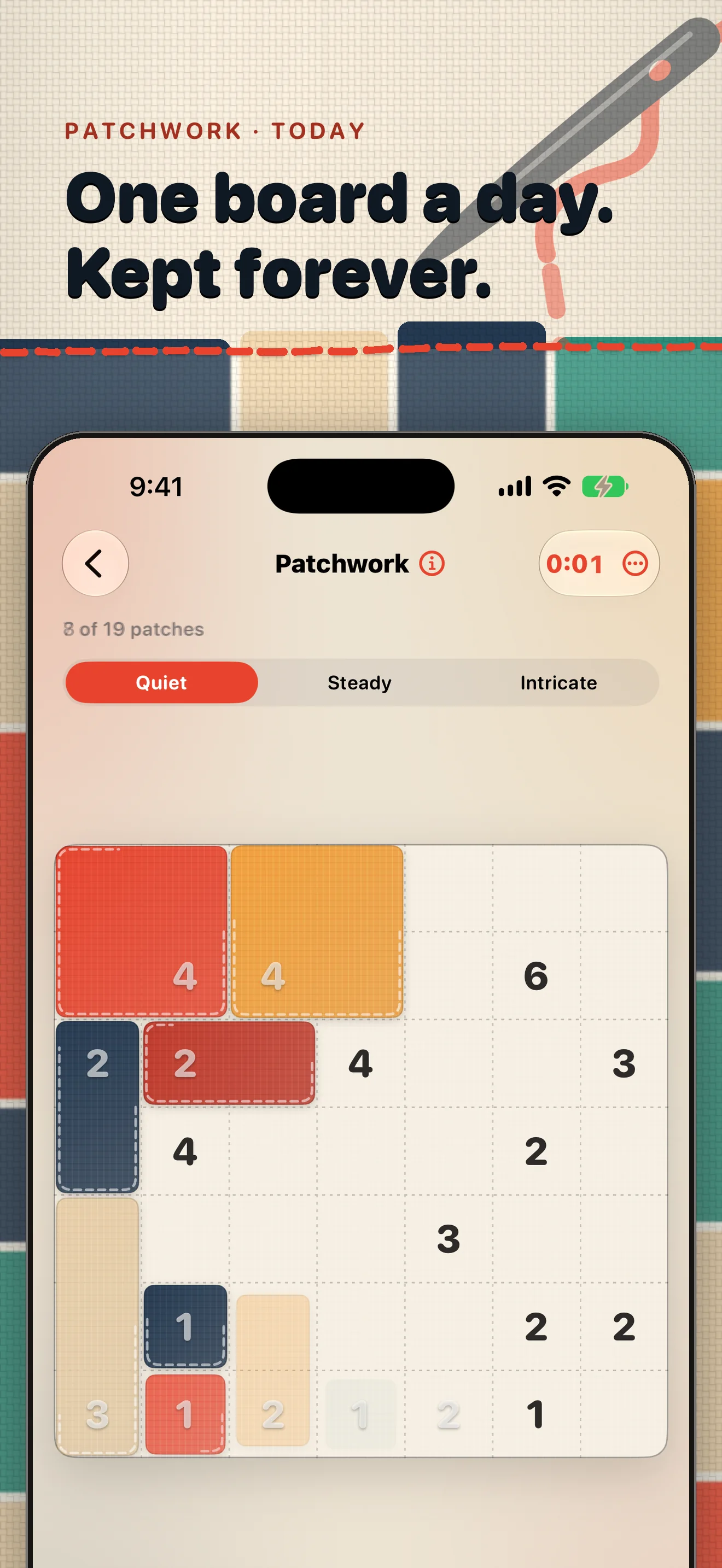
Shikaku and Coverlet Patchwork begin with the same satisfying translation: a number on a grid is an area, and that area must belong to one rectangle. A clue marked 6 might fit a 1x6 strip, a 2x3 rectangle, or a rotated version of either shape, depending on the board. The solve is not about placing the digit 6 in a row or column. It is about deciding which cells the clue owns. Every rectangle must contain one clue, rectangles cannot overlap, and the completed board must have no empty cells. That gives the puzzle its characteristic rhythm: list plausible shapes, remove the shapes that cannot fit, and use each confirmed rectangle to constrain its neighbours. Coverlet's Shikaku vocabulary guide explains this shared language in more detail. The important point is that Patchwork is recognisable to someone who already enjoys Shikaku, while remaining approachable to someone meeting rectangle-area logic for the first time.
What a Shikaku solve emphasizes
A traditional Shikaku session is usually about the partition itself. You open a board, inspect the clues, and work toward one complete arrangement of rectangles. The board is the whole story. A good move is one you can justify from the geometry: a corner clue may have only one legal orientation, or a large area may have so few factor pairs that the edge of the board removes every alternative. The satisfaction comes from watching a set of local decisions become a globally consistent partition. There is no need to make the puzzle decorative or to add a second reward layer for the spatial logic to work. If you want a focused solving method, the beginner strategy guide is the direct next step. It treats area counting, edge clues, candidate shapes, and propagation as a repeatable method rather than a collection of lucky observations.
What Coverlet adds around the logic
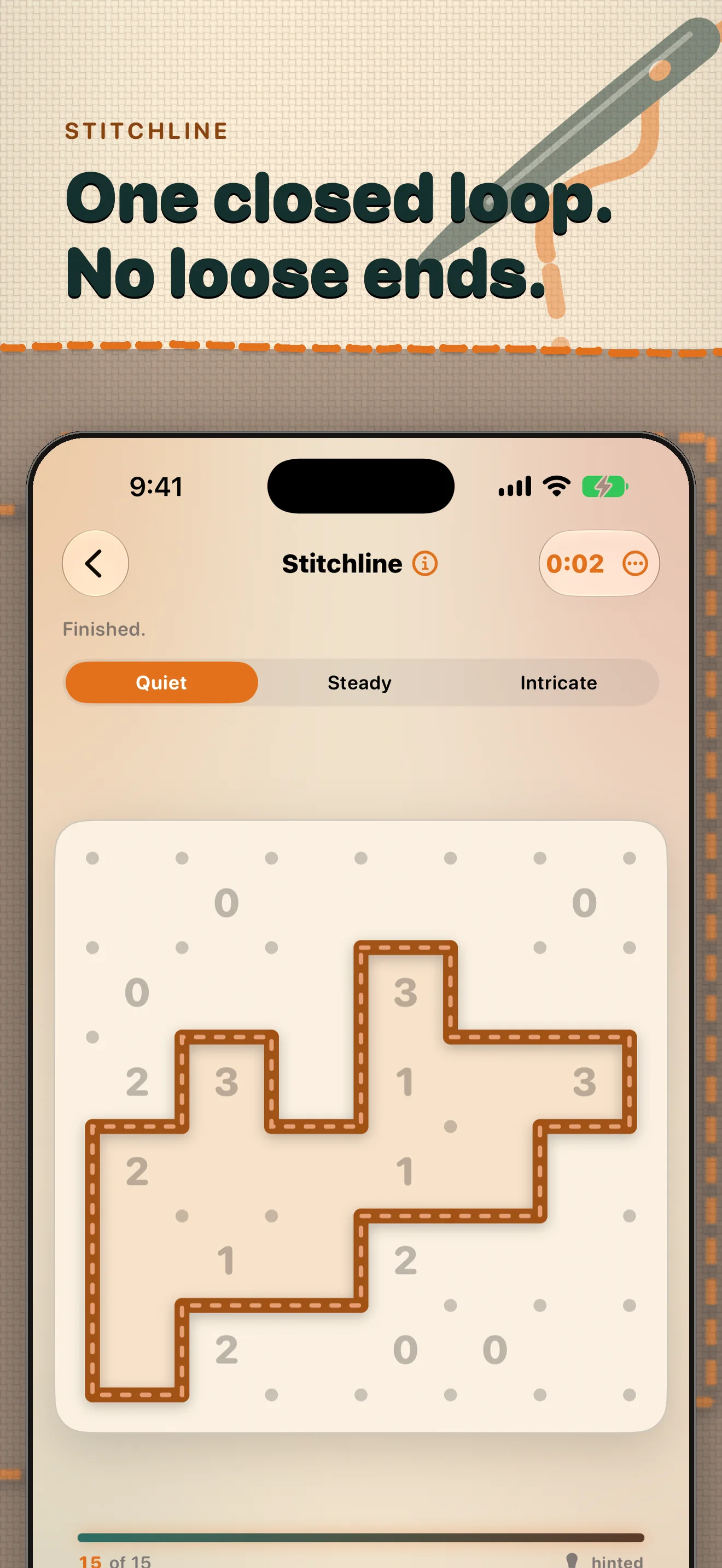
Coverlet puts that rectangle logic inside a broader daily game. The app presents a daily board in each of eight techniques, with Quiet, Steady, and Intricate sizes, so the amount of board in front of you can match the time you have. A completed solve does not simply disappear when you close the board: it becomes a block in a personal quilt. That quilt is a visual record of finished work, not a claim that every session needs to become a competition. Coverlet also includes other techniques—Appliqué, Piecing, Stitchline, and Rosette—so the rectangle-and-area idea is one doorway into a larger set of puzzle moods. The eight-technique guide is useful when you understand Patchwork but want to know what changes in the other modes. The result is not a different definition of Shikaku; it is a daily app experience built around one related rectangle logic technique among several.
What stays different
It is useful to keep the names separate. Calling Coverlet Patchwork Shikaku-style rectangle logic describes the shared deduction, but Coverlet is not presented as a generic catalogue of every Shikaku board. Its product layer includes a daily ritual, a quilt, multiple techniques, and app-specific choices such as on-device generation for the core game. The visual language also matters. In a standalone Shikaku puzzle, the main question may be how to complete the partition. In Coverlet, you may begin with Patchwork and later choose a connected colour region, a line loop, a tile deduction, or a pattern board. The underlying experience is still careful constraint solving, but the object of attention changes. If you are comparing the two because you want to learn the rule, start with Patchwork. If you are comparing them because you want a wider daily app, read the Coverlet app page and check the current platform and privacy details there.
Which starting point fits you?
Choose a Shikaku guide when you want a clear explanation of the rectangle-area rule, a worked example, or a comparison with other classic logic formats. Choose Coverlet when you want that same kind of spatial deduction inside a daily iPhone and iPad game that keeps completed boards in a quilt. You do not have to decide by genre label alone. Try one small rectangle board and notice what you enjoy: generating candidate shapes, reading the edge, or seeing the final partition lock together. Then decide whether you want to keep practising the same logic or explore another Coverlet technique. The comparison guide can help place Shikaku among other constraint puzzles, while the game shelf shows the other Coverlet modes. The practical difference is simple: Shikaku names the rectangle puzzle idea; Coverlet uses that idea as part of a wider, private daily ritual.
Use the difference as a filter
The comparison becomes most useful when it answers a concrete choice. If you want to learn one rule in isolation, read the Shikaku explanation and work through a small example without worrying about daily progress. If you want a repeatable app ritual, open Coverlet and decide whether Patchwork is the right first technique or whether another mode better matches your attention. If you want both, there is no conflict: learn the shared rule from the guided introduction, practise the rectangle reasoning in Patchwork, and then let the quilt give the completed board a place to remain. This sequence keeps terminology honest. You are not claiming that every Shikaku puzzle has the same presentation as Coverlet, and you are not overlooking the fact that Coverlet includes more than one technique. You are choosing the right layer for the question you have today: definition, practice, or a wider daily game.
If you want to practise the shared rectangle logic, open Coverlet Patchwork, then explore the full app experience when you want more than one technique.
Keep reading