 Coverlet
Why finishing a small puzzle feels so satisfying
The pleasure is not only in being right. It is in seeing a problem become legible, manageable, and finally complete.
By Mourad Hamdi · Last reviewed
Completion is a signal, not just a score
When the final cell fits, the board gives you a clean signal: the rules were understood, the choices were consistent, and the task is finished. That is different from an endless feed in which the next challenge is always waiting. The signal can feel satisfying because it closes a small loop of intention, effort, and confirmation.
Competence needs a visible path
Self-determination theory describes competence as the experience of being effective in an activity, alongside autonomy and relatedness (Ryan & Deci, 2000). In game research, need satisfaction is one explanation for why a well-designed challenge can feel intrinsically motivating (Ryan et al., 2006; Przybylski et al., 2010). A readable Coverlet board supports that path by showing the clue, the candidate shape, the consequence, and the finished patch without hiding the reasoning behind spectacle.
Good feedback explains instead of scolding
A satisfying puzzle does not merely announce correct or incorrect. It helps a player understand what changed: an edge constrained the rectangle, a completed region removed candidates, or a final check found a gap. Explanation turns feedback into learning and protects the feeling that the solve belongs to the player. That is the difference between competence and a lucky tap.
The quilt makes time visible
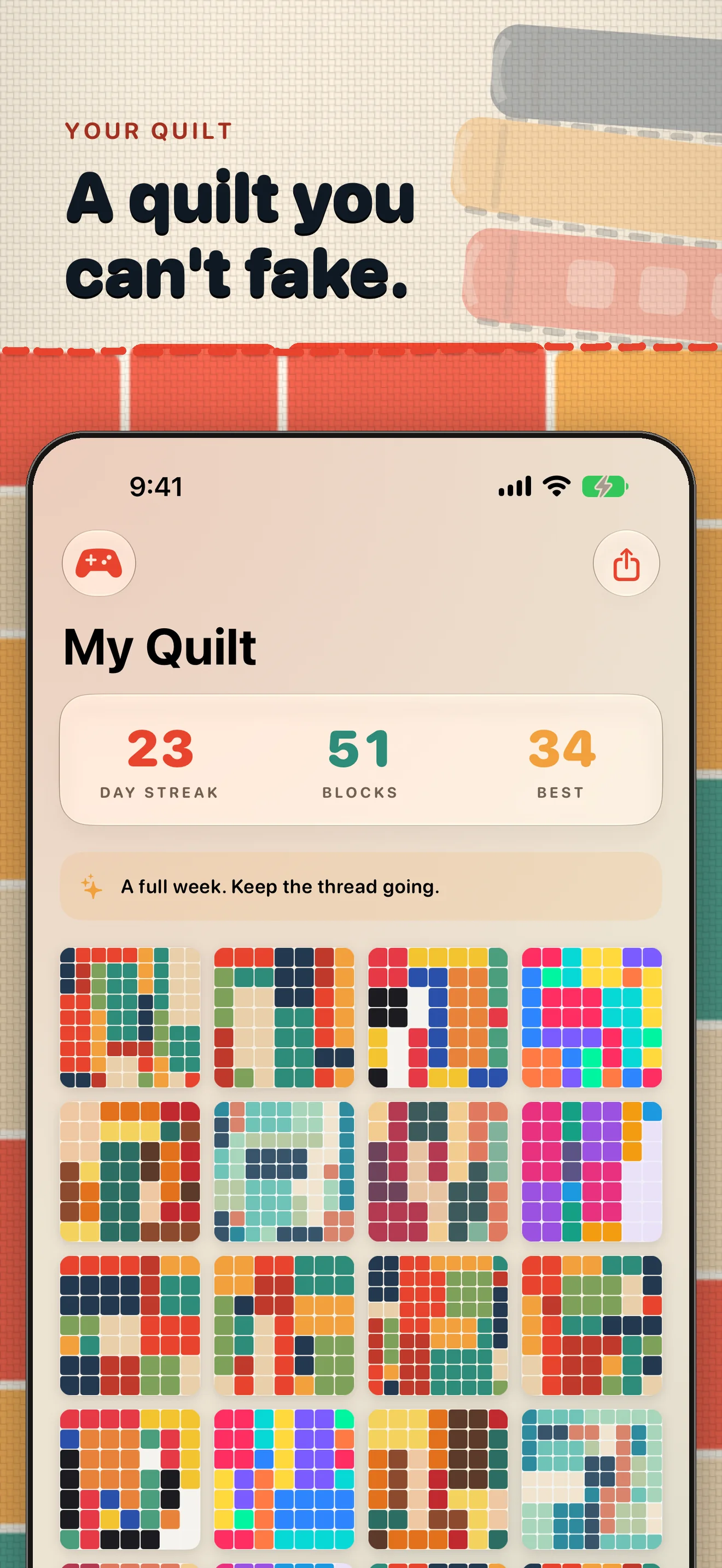
Coverlet adds a gentle second layer after the board: the completed solve becomes a block in a private quilt. This does not make the puzzle more important; it gives the finished moment somewhere to go. A person can look back and see continuity without being asked to compare their performance with everyone else.
Stop at the good ending
The most humane reward may be permission to stop. A board that ends clearly can fit into a commute, a break, or a quiet evening without converting every success into another obligation. If a puzzle leaves you feeling capable and finished, close it there. A small complete experience is allowed to be enough.
Completion is a signal, not just a score
When the final cell fits, a small puzzle gives you a clean signal: the rules were understood, the choices were consistent, and the task is finished. That signal is different from a score that can always be improved or a feed that immediately replaces one challenge with another. The satisfaction often comes from seeing uncertainty become structure. At the beginning, several rectangles or moves may be possible. By the end, the board shows why the path worked. This is a modest experience, but it has a complete shape: intention, effort, feedback, and closure. The feeling does not require a large reward or a public record. In fact, a small board can make the boundary more visible because the player can see the whole problem and the exact moment it resolves. That is why the best completion screen is often simple. It should confirm what happened, preserve the result if the player wants it, and avoid turning a finished moment into an automatic demand to continue.
Competence needs a visible path
Self-determination theory describes competence as the experience of being effective in an activity, alongside autonomy and relatedness (Ryan & Deci, 2000). In game research, satisfaction of these needs is one explanation for why a well-matched challenge can feel intrinsically motivating (Ryan et al., 2006; Przybylski et al., 2010). A puzzle supports that path when the player can connect a clue to a constraint, a constraint to a choice, and a choice to a visible consequence. If the board is opaque, success may feel accidental. If it is trivial, there is no discovery. The satisfying middle is not identical for everyone, so a thoughtful game gives players ways to find a suitable pace. Coverlet's Quiet, Steady, Intricate, and Sprint shapes reflect that design intention, but they should be understood as options rather than a tested psychological intervention. The important part is the relationship between effort and understanding. A player should be able to look back at a solve and say, I can see why that worked.
Good feedback explains instead of scolding
A satisfying puzzle does not merely announce correct or incorrect. It helps the player understand what changed. An edge may have forced a rectangle orientation. A completed region may have removed candidates nearby. A final check may reveal a gap that points back to an earlier boundary. This kind of feedback turns the result into information. It also protects ownership: the player is not being rescued by a hidden hint or punished by a mysterious error state. The interface can be gentle without being vague. Use clear labels, distinguish selected cells from completed cells, and make recovery possible. If a mistake can be undone without losing the whole board, the player can continue reasoning instead of defending a past tap. That matters for satisfaction because the emotion is not only relief at being right. It is the recognition that the problem became more legible through your own attention. A polished animation can celebrate the last move, but explanation is what makes the celebration feel earned rather than random.
The quilt makes time visible
Coverlet adds a second layer after the board: the finished solve becomes a block in a private quilt. That archive does not change the logic of the puzzle, but it gives the completed moment somewhere to go. A person can look back and see continuity without being asked to compare performance with a public leaderboard. The reward is cumulative in a quiet way. One block is small; a row begins to show a pattern; a month becomes a record of returning. This is different from an endless progress bar because the visible result is made of completed things rather than an unfinished obligation. The design should keep that boundary intact. A quilt should not require a perfect streak to be meaningful, and a missed day should not erase the value of previous work. Research on play and well-being does not establish that this specific archive improves happiness, but it does support a cautious interest in how game structure, motivation, and emotional context can vary (Johannes et al., 2021; Granic et al., 2014). The product can offer a place for meaning without claiming to manufacture it.
Stop at the good ending
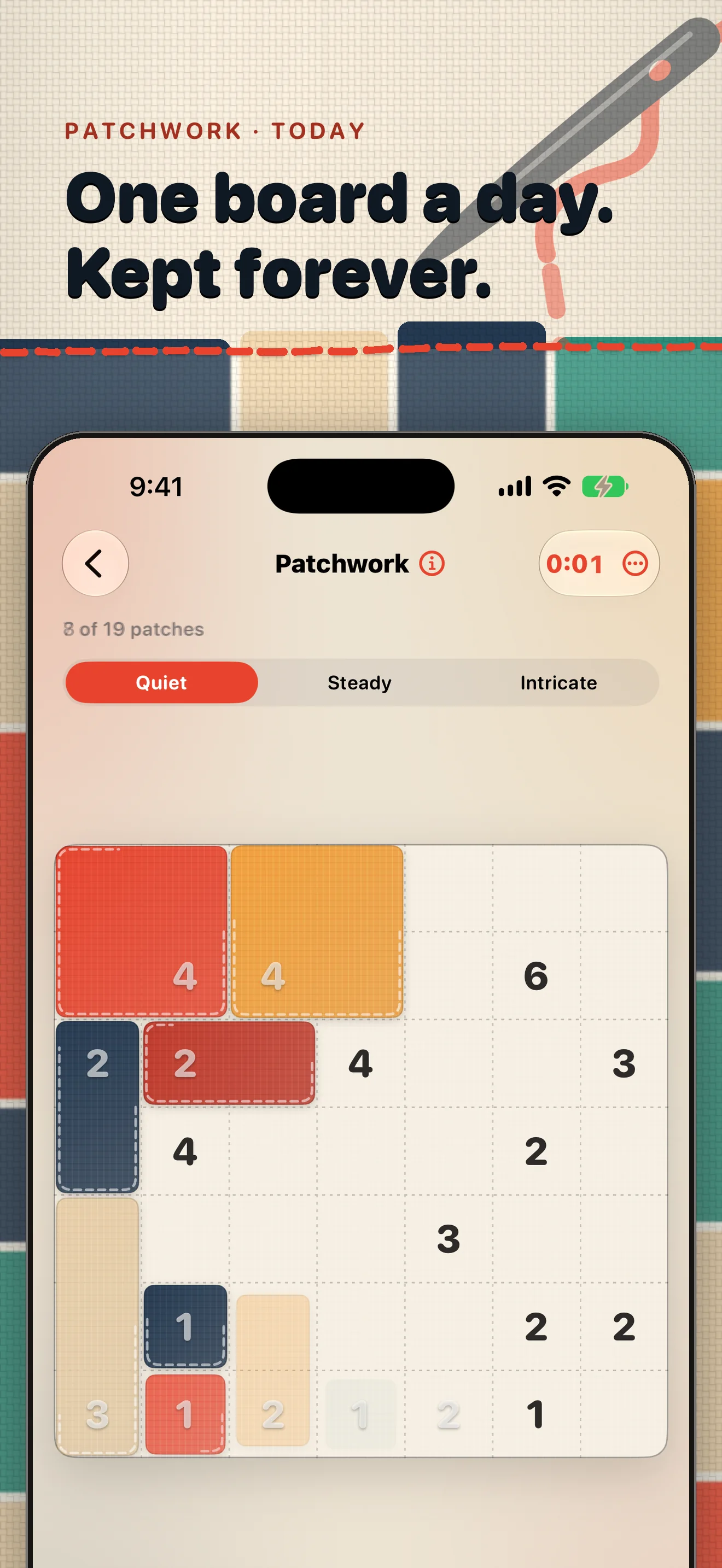
The most humane reward may be permission to stop. A board that ends clearly can fit into a commute, a break, or a quiet evening without converting every success into another obligation. If the puzzle feels satisfying, that feeling can be complete even when there is no next action. Try noticing the moment your attention changes from solving to chasing. If you are continuing because the next board is genuinely appealing, continue. If you are continuing because the interface suggests that stopping wastes momentum, close it. This boundary is part of the design quality. A small puzzle is not valuable because it occupies more time; it is valuable when the time has a shape you chose. Coverlet's Patchwork completion loop and private quilt are built around that idea: solve a bounded problem, see the result, and let the finished block be enough for today. The same principle applies to the way the result is presented. A completion message can celebrate the player's reasoning, show what was finished, and offer a reset without placing a louder reward, timer, or social comparison in the way. Players should be able to close the page and return later without losing dignity or progress. The satisfaction belongs to the completed act, not to the number of sessions a product can extract afterward.
Try the completion loop in Coverlet Patchwork, then see how the same design idea changes across eight daily puzzle techniques.
References
APA 7 references for the research discussed in this article. Last checked 29 Aug 2026.
- Ryan, R. M., & Deci, E. L. (2000). Self-determination theory and the facilitation of intrinsic motivation, social development, and well-being. American Psychologist, 55(1), 68–78. Source
- Ryan, R. M., Rigby, C. S., & Przybylski, A. (2006). The motivational pull of video games: A self-determination theory approach. Motivation and Emotion, 30(4), 344–360. Source
- Przybylski, A. K., Rigby, C. S., & Ryan, R. M. (2010). A motivational model of video game engagement. Review of General Psychology, 14(2), 154–166. Source
- Johannes, N., Vuorre, M., & Przybylski, A. K. (2021). Video game play is positively correlated with well-being. Royal Society Open Science, 8(2), 202049. Source
Keep reading