 Coverlet
Apple Watch puzzle games: what makes a good wrist-sized logic game
The best Apple Watch puzzle is not a shrunken iPhone game. It is a small, legible question that fits the moment your wrist can actually give it.
By Mourad Hamdi · Last reviewed
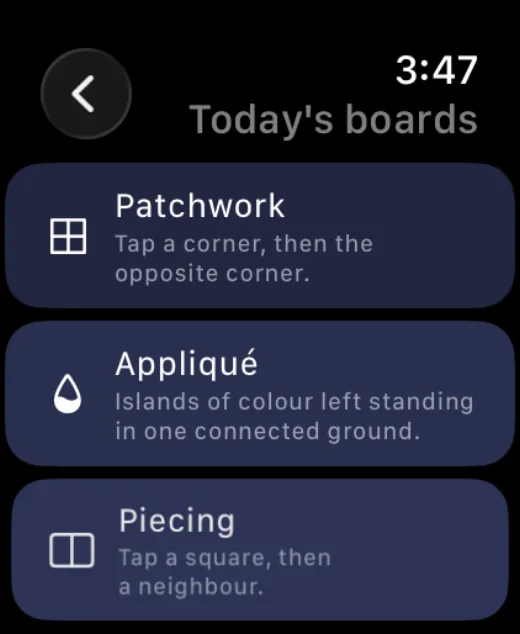
An Apple Watch is not a mini phone
A watch is worn, glanced at, and interrupted. The player may be standing, walking, talking, or checking the screen for only a few seconds. A puzzle that works beautifully on iPhone can fail on the wrist if it requires dense notation, tiny controls, long text, or a remembered chain of hypothetical moves. Apple’s game guidance treats watchOS as its own interaction environment, with touch as the core input assumption (Apple, n.d.). Start there: design for a small, direct question rather than shrinking a large interface.
Make the state legible at a glance
A watch player should be able to answer three questions quickly: what am I solving, what have I already done, and what is the next available action? Use strong hierarchy, stable cell positions, clear selected states, and feedback that does not depend on colour alone. A compact board can still be rigorous if its constraint is visible. It should not ask the player to open a help screen every time the wrist turns away.
Choose tap-first mechanics
Direct taps are more reliable on a watch than long drags, edge gestures, or interactions that require two-handed precision. A good wrist puzzle gives each target enough room, provides immediate confirmation, and makes undo easy to find. If a mode requires a larger canvas, reduce the board, change the rule, or move the full solve to the phone rather than letting the watch version become a test of motor accuracy. The device is telling you what the mechanic should become.
Treat interruption as a normal exit
The watch is often used between other tasks, so the board should tolerate an unfinished moment. A player should be able to solve one small part, raise the wrist again later, and understand the same state. Research on games and recovery suggests that play can be part of a transition after strain, but the fit depends on the context and the person (Reinecke, 2009). A watch puzzle should therefore offer a bounded pause, not a demand to preserve a streak at all costs.
Explain standalone play and local progress precisely
“Works on Apple Watch” can mean several things: the app is installed on the watch, the phone can send a board, the watch can calculate a board, or the watch can preserve progress without the phone. State which one is true. Coverlet’s platform guide describes a standalone watch app with compact daily boards, a local solve ledger, and explicit WatchConnectivity snapshots rather than pretending that an iPhone App Group is shared across devices. That level of detail helps people decide whether the watch is a real companion for travel or only a remote control.
Use complications for a useful glance
A complication should answer one small question: is today’s board waiting, in progress, or complete? It should not turn every palette change or menu tap into a notification. Keep updates meaningful and let the player decide whether to open the full app. A quiet progress cue can support a routine; a constant reminder can turn leisure into obligation. The product’s tone matters as much as the implementation.
Where Coverlet fits on the wrist
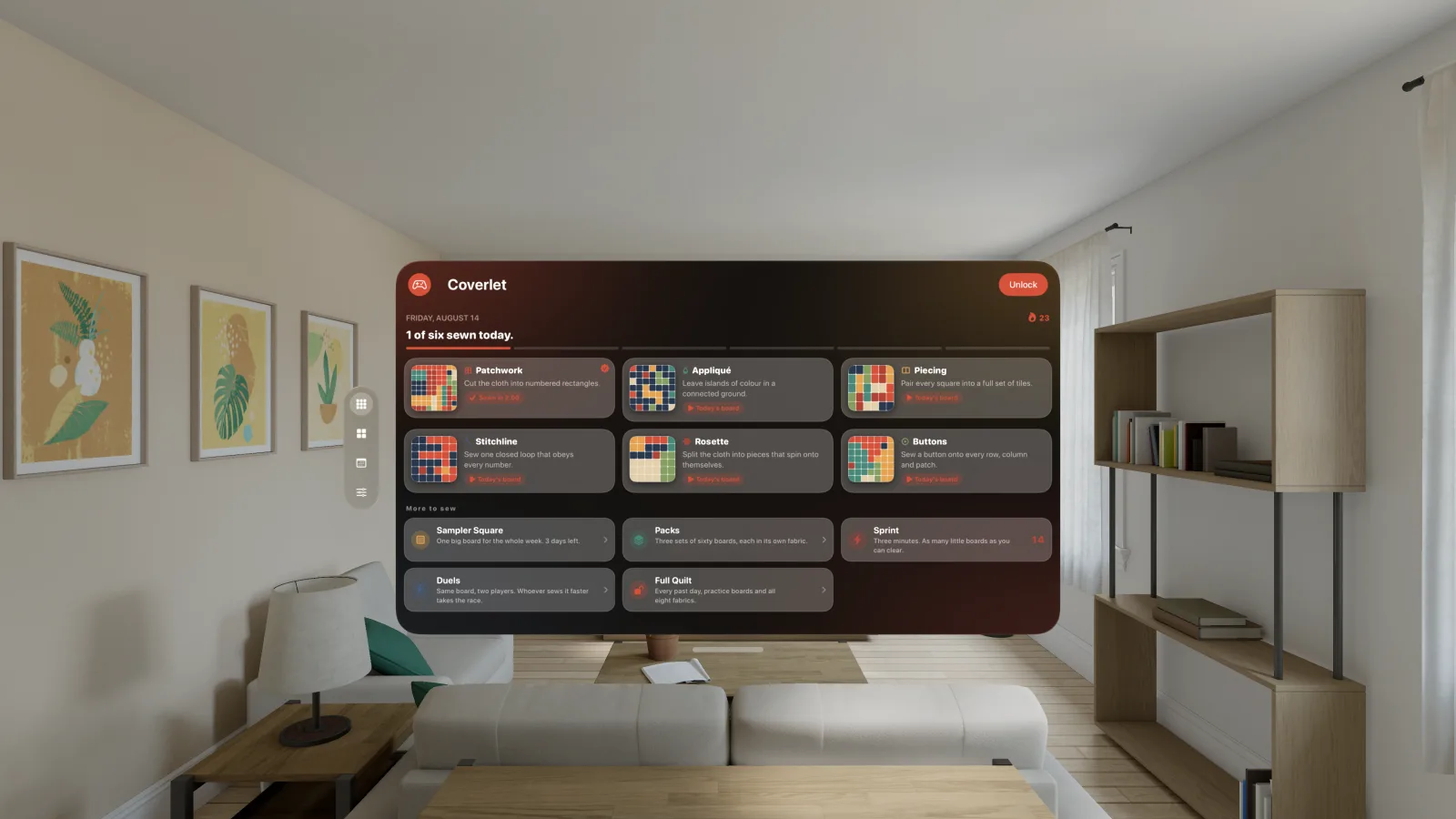
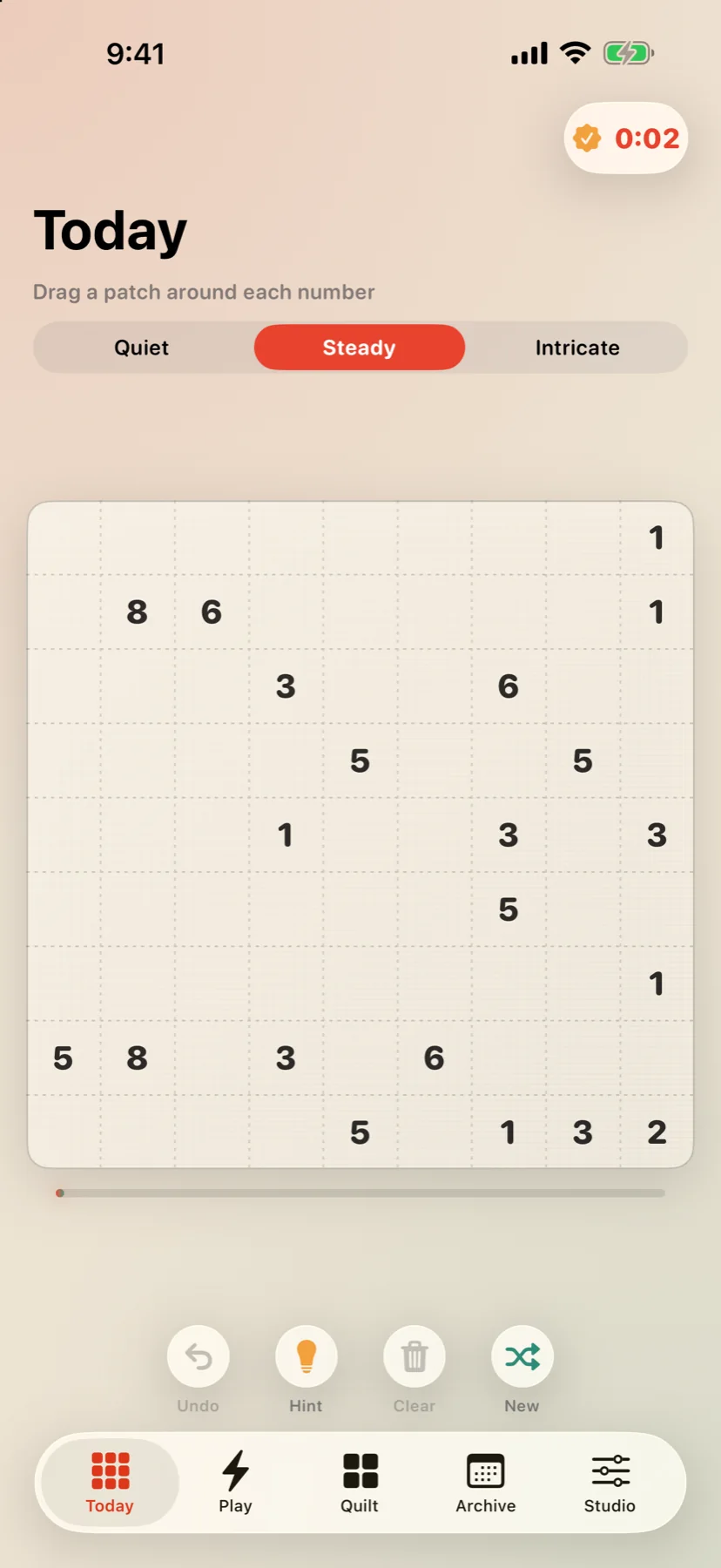
Coverlet’s watch experience is described as its own small product: compact boards, direct taps, local progress, complications, and a daily shelf that is separate from the larger iPhone and iPad layouts. The current watch surface carries seven techniques, with Gingham added in 2.1; the Apple Watch platform page states that boundary precisely. The design promise is consistent across versions: use the wrist for a complete, readable piece of logic, then return to the larger screen when you want the full quilt, archives, or broader comparison.
A simple Apple Watch evaluation
Open the board while standing. Can you tell what the rule is without reading a paragraph? Can you tap a target without covering a neighbour? Can you pause and return after a few minutes? Does the board feel pleasant without a timer? Can the app explain what is local and what needs the phone? If the answers are yes, the game is using the watch’s strengths. If not, keep the watch for progress and move the deep solve to iPhone or iPad.
Compare the wrist experience with the full Apple platform guide, then see how Coverlet’s daily shelf begins on iPhone.
References
APA 7 references for the research discussed in this article. Last checked 29 Aug 2026.
- Apple. (n.d.). Designing for games. Apple Developer. Retrieved August 25, 2026, from https://developer.apple.com/design/human-interface-guidelines/designing-for-games/ Source
- Ryan, R. M., Rigby, C. S., & Przybylski, A. (2006). The motivational pull of video games: A self-determination theory approach. Motivation and Emotion, 30(4), 344–360. Source
- Reinecke, L. (2009). Games and recovery: The use of video and computer games to recuperate from stress and strain. Journal of Media Psychology, 21(3), 126–142. Source
Frequently asked
Questions about this puzzle
What makes a good puzzle game for Apple Watch?
It should be readable at a small size, use tap-sized targets, explain its state without scratch space, and remain satisfying when interrupted after a short session.
Can an Apple Watch puzzle game work without the iPhone nearby?
Some watch apps support standalone play and local progress, while others depend on the companion phone. Check the product’s platform documentation rather than assuming that a watch icon means independent play.
Does Coverlet support Apple Watch?
Coverlet’s current product and platform guide describe an Apple Watch destination with compact, tap-first puzzle boards, local progress, and complications included with the iPhone product.
Should a watch puzzle use a timer?
Only when the player chooses that kind of pressure. A glanceable board usually benefits more from a clear stopping point than from adding a clock to every interaction.
Keep reading