 Coverlet
Do logic puzzles improve your brain? A careful evidence guide
Puzzles can exercise the processes they require. That is useful—and much narrower than promising a universal brain upgrade.
By Mourad Hamdi · Last reviewed
Start with near transfer and far transfer
If practising a task improves performance on a similar task, researchers often call that near transfer. Far transfer means improvement on a different ability or in everyday life. A logic puzzle can plausibly sharpen familiarity with its own constraints; that does not automatically mean it will improve memory, work performance, or general intelligence.
What training studies actually find
Oei and Patterson (2013) found that different game genres improved different tasks, with gains often tied to processes the games repeatedly required. A meta-analysis by Powers and colleagues (2013) likewise reported that results differed by cognitive domain and study design. The lesson is not that games do nothing; it is that the outcome must match the demand.
Why genre and mechanics matter
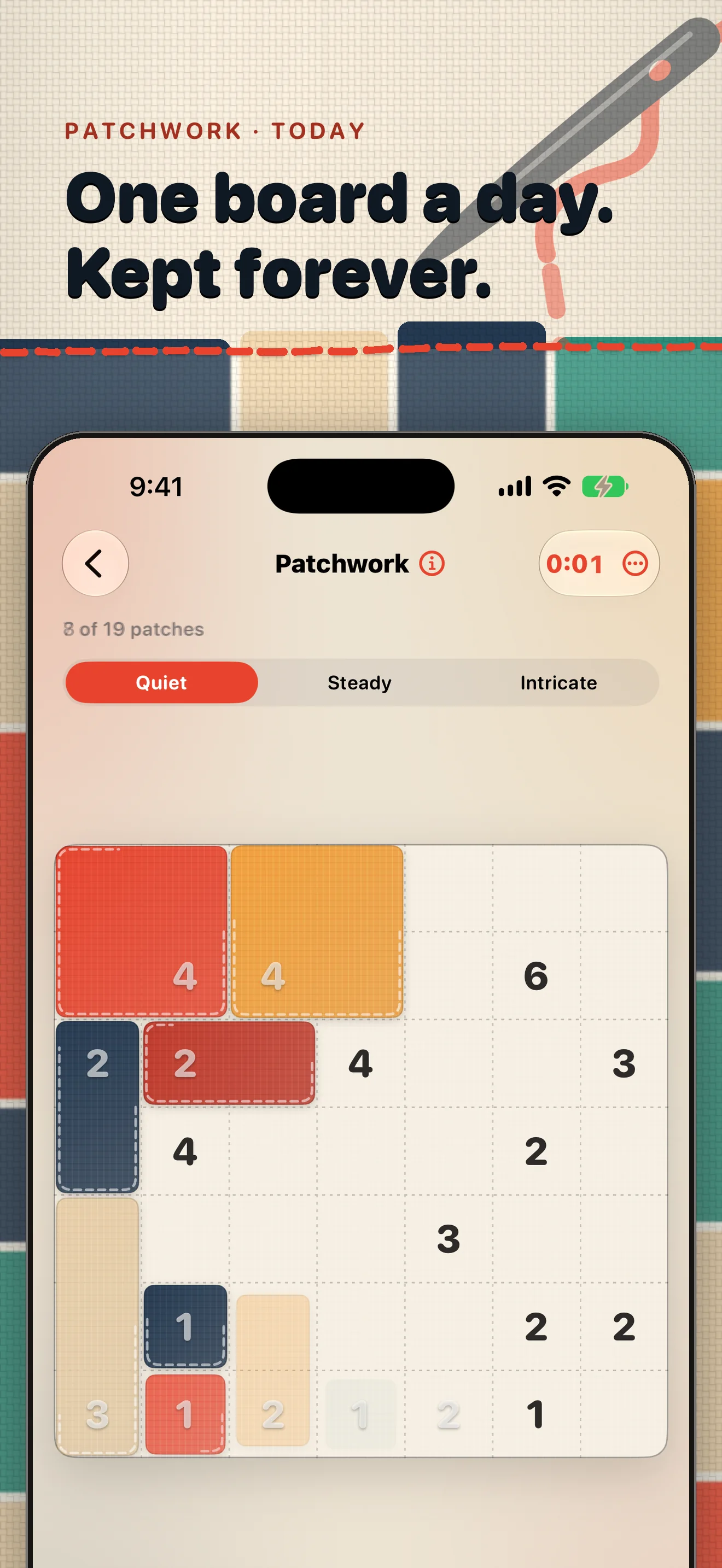
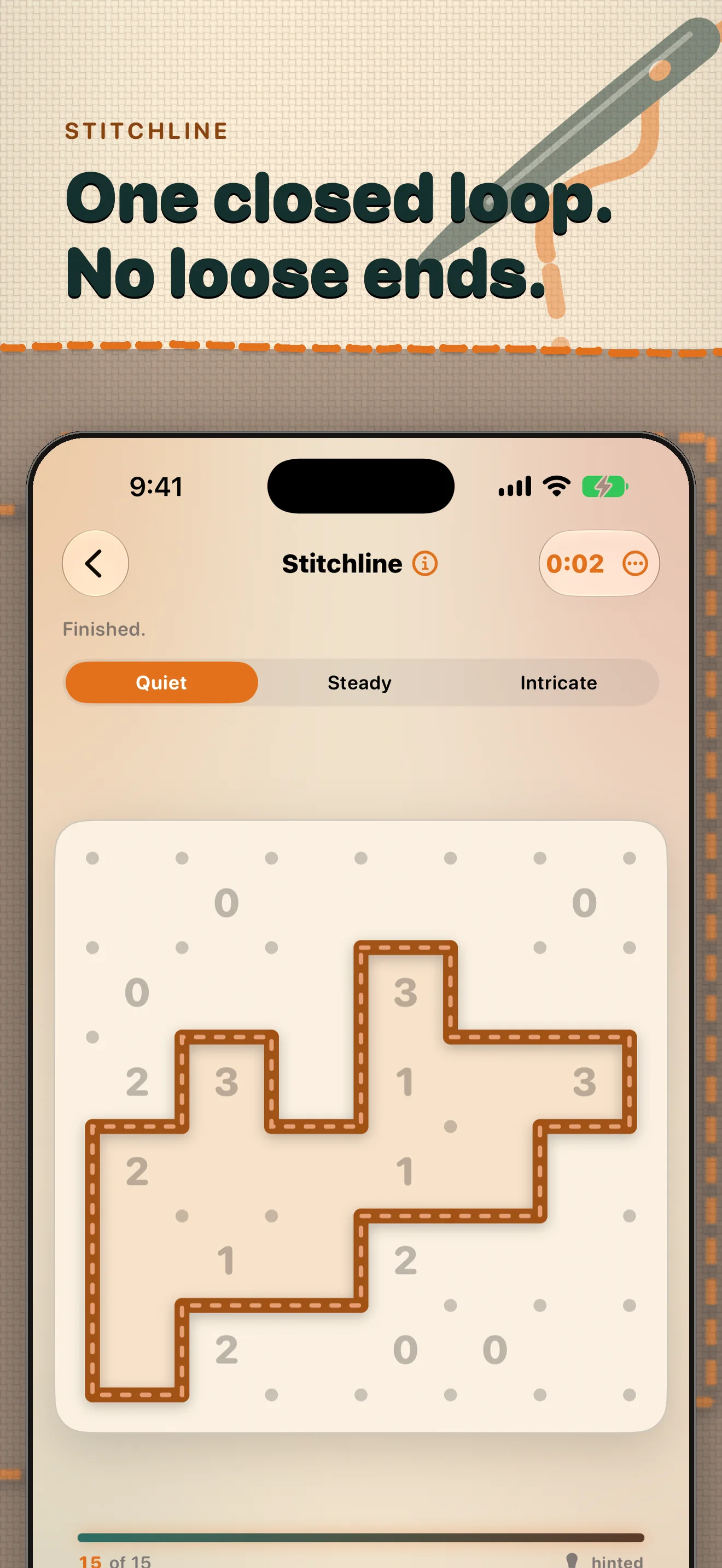
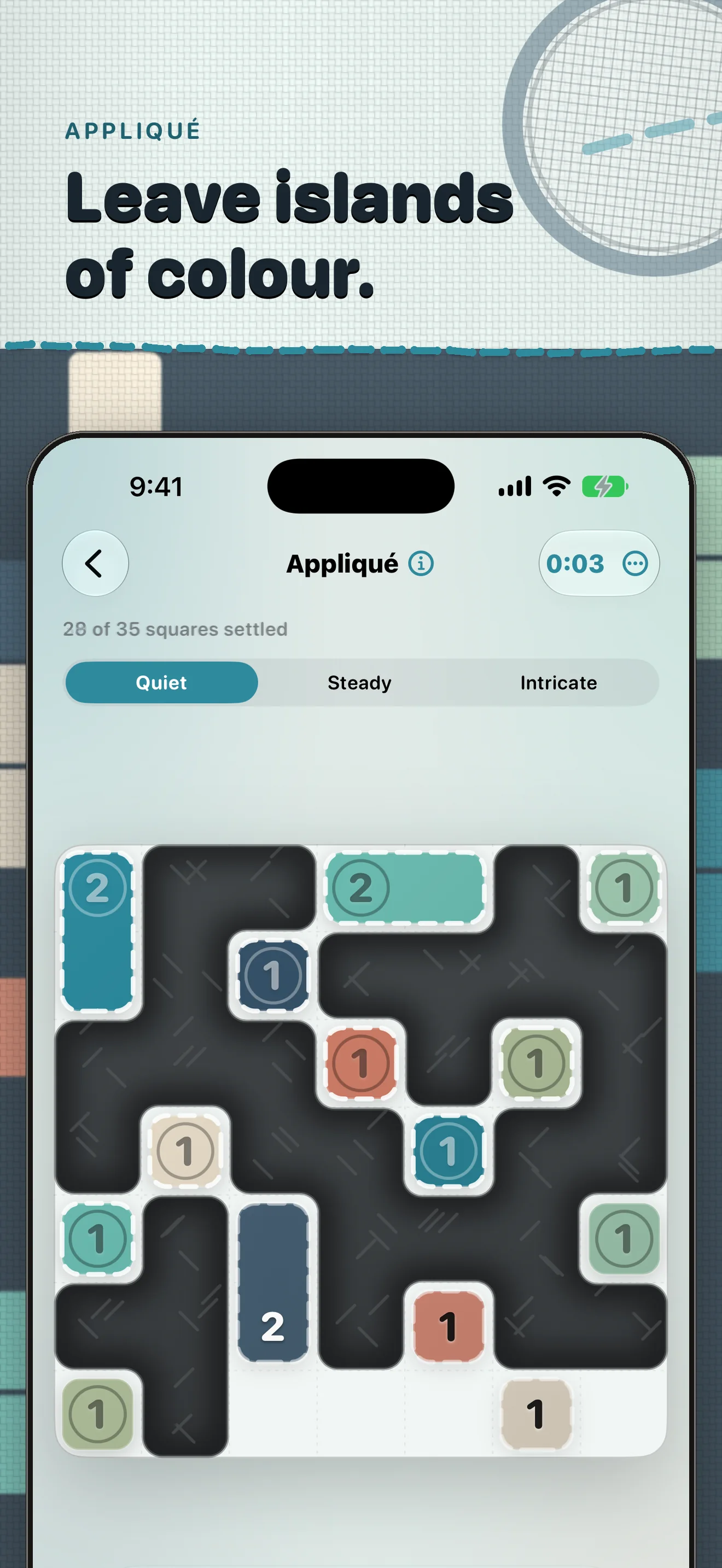
A meta-analysis of action games found evidence for benefits in top-down attention and spatial cognition, but action-game evidence is not a direct study of a slow, number-and-area puzzle (Bediou et al., 2018). A Coverlet Patchwork board, Appliqué region, or Stitchline loop may invite careful visual reasoning, yet any claim about transfer beyond those skills would need a study of that exact design.
What Coverlet should say
Coverlet can say that its puzzles ask you to practise observation, constraints, comparison, and patience. It should not say that completing a daily board prevents dementia, repairs attention, or makes a person smarter. Good product language respects the player enough to describe the experience without borrowing certainty from unrelated experiments.
Enjoy the process even without a brain claim
The value of a puzzle does not depend on a measurable transfer effect. Solving can be playful, absorbing, beautiful, and satisfying in its own right. If you like the moment when a set of constraints becomes a pattern, that is already a valid reason to open Coverlet.
Start with near transfer and far transfer
If practising a task improves performance on a similar task, researchers often call that near transfer. Far transfer means improvement on a different ability or in everyday life. A logic puzzle can plausibly make you more familiar with its own constraints: after solving many rectangle boards, you may become better at noticing area, boundaries, and candidate shapes in similar boards. That does not automatically mean the practice will improve memory, work performance, general intelligence, or protection from cognitive decline. The distance between the trained task and the claimed outcome is the central question. A careful evidence guide therefore asks what participants practised, what they were later tested on, how long the training lasted, and whether a comparison group was used. It also asks whether a result was replicated and whether the effect was large enough to matter outside a study. The narrow claim is still useful. Puzzles can exercise observation, comparison, planning, and rule-following. The responsible mistake to avoid is turning exercise of a process into a promise of a universal brain upgrade.
What training studies actually find
Oei and Patterson (2013) found that different game genres improved different cognitive tasks in a multiple-game training study, with gains often connected to the processes the games repeatedly required. A meta-analysis by Powers and colleagues (2013) likewise reported that results varied by cognitive domain and study design. The lesson is not that games do nothing. It is that the outcome must match the demand. A training task can improve familiarity with a type of response without producing broad transfer to unrelated abilities. The study design also matters: practice effects, expectations, sample size, and the choice of comparison group can change the result. When reading a headline about brain training, look for the exact task that improved. Was it the trained game, a similar test, or a broad measure of everyday functioning? Those distinctions make the evidence less exciting in a marketing sentence but more useful for a real decision. If you enjoy a puzzle, you do not need to inflate the claim to justify playing it.
Why genre and mechanics matter
A meta-analysis of action games found evidence for benefits in some aspects of top-down attention and spatial cognition, but action-game evidence is not a direct study of a slow, number-and-area puzzle (Bediou et al., 2018). A Coverlet Patchwork board, Appliqué region, or Stitchline loop may invite careful visual reasoning, yet any claim about transfer beyond those skills would need a study of that exact design, population, dose, and comparison. Even within logic puzzles, mechanics differ. A rectangle board asks you to preserve area and boundaries. A loop asks you to avoid early cycles and protect path continuity. A connected-region board asks you to think about separation and reachability. It is reasonable to describe those demands as practice in particular forms of reasoning. It is not reasonable to borrow results from a different genre and present them as proof for every puzzle. The more specific the mechanic, the more specific the language should be: this board asks you to compare candidates, not this app rewires your brain.
Be especially careful with aging and long-term claims
Some studies have reported promising results in particular populations and tasks. For example, Nouchi and colleagues (2012) reported improvements in selected executive-function and processing-speed measures after a structured brain-training intervention with older adults, while Anguera and colleagues (2013) reported cognitive-control findings from a specific video-game training design. Those findings are important because they show why controlled studies are worth doing. They are not evidence that any logic puzzle will prevent dementia or preserve cognition for everyone. Observational work can also find associations between leisure activities and later outcomes, but an association may reflect education, health, social opportunity, baseline ability, or many other factors. Verghese et al. (2003) and Wilson et al. (2013) illustrate why long-term cognitive-activity research is valuable and difficult to interpret. A product page should therefore avoid words such as prevent, repair, protect, or make smarter unless a study directly supports that exact claim. Respect for older players begins with not using their health concerns as a marketing shortcut.
Enjoy the process without a brain-upgrade promise
Coverlet can say that its puzzles ask players to practise observation, constraints, comparison, spatial reasoning, and patience. It can explain that different techniques recruit different kinds of attention and that a completed board offers a clear, satisfying endpoint. It should not say that finishing a daily board prevents dementia, repairs attention, or makes a person more intelligent. No cited study tested Coverlet, and research on other games cannot be used as a product trial by implication. The value of a puzzle does not depend on a measurable transfer effect. Solving can be playful, absorbing, beautiful, and satisfying in its own right. If you like the moment when a set of constraints becomes a pattern, that is already a valid reason to open the app. Treat any cognitive benefit as a question for careful research, not a promise attached to a download. For a concrete example, read what Shikaku means and then practise the rectangle constraints in Patchwork. A useful personal measure is therefore concrete and local: Did you understand the rule? Did you notice a new relationship? Did the challenge hold your attention for a time you chose? Those observations can guide which puzzle to play without pretending to measure general cognition. They also make the product story stronger, because the invitation is specific. Coverlet offers a designed reasoning experience; it leaves broad health conclusions to research that can actually test them.
For a concrete example, read what Shikaku means and then practise the rectangle constraints in Patchwork.
References
APA 7 references for the research discussed in this article. Last checked 29 Aug 2026.
- Oei, A. C., & Patterson, M. D. (2013). Enhancing cognition with video games: A multiple game training study. PLoS ONE, 8(3), e58546. Source
- Powers, K. L., Brooks, P. J., Aldrich, N. J., Palladino, M. A., & Alfieri, L. (2013). Effects of video-game play on information processing: A meta-analytic investigation. Psychonomic Bulletin & Review, 20(6), 1055–1079. Source
- Bediou, B., Adams, D. M., Mayer, R. E., Tipton, E., Green, C. S., & Bavelier, D. (2018). Meta-analysis of action video game impact on perceptual, attentional, and cognitive skills. Psychological Bulletin, 144(1), 77–110. Source
- Pallavicini, F., Ferrari, A., & Mantovani, F. (2018). Video games for well-being: A systematic review on the application of computer games for cognitive and emotional training in the adult population. Frontiers in Psychology, 9, 2127. Source
- Nouchi, R., Taki, Y., Takeuchi, H., Hashizume, H., Akitsuki, Y., Shigemune, Y., Sekiguchi, A., Kotozaki, Y., Tsukiura, T., Yomogida, Y., & Kawashima, R. (2012). Brain training game improves executive functions and processing speed in the elderly: A randomized controlled trial. PLoS ONE, 7(1), e29676. Source
- Anguera, J. A., Boccanfuso, J., Rintoul, J. L., Al-Hashimi, O., Faraji, F., Janowich, J., Kong, E., Larraburo, Y., Rolle, C., Johnston, E., & Gazzaley, A. (2013). Video game training enhances cognitive control in older adults. Nature, 501(7465), 97–101. Source
- Verghese, J., Lipton, R. B., Katz, M. J., Hall, C. B., Derby, C. A., Kuslansky, G., Ambrose, A. F., Sliwinski, M., & Buschke, H. (2003). Leisure activities and the risk of dementia in the elderly. New England Journal of Medicine, 348(25), 2508–2516. Source
- Wilson, R. S., Boyle, P. A., Yu, L., Barnes, L. L., Schneider, J. A., & Bennett, D. A. (2013). Life-span cognitive activity, neuropathologic burden, and cognitive aging. Neurology, 81(4), 314–321. Source
Keep reading