 Coverlet
What puzzle games can teach us about attention and focus
Focus is not a personality trait you either have or lack. A puzzle gives you a small system in which to practise directing it.
By Mourad Hamdi · Last reviewed
Attention is task-shaped
When you solve, you do not use one generic focus muscle. You select clues, hold a rule in mind, compare candidates, ignore irrelevant cells, and update your plan. Different puzzle mechanics make different parts of that process visible. That is why a player may feel focused in a puzzle while still finding an unrelated task difficult. When a person says that a puzzle helped them focus, that statement can mean several things. They may have selected relevant clues, held a rule in working memory, compared candidate shapes, ignored distracting cells, or persisted through uncertainty. Those are related operations, not one general focus muscle. A puzzle makes a small system in which these choices are visible, so the player can notice what they are attending to and why. The same player may feel absorbed in a board and still struggle to read a long email or begin a difficult conversation. That is not a contradiction; it is a reminder that attention is shaped by task, motivation, fatigue, sensory conditions, and environment. A careful article should describe what the mechanic asks for rather than promise a global improvement. Coverlet’s rectangle, region, tile, loop, pattern, and timed modes offer different attentional invitations. They may make practice feel concrete, but the evidence for any benefit should be kept tied to the practiced demand.
What cognitive studies support
Oei and Patterson (2013) found that different games produced different patterns of improvement, often on tasks sharing the games' underlying demands. Powers and colleagues (2013) also found that effects varied across domains and experimental designs. These findings support a modest statement: repeated practice can make certain forms of processing more familiar, especially when the test resembles the practice. Oei and Patterson (2013) reported that different game-training groups showed different patterns of improvement, with gains often related to the processes repeatedly demanded by the games. Powers and colleagues (2013) likewise found that video-game effects varied across information-processing domains and study designs. These findings support a modest near-transfer idea: repeated practice may make certain forms of processing more familiar, especially when a later task resembles the training task. They do not show that every game improves every kind of attention, nor that laboratory measures automatically become better concentration at work or school. Bediou and colleagues (2018) found evidence in a meta-analysis for some perceptual and attentional advantages associated with action-game play, but action-game evidence is not a direct study of a slow, number-and-area puzzle. The useful lesson is specificity. Ask what the player repeatedly does, what outcome was measured, and how similar the test is to the play. Avoid turning a real but bounded finding into a claim about general intelligence.
Clarity protects the reasoning
Attention is spent on reasoning, not only on the puzzle rule. If clues are too small, boundaries are ambiguous, feedback relies on colour alone, or controls move unexpectedly, the player must decode the interface before making a deduction. That extra load can be tiring and can make a clear puzzle feel confusing. A readable board should therefore use stable spatial relationships, strong contrast, sufficiently large targets, visible focus states, and feedback that has more than one signal. These are accessibility practices, not evidence that the game produces a cognitive benefit. They simply make the intended reasoning available to more people. In Coverlet, a player might need to see how a number relates to an area, how a region remains connected, or where a loop can continue. The interface should support those relationships with whitespace, consistent marks, and recoverable mistakes. The practical promise is modest but valuable: reduce accidental friction so the player can decide where to look. A calm visual system does not guarantee focus, but it avoids making attention harder than the puzzle requires.
Choose the kind of focus you want to practise
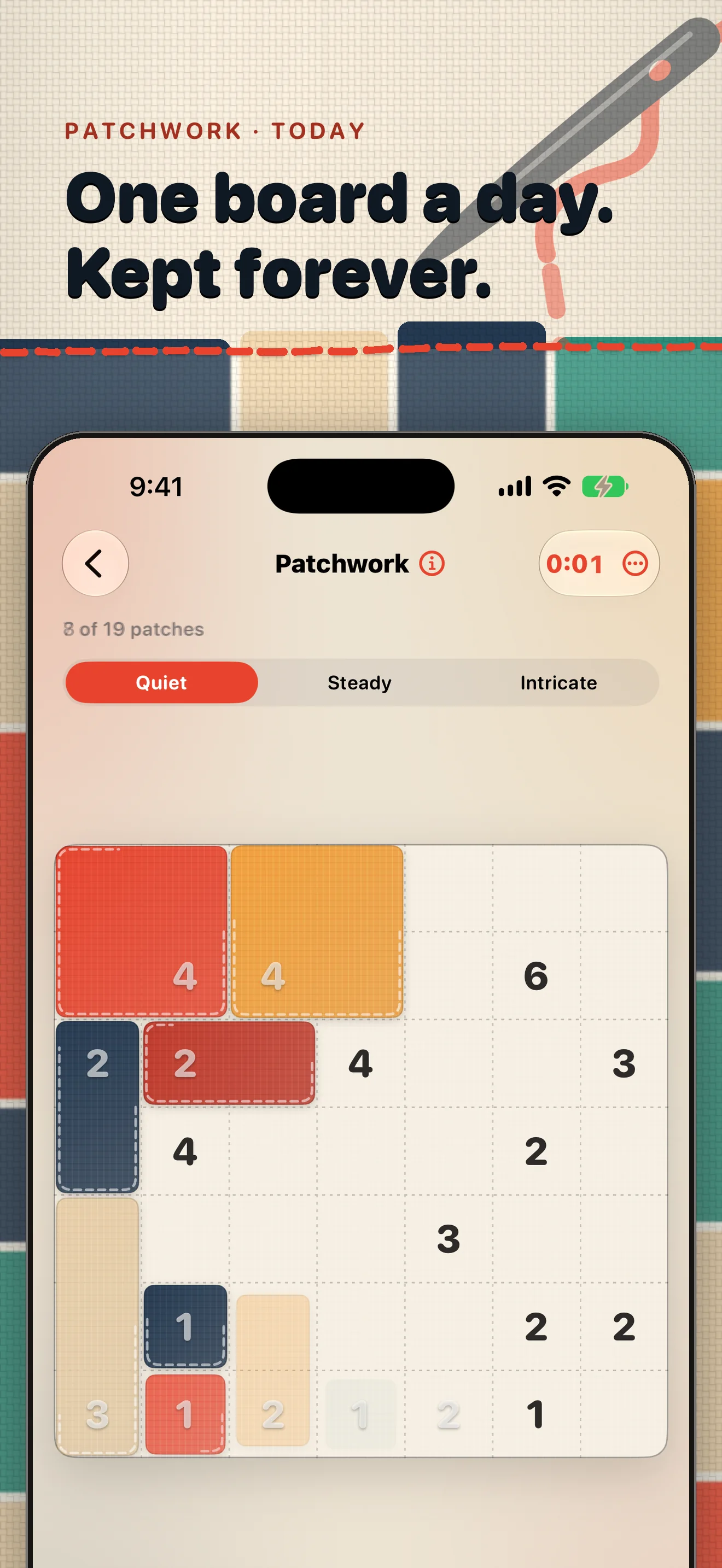
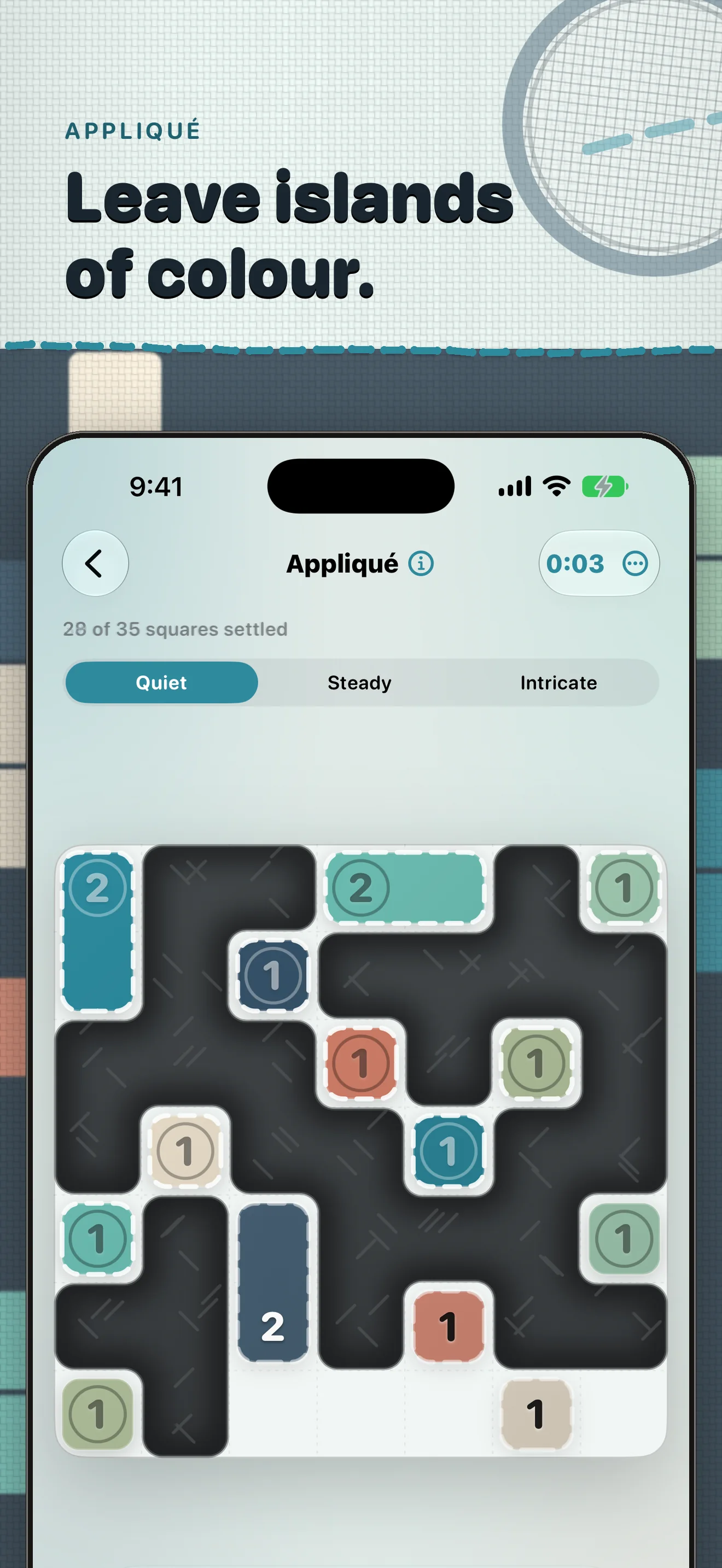
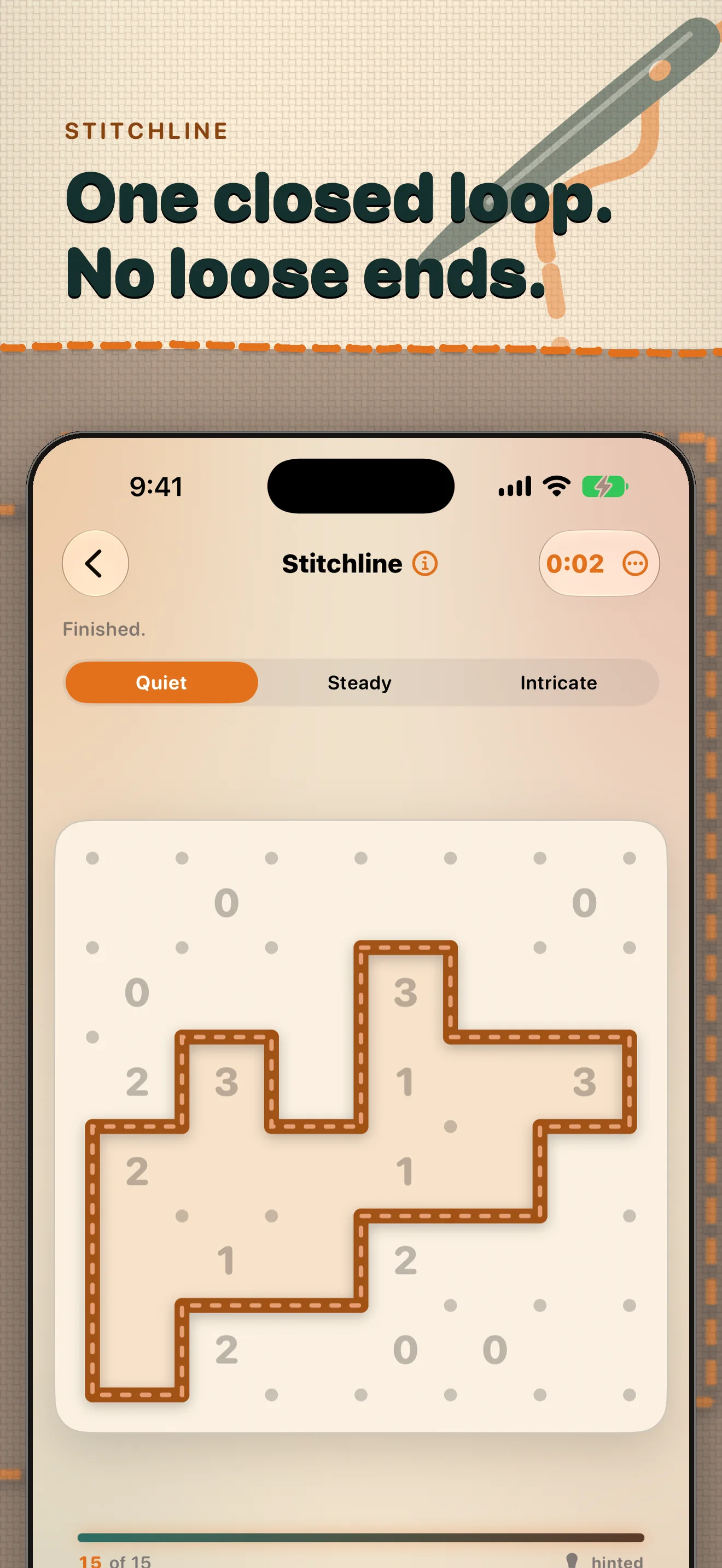
Different mechanics can give attention a different shape. Patchwork emphasises area, partition, and the relationship between a number and the cells it must contain. Appliqué asks the player to preserve connected colour regions. Piecing draws attention toward combinations and candidate arrangements. Stitchline asks the player to maintain a single loop while checking local and global consequences. Rosette brings repetition and rotation into view, while Sprint adds a clock and therefore a different level of urgency. These are design descriptions, not claims that one technique trains a named ability. A player who wants a slower visual search may prefer Patchwork or Appliqué; someone who enjoys continuity may prefer Stitchline; someone who finds a timer energising may choose Sprint. The right choice can change with sleep, stress, vision, and available time. Treat the mode as a setting for attention rather than a treatment for inattention. Agency matters because choosing a suitable demand can make practice more engaging without pretending that engagement is proof of transfer.
A simple focus practice
Before a board, name the constraint you are looking for: an edge, a forced area, a connection, or a repeated pattern. Work until you can explain one deduction in a sentence. That small act turns vague concentration into an observable choice, which is useful whether or not you continue playing. Before opening a board, name one constraint you intend to notice: an edge, a forced area, a connection, a repeated pattern, or a contradiction. Work until you can explain one deduction in a sentence. If you lose the thread, return to the rule and identify what changed instead of blaming yourself for a lack of focus. Stop after one clear insight if that is enough for the moment. This practice turns vague concentration into an observable choice and can help a player learn which puzzle demands feel satisfying. It also keeps the claim honest. You are practising how you attend inside a particular system; you are not measuring whether your whole mind has become more capable. If a board is too difficult, reduce the challenge or choose a different technique. If visual fatigue, frustration, or distraction persists outside play, address the environment or seek appropriate support. A puzzle can be a useful attentional exercise in the ordinary sense of the word while remaining a leisure activity rather than a cognitive prescription.
Make the transfer question specific
If you want to learn from your own play, choose an observation that stays close to the mechanic. Notice whether you can explain a rectangle deduction, track a loop without losing the rule, or return to a clue after checking another candidate. Do not treat a single good session as evidence that your general attention has changed. Fatigue, novelty, mood, device settings, and the difficulty of the board all affect performance. A simple record can still be useful: note the technique, the length of the session, the constraint you practised, and whether the activity felt clear or confusing. Over time, that record may help you choose better conditions for enjoyment. It cannot establish a clinical effect, and it should not become another performance demand. Specific practice is more honest than a broad brain claim, and a player can value the practice even when the result stays inside the game.
Start with the rectangle method in the beginner strategy guide, then browse Coverlet's game shelf for a different kind of attention.
References
APA 7 references for the research discussed in this article. Last checked 29 Aug 2026.
- Oei, A. C., & Patterson, M. D. (2013). Enhancing cognition with video games: A multiple game training study. PLoS ONE, 8(3), e58546. Source
- Powers, K. L., Brooks, P. J., Aldrich, N. J., Palladino, M. A., & Alfieri, L. (2013). Effects of video-game play on information processing: A meta-analytic investigation. Psychonomic Bulletin & Review, 20(6), 1055–1079. Source
- Bediou, B., Adams, D. M., Mayer, R. E., Tipton, E., Green, C. S., & Bavelier, D. (2018). Meta-analysis of action video game impact on perceptual, attentional, and cognitive skills. Psychological Bulletin, 144(1), 77–110. Source
- Granic, I., Lobel, A., & Engels, R. C. M. E. (2014). The benefits of playing video games. American Psychologist, 69(1), 66–78. Source
Keep reading